
Delhi court grants NIA 45-day extension in Red Fort blast probe
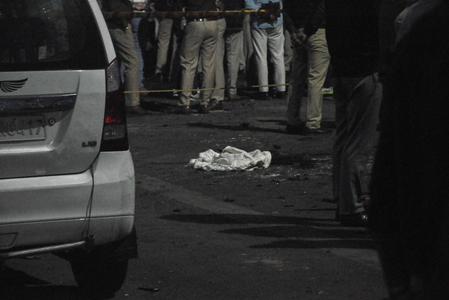
New Delhi, Feb 13 (IANS) A Delhi court on Friday granted the National Investigation Agency (NIA) an additional 45 days to complete its investigation in the Red Fort blast case that claimed 11 lives and left several others injured.
Though the anti-terror agency had sought a 90-day extension, the Patiala House Court partially allowed the NIA’s plea and directed that the investigation be completed within the extended period.
It also extended the judicial custody of the seven accused in the case till March 13.
Accused Shoaib was produced before the court physically, while the remaining six accused appeared through video conferencing.
Earlier, Additional Sessions Judge Prashant Sharma had then permitted the NIA to interrogate accused Yasir Ahmad Dar for 10 more days, while the custody of co-accused Dr Bilal Naseer Malla was also extended.
According to the NIA, Dar, a resident of Shopian district in Jammu and Kashmir, is the ninth accused arrested in the case. He was arrested in New Delhi under relevant provisions of the Unlawful Activities (Prevention) Act, 1967, and the Bharatiya Nyaya Sanhita (BNS), 2023.
"NIA investigations have revealed Dar's active role in the conspiracy behind the car bomb blast that rocked the national capital on November 10. An active participant in the conspiracy, he had sworn allegiance and taken an oath to carry out self-sacrificial operations," the anti-terror agency had said earlier.
The NIA has also claimed that Dar was in close contact with other accused persons in the case, including Dr Umar Nabi, the deceased perpetrator of the bombing, and Mufti Irfan. Dr Malla of Baramulla, who is the eighth accused in the case, was arrested by an NIA team from Delhi on December 9. As per the agency, he had knowingly harboured Umar Nabi by providing him logistical support and is also accused of destruction of evidence related to the terror attack.
The NIA has said that it is continuing its investigation into the larger conspiracy behind the deadly blast and is working closely with various central and state agencies to unravel all its links.
--IANS
pds/vd
Rabri Devi targets Bihar govt over law and order in Assembly
Patna, Feb 13 (IANS) Proceedings are underway in both Houses of the Bihar Legislature, with the Opposition intensifying its attack on the state government over law and order issues both inside and outside the State Assembly and Legislative Council.
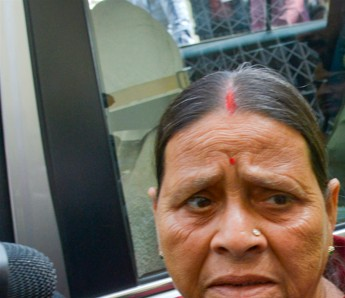
Outside the Bihar Legislative Council on Friday, Opposition leaders led by former Chief Minister and Rashtriya Janata Dal (RJD) leader Rabri Devi raised slogans against the state government over the suspicious death of a student in Patna's Phulwari Sharif area.
The protesters accused the state government of failing to ensure women's safety in the state.
Addressing the media, Rabri Devi alleged that the student was thrown from the rooftop of a building and demanded immediate action against those responsible.
She also took a sharp jibe at Deputy Chief Minister Samrat Choudhary, questioning his earlier claim that the culprits would be arrested within 24 hours or he would resign from his position.
"Samrat Choudhary says he will resign if the accused are not caught within 24 hours. Where is that resignation? Crimes are happening every day -- girls are being raped, kidnapped, and murdered. Who will stop this?" Rabri Devi said.
Meanwhile, senior RJD leader Abdul Bari Siddiqui also launched a scathing attack on the state government inside the House.
He said the Opposition had exposed the state government's failure and questioned the claims of "Ram Rajya" versus "Jungle Raj".
"Crime incidents are increasing rapidly in Bihar. Criminals are not being controlled. Murders, robberies, dacoities, and thefts are occurring daily. The Bihar government has completely failed to maintain law and order," Siddiqui added.
Responding to the Opposition's allegations, Bihar minister Ashok Choudhary dismissed Rabri Devi's statements, saying that her wishes would not determine the future of the state government.
He alleged that during the Lalu Prasad Yadav-led state government, Bihar witnessed a collapse of governance, forcing doctors and engineers to flee the state.
"Ashok Choudhary's death and Deputy Chief Minister Samrat Choudhary's removal may be Rabri Devi's wish, but nothing will happen because of it," the Minister said, reiterating that the present state government remains committed to maintaining law and order in the state.
As debates and protests continue, the law and order situation remains a key flashpoint in Bihar's ongoing political confrontation between the ruling alliance and the Opposition.
--IANS
ajk/khz
Rahul Gandhi meets farm union leaders in Parliament House amid opposition to India-US trade deal
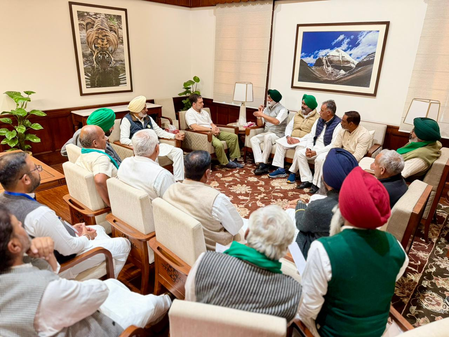
New Delhi, Feb 13 (IANS) Leader of Opposition in the Lok Sabha, Rahul Gandhi, on Friday met leaders of several farm unions from across the country at the Parliament House.
During the meeting, the farm union representatives expressed strong opposition to the India-US trade deal and conveyed their deep concern over the potential impact on farmers’ livelihoods, particularly those engaged in the cultivation of corn, soybean, cotton, fruits, and nuts.
The leaders told the Congress leader that they fear the agreement could open the door for agricultural imports, which may adversely affect domestic producers. Gandhi also reiterated his position, stating that the trade deal has opened the door for agricultural imports and warned that many other crops could soon be impacted as well.
The discussion also focused on the need for a large-scale national movement to oppose the deal and safeguard the livelihoods of farmers and farm labourers.
The farm leaders who participated in the discussion included Sukhpal S. Khaira (All India Kisan Congress), Ranjit S. Sandhu (GKS Rajasthan), Adv. Ashok Balhara (Bharatiya Kisan Mazdoor Union, Haryana), P.T. John (KMM Kerala), Baldev (BKU Krantikari, Zira), R. NandKumar (Progressive Farmers Front), Amarjit S. Mohri (BKU Shaheed Bhagat Singh), Akhilesh Shukla (All India Kisan Congress), Kedar Sirohi (Aam Kisan Union), Kiranjit S. Sandhu (Kisan Congress Punjab), Gurpreet S. Sangha (Rajya Sabha), Guramneet S. Mangat (Kisan Mazdoor Morcha - India), Hameed Malik (J&K Zamidara Forum), Tejveer Singh (KMM), Dharamvir Goyat (Haryana Kisan Sangarsh Samiti), Ishwar Singh Nain (Krishak Samaj), and Satbir Khatana (South Haryana Kisan Union).
Rahul Gandhi on Thursday asserted he would not be deterred by any FIR, criminal case or privilege motion and asserted that he would continue to fight for farmers' rights.
In a video post on X, Gandhi had reiterated his opposition to the India-US trade deal, claiming it would severely impact Indian farmers. He alleged that Prime Minister Narendra Modi had "opened the doors" of India’s agriculture market to foreign players at the cost of domestic producers.
"I have spoken the truth in Parliament. If you do not like the truth, that is a different matter. The country understands the truth. Do whatever you want to do. Let an FIR be filed, let a case be registered or bring a privilege motion. I and the entire party stand with farmers," Gandhi had said.
He had said any trade agreement that threatens farmers' livelihoods or weakens the country's food security is anti-farmer. Gandhi also claimed that corn, soybean, cotton and fruit growers would be the first to suffer, alleging that the government would eventually open the entire farm sector to foreign interests and corporate allies.
--IANS
jk/vd
Bengal SIR: 500 officers in Bengal govt list already serving as AEROs
Kolkata, Feb 13 (IANS) The Election Commission of India (ECI), on Friday, noticed that in the list of 8,505 Group-B officials sent by the West Bengal government for inclusion in the ongoing Special Intensive Revision (SIR) exercise in the state, 500 are already operating as assistant electoral registration officers (AEROs) in the voter revision exercise.
An insider from the West Bengal Chief Electoral Officer (CEO)'s Office, said that the main idea behind getting the names of these 8,505 Group-B officers from the state government was to include them in the voter revision exercise as micro-observers.
"However, since 500 officers mentioned in the 8,506 officers provided by the state government are already operating as AEROs, there is no logic behind appointing them as micro-observers in the voter revision exercise, considering the nature of the assignments of the micro-observers is different from that of electoral registration officers (EROs) and AEROs," the CEO's office insider added.
At the same time, the CEO's office insider said that with the deadline for completion of the hearing sessions regarding the SIR expiring on Saturday, the Commission is yet to receive detailed background information about these 8,505 Group-B officers, including their current pay bands, from the state government or the state government departments to which these officers are attached.
The Commission had sought the background details of these officers following information received by the CEO's office that all the 8,505 officers in the list furnished by the state government were in the Group-B category.
There is also information that the name of a retired state government officer had also been included in the list.
Leader of the Opposition (LoP) in West Bengal Assembly, Suvendu Adhikari, had also become vocal on this issue and claimed that in the electoral voter list, only the names of those officers and employees have been included, who are extremely close confidants of the ruling Trinamool Congress.
"This is nothing short of a sinister plot by the ruling dispensation to rig the polls through backdoor influence. How can we trust the process when loyalists are being deployed like pawns without any transparency? I urged the ECI to look into the matter and take necessary steps," LoP Adhikari said.
--IANS
src/khz
CPI likely to remain below 4 pc target; New series to better capture India’s consumption curve

New Delhi, Feb 13 (IANS) The Consumer Price Index (CPI) is expected to remain below the 4 per cent target level even in newly-introduced CPI series, and will better capture India’s evolving consumption curve and align data for policy decisions with international practices, a report said on Friday.
The report from the Bank of Baroda said, "The trajectory of core inflation needs to be closely watched as prices of precious metals pose upside risk. But with fine balancing of weights in the new CPI series, we expect it to be within the targeted 4+/-2 per cent level."
Bank of Baroda said the new series ensures headline CPI, the crucial target variable for monetary policy, remains contemporary and aligned with international practices.
The new series has better captured the seasonality in prices of the majority of food items by adjusting their weights, it commended.
"Going forward, we expect the government's supply side measures would be adequate to maintain a desirable food inflation trajectory," the bank forecasted.
Bank of Baroda’s Essential Commodities Index ECI runs at -0.4 per cent YoY for the first 11 days of February 2026 and that, except for some edible oils and pulses, high‑frequency food prices are largely contained and do not pose immediate risk, the report said.
However, in the new base, food inflation has reversed the deflationary trend that was observed in the past series for the last 7 months. The bank attributed this change to reduction in weight of the most volatile basket of CPI which is the TOP (Tomato, Onion and Potato) vegetables.
The new series increases the number of weighted items to 358 from 299, covers 1,465 rural and 1,395 urban markets plus 12 online markets, and reduces the weight of food in the CPI basket to 40.1 per cent from 45.8 per cent.
Rural housing, online media/streaming services, value added dairy products, barley, pendrive and external hard disk amongst others have been included in the basket for CPI estimation.
Additionally, some components, such as radio, tape recorder, DVD player and second-hand clothing, etc that were used previously for estimation have now been removed.
—IANS
aar/na
Fraud charges in Global Ayyappa Meet linked to Sabarimala temple create fresh row; Cong targets Minister Vasavan
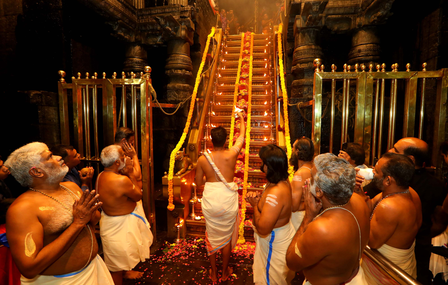
Thiruvananthapuram, Feb 13 (IANS) Allegations of large-scale financial irregularities in the conduct of the Global Ayyappa Meet linked to Sabarimala have triggered a fresh political storm, with senior Congress leaders Ramesh Chennithala and Thiruvanchoor Radhakrishnan accusing Devaswom Minister V. N. Vasavan of misleading the Assembly and demanding detailed disclosures.
The much-hyped meeting was held last year and now the High Court too has come out strongly about its financial accountability.
Chennithala alleged that "massive fraud" was carried out under the guise of the Ayyappa meet and announced he will move a breach of privilege notice against the Minister for allegedly providing incorrect information in the Kerala Assembly.
The Assembly session will resume on February 23 and Chennithala is expected to move it during the ongoing session.
He claimed the Minister had stated that funds related to the event were handed over to the Devaswom Board, but the full amount had not been transferred.
"The government told the court that the event would not be conducted at government expense. But a different version was presented in the Assembly. Why are there two sets of figures before the Assembly and the High Court?" Chennithala asked, demanding a comprehensive clarification from both the government and the Devaswom Board.
Radhakrishnan echoed the charge, terming the event a "liability" for the government.
He said the Assembly record is considered an authoritative document and questioned why a truthful reply was not provided on the floor of the House.
"Why did two different accounts emerge before the Assembly and the High Court?" he asked, insisting that the government and the Board explain the discrepancy.
Chennithala also raised questions over the execution of the event, including how organisational responsibility was assigned and whether expenditure claims were inflated.
He alleged that bills were raised even for programmes that were not conducted and sought clarity on reported discrepancies in logistics and payments.
Both leaders maintained that the accounts and expenditure details of the Ayyappa meet must be made fully public.
"Citizens have the right to know the truth," they said, calling for a categorical response from the Devaswom Minister and clarity on whether differences exist between the Minister and the Devaswom Board over the handling of the event’s finances.
Reacting to the controversy, former TDB president P.S. Prasanth during whose tenure the event was held took to his social media account and pointed out that attempts are being made to spread misinformation regarding the organisational expenses of the Ayyappa Meet.
"So far, only Rs 3 crore has been spent for organising the event. This entire amount was received through sponsorship. An additional Rs 1 crore has also been obtained as sponsorship," Prasanth said.
"An advance of Rs 3 crore had been drawn under the head 'Religious Conferences and Discourses' for organisational purposes. However, immediately upon receiving the sponsorship funds, the amount was fully repaid on October 17, 2025. Apart from this, not even a single rupee has been spent from the Devaswom Board's funds to date," he said.
"With regard to the total expenditure, the Devaswom Commissioner, in an interim report submitted before the court on November 4, 2025, had stated that the total amount was Rs 4.5 crore plus GST," he said.
"Therefore, the basis on which the present report has been submitted needs to be examined. These details are open to verification by anyone," stated Prasanth.
Meanwhile the Board (a new one is in place) will soon hold a meeting to come out with explanations on the ongoing row.
--IANS
sg/svn
Leopard attacks caretaker at Bannerghatta Biological Park; staffer seriously injured

Bengaluru, Feb 13 (IANS) A leopard attacked a caretaker at the Bannerghatta Biological Park on Friday morning, leaving him seriously injured.
The Bannerghatta Biological Park is located on the outskirts of Bengaluru city and a large number of people from the city visit it.
The victim, identified as Shantappa, was reportedly carrying out cleaning work inside the leopard's enclosure when the incident occurred at around 8.30 a.m. The park falls under the jurisdiction of the Bannerghatta police station.
According to preliminary information, the leopard had been fed chicken and mutton on Thursday night as part of its regular diet. As per standard procedure, the animals are shifted to a separate enclosure in the morning to facilitate cleaning of their cages. After the cleaning work is completed, the animals are returned to their usual enclosures.
However, officials said that despite being shifted to another cage, the leopard managed to sneak through a narrow gap and attacked Shantappa during the cleaning process.
Shantappa sustained serious injuries to his neck, face and chest in the attack. He was immediately rushed to a hospital in Jigani, on the outskirts of Bengaluru, where he is currently undergoing treatment. Hospital sources said he is recovering. Further details are awaited.
Recent incidents at Bannerghatta Biological Park involved leopards attacking tourist buses, injuring a 56-year-old Chennai woman in November 2025 and a 13-year-old boy in August 2025, when the big cats clawed them through open windows or mesh, leading to temporary suspension of non-AC safaris for safety reviews, reinforcing mesh, and stricter rules for following instructions to prevent future incidents.
These incidents, which occurred in the leopard safari zone, sparked widespread concern about tourist safety and human-wildlife conflict in one of Bengaluru's most popular attractions.
Bannerghatta Biological Park, sprawling across 20 hectares, hosts South India's first and the country's largest leopard safari, drawing thousands of visitors. Bannerghatta Biological Park is a part of Bannerghatta National Park, but operates as a distinct entity. A portion of the park was carved out to form the Bannerghatta Biological Park to cater to eco-recreation and eco-tourism.
--IANS
mka/rad
Big twist in Sadhvi Prem Baisa death case as FSL report rules out poisoning
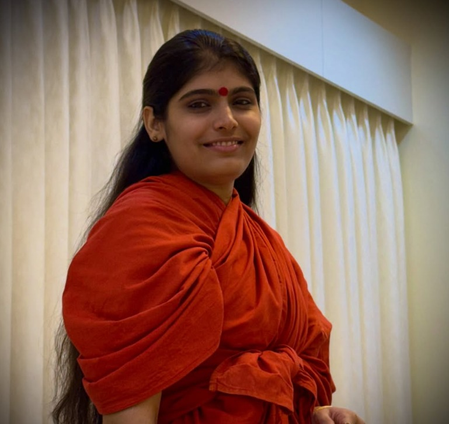
Jaipur, Feb 13 (IANS) In a significant development in the mysterious death of Sadhvi Prem Baisa, the State Forensic Science Laboratory (FSL) has submitted its viscera examination report to the police, ruling out poisoning or any unnatural cause of death.
The report, received late Thursday night, has brought a major twist to the case that had sparked widespread speculation and controversy.
According to sources, the FSL analysis found no traces of poison or toxic substances in Sadhvi Prem Baisa's body. This has dismissed earlier suspicions of foul play or forced poisoning.
However, the final cause of death will be determined by the medical board after a detailed review of the forensic findings. Investigators revealed that Sadhvi Prem Baisa had been suffering from asthma and had developed severe breathing difficulties after catching a cold on January 28.
As her condition worsened, she contacted a male nurse, Devi Singh, who administered Dexona and Dynapar injections.
Doctors at Mahatma Gandhi Hospital will now analyse whether these medications or underlying health conditions contributed to her death.
Sadhvi Prem Baisa fell seriously ill at the Aarti Nagar Ashram in Pal village under Boranada police station limits on January 28.
She was taken to a private hospital on Pal Road but was declared dead on arrival.
Following a complaint filed by her father, Biramnath, the police registered a case and conducted a post-mortem examination on January 29 through a medical board. Her viscera samples were sent to the FSL on February 2, and the forensic investigation was completed within 11 days.
During the investigation, compounder Devi Singh stated that the injections were administered based on a prescription allegedly given by a private hospital doctor.
Police are now examining who prescribed the injections and whether proper medical protocols were followed.
While the FSL report has ruled out poisoning, authorities say the case is still under investigation, and all aspects, including medical treatment, circumstances at the ashram, and statements of witnesses, are being scrutinised.
Officials said more clarity will emerge after the medical board submits its final opinion.
--IANS
arc/svn
Group II and II-A main exams postponed in TN after widespread irregularities claims at test centres
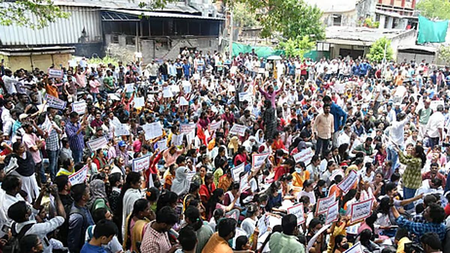
Chennai, Feb 8 (IANS) The Tamil Nadu Staff Selection Commission has postponed the Group II and Group II-A main examinations across the State following reports of serious irregularities at multiple examination centres.
The decision was announced on Sunday, affecting thousands of candidates who were scheduled to appear for the crucial recruitment tests.
The examinations were to be conducted for a range of government posts, including Assistant Inspector, Junior Employment Officer, Probation Officer, Sub-Registrar Level-2, Special Division Assistant, Forester, Senior Inspector, Audit Inspector, Supervisor, Assistant Level-3, Executive Officer Level-3, Lower Division Executive Clerk, and several other Group II cadre positions.
A total of 828 vacancies had been notified in July 2025.
Last year, more than 4.2 lakh candidates appeared for the preliminary examination held on September 28. Following the results released in December last year, 1,126 candidates qualified for Group II posts, and 9,457 candidates cleared the eligibility stage for Group II-A positions.
The subject examination for Group II-A was scheduled for the morning session, while the Tamil eligibility test for both categories was planned for the afternoon.
However, the Commission reported irregularities at seven examination centres, including private colleges in Nandanam and Arumbakkam in Chennai, prompting the immediate cancellation of the day's tests.
Subsequently, authorities extended the postponement to all 38 centres across Tamil Nadu.
At one private college in Arumbakkam, only 200 out of 600 candidates were allegedly allowed to take the examination.
Many others, though assigned the same venue on their admit cards, found that no arrangements had been made to conduct the test.
Candidates also complained about missing roll numbers and poor coordination, leading to confusion and protests at several locations.
Additional complaints included last-minute changes to examination centres and the non-arrival of question papers at the Government College centre in Nandanam.
Initially, the Commission suspended exams at seven Chennai centres, but later decided to postpone the entire State's examination to ensure fairness and transparency.
Commission Chairman Prabhakar stated that a fresh date for the examinations would be announced after a detailed review. Authorities assured candidates that necessary steps would be taken to prevent such lapses in future and to conduct the recruitment process smoothly.
--IANS
aal/svn