
Women own 39.2 pc of all bank accounts in India, highest in rural areas: Govt data

New Delhi, April 6 (IANS) Women own 39.2 per cent of all bank accounts and contribute to 39.7 per cent of total deposits in India and their participation is highest in rural areas, where they make up 42.2 per cent of account holders, the government data showed on Sunday.
There is rise in demat account over the years, indicating growing participation in the stock market.
From March 31, 2021, to November 30, 2024, the total number of demat accounts increased from 33.26 million to 143.02 million, marking more than a fourfold rise.
Male account holders have consistently outnumbered female account holders, but female participation has also shown a growing trend.
The number of male accounts rose from 26.59 million in 2021 to 115.31 million in 2024, while female accounts increased from 6.67 million to 27.71 million during the same period, according to the publication titled “Women and Men in India 2024: Selected Indicators and Data”, released by the Ministry of Statistics and Programme Implementation (MoSPI).
“Rising percentage of female-headed proprietary establishments across manufacturing, trade, and other services sectors over the years 2021-22, 2022-23 and 2023-24 has been observed,” according to the data.
Over the years, there has been an increase in the number of startups recognised by DPIIT with at least one-woman director, reflecting a positive trend in female entrepreneurship. The total number of such startups rose from 1,943 in 2017 to 17,405 in 2024.
The total number of electors increased from 173.2 million in 1952 to 978 million in 2024, with a notable rise in female voter registration.
Female voter turnout varied over the years, reaching 67.2 per cent in 2019 but slightly declining to 65.8 per cent in 2024. The gender gap in voting has narrowed, with female turnout surpassing male turnout in 2024.
The primary and higher secondary levels have consistently high gender parity index (GPI), indicating strong female enrolment. Upper primary and elementary levels saw fluctuations but remained close to parity.
“The labour force participation rate (LPFR) in usual status for ages 15 years and above has improved from 49.8 per cent (2017-18) to 60.1 per cent (2023-24),” showed the data.
—IANS
na/
BJP Sthapna Diwas: Leaders recall party’s legacy, reaffirm dedication to ‘Viksit Bharat’

New Delhi, April 6 (IANS) On the occasion of the 45th Sthapna Diwas of the Bharatiya Janata Party (BJP), senior party leaders extended heartfelt wishes to lakhs of workers and paid rich tributes to the founding fathers of the party.
Marking the day as one of commitment, they reaffirmed their dedication to the goal of building a 'Viksit Bharat' under the leadership of Prime Minister Narendra Modi.
The BJP was established on April 6, 1980, during a workers' convention at the Kotla Ground in New Delhi, where Atal Bihari Vajpayee was elected the party's first president.
However, its ideological and organisational roots can be traced back to the Bharatiya Jana Sangh, founded by Syama Prasad Mukherjee in 1951. The Jana Sangh emerged in opposition to the dominance of the Indian National Congress and was formed in collaboration with the Rashtriya Swayamsevak Sangh (RSS), widely regarded as its political arm.
Union Minister Amit Shah posted on X, "Hearty congratulations to all the workers on the 45th Sthapna Diwas of the world's largest political organisation, Bharatiya Janata Party. On this occasion, I salute all those great men who sowed the seeds of patriotism in the foundation of the BJP and created a banyan tree of crores of patriots. Under the leadership of PM Modi, BJP will continue to work towards building a developed and best India in every field."
BJP National President and Union Minister J.P. Nadda also paid tribute to the founding members and senior leaders of the organisation, acknowledging their sacrifices and unwavering dedication.
"Today, on the 'Sthapna Diwas' of the Bharatiya Janata Party, I pay my heartfelt tributes to all the founding fathers and senior leaders of the organisation, who nurtured the creation and expansion of the party with their blood and sweat and remained constantly engaged with it with all their heart and soul," he said
Nadda further stated, "On this occasion, I extend my heartiest congratulations and best wishes to all the workers, brothers and sisters across the country who have strengthened the organisation at the booth level and made BJP the biggest political party in the world."
He credited the Modi government for its unwavering commitment to the vision of a Viskit Bharat, along with "realising the resolution of Antyodaya."
"Today, on this auspicious day, I appeal to millions of my BJP workers to be determined to establish 'Maa Bharti' at the pinnacle of glory and make their valuable contribution to the progress of every section of the society," the BJP chief added.
Defence Minister Rajnath Singh praised the party's inclusive ethos and its growing influence.
"On the foundation day of BJP, I congratulate and extend my heartfelt best wishes to all BJP workers. Under the leadership of Prime Minister Narendra Modi, the BJP has become the pivot of Indian politics today. BJP is a party that takes along all sections of society and is dedicated to the development and welfare of all. Whether it is the central government or its state governments, this is fully reflected in the functioning of all," he posted.
"BJP is the only party in India today that is working as a representative of the aspirations of the poor, Dalits, deprived and exploited sections of the society. BJP is the only party that knows how to coordinate between national aspirations as well as regional aspirations. Today, under the leadership of Modiji, the BJP is working with the resolve of a developed India, and the people of the country also have full faith that this resolve will certainly be fulfilled in 2047," he added.
External Affairs Minister S. Jaishankar extended his greetings and stated, "Heartiest greetings to all the workers of Bharatiya Janata Party on its 45th Sthapana Diwas. With the spirit of Nation First, we are committed to building a developed and prosperous India."
Uttar Pradesh Chief Minister Yogi Adityanath hailed the BJP's nationalist spirit and mass connection.
"Connected with the soil of India, representing the great men of India and the soul of India, dedicated to service, good governance and welfare of the poor with the spirit of 'Rashtra Sarvopari' (Nation above all), hearty congratulations and best wishes to all the dedicated, nationalistic, people-oriented workers on the Sthapana Diwas of the Bharatiya Janata Party, the largest political party in the world!" he wrote on X.
Uttarakhand Chief Minister Pushkar Singh Dhami also joined the celebrations.
"Hearty congratulations and best wishes to all the workers on the Sthapna Diwas of Bharatiya Janata Party, the world's largest political organisation dedicated day and night in the service of nation-building and Maa Bharati, dedicated to integral humanism, cultural nationalism and upliftment of the poor," he added.
He further noted, "Under the able leadership of PM Modi, every worker of the Bharatiya Janata Party is working with determination to establish India on the world stage as a strong, prosperous and powerful nation by discharging the Panchnishtha principles."
Though formally launched in 1980, the BJP's ideological foundation is deeply rooted in the Bharatiya Jana Sangh. According to the party's official website, the post-independence era saw growing discomfort among nationalist citizens, especially after the demise of Sardar Vallabhbhai Patel.
With what the party, on its website, describes as "Nehru's authoritarianism" gaining ground in the Congress, concerns arose over policies like minority appeasement, the license-permit-quota system, national security issues, and what was perceived as weak stances on Kashmir and other international matters.
"Frustrated by 'Nehruism' and India's silence on the atrocities being committed on Hindu minorities in Pakistan and Bangladesh, Dr. Shyama Prasad Mukherjee resigned from the Nehru cabinet," reads the BJP website.
It further notes, "As a result, the Bharatiya Jana Sangh was established on October 21, 1951, in Delhi's Raghomal Arya Kanya High School under the chairmanship of Dr. Shyama Prasad Mukherjee."
--IANS
sd/
Tight security in Rameswaram ahead of PM Modi‘s visit for Pamban bridge inauguration

Chennai, April 6 (IANS) The coastal town of Rameswaram in Tamil Nadu’s Ramanathapuram district has been placed under heavy police security as Prime Minister Narendra Modi is set to arrive here on Sunday for a series of official engagements, including the inauguration of the iconic Pamban Bridge.
A robust security arrangement has been put in place with the deployment of 2,700 police personnel. The security detail includes the Inspector General of Police (IGP) for the South Zone, two Deputy Inspectors General (DIGs), 12 Superintendents of Police (SPs), 13 Additional SPs, and 35 Deputy SPs.
One of the key highlights of the Prime Minister’s visit is the inauguration of India’s first vertical lift railway sea bridge at Pamban. The 2.08-kilometre-long bridge, constructed for Rs 550 crore, boasts 99 spans and a 72.5-metre vertical lift section capable of rising to 17 metres.
Designed with provisions for dual rail tracks to meet future demands, the bridge is an indigenous engineering feat. A standout feature of the new Pamban Bridge is its vertical lift span, weighing 660 metric tons. This structure can be elevated vertically to allow the passage of ships beneath -- an innovation developed entirely using Indian technology.
The bridge is expected to significantly boost connectivity to Rameswaram, a revered pilgrimage destination, enhancing travel convenience for thousands of pilgrims and tourists.
During his visit, PM Modi will also flag off a new train service between Rameswaram and Tambaram in Chennai, further enhancing regional connectivity. Preparations for the Prime Minister’s visit have been underway for weeks. On March 22, a high-level team led by Additional General Manager Kaushal Kishore conducted an extensive inspection of key sites in Rameswaram and Pamban. The team, which included Madurai Divisional Railway Manager Sharad Srivastava and other senior officials, reviewed critical infrastructure and logistical arrangements at locations such as the Ramanathaswamy temple premises, Mandapam camp helipad, Kunthukal, Mandapam railway station, and the Pamban road bridge.
Following the inspections, a high-level review meeting involving top railway officials, law enforcement agencies, and intelligence personnel was held to ensure a smooth and secure inauguration event.
The Indian Railways, in a statement released on April 5, said: “Bridging the past, lifting the new, Pamban stands tall with a breathtaking view. This Ram Navami, witness the unveiling of India’s first vertical lift railway sea bridge.”
The statement added that the bridge connects Rameswaram to the mainland and symbolises Indian engineering excellence on the global stage.
Prime Minister Modi is also expected to visit the historic Ramanathaswamy Temple around 12.45 p.m. In addition, he will lay the foundation stones for a range of infrastructure projects worth Rs 8,300 crore. These include major highway developments such as the four-laning of the 28-km Walajapet-Ranipet section of NH 40, dedication of the 29-km four-laned Villupuram-Puducherry stretch of NH 332, the 57-km Poondiyankuppam-Sattanathapuram section of NH 32 and the 48-km Cholapuram-Thanjavur section of NH 36.
These road projects are expected to significantly improve access to pilgrimage centers and tourist destinations while benefiting local farmers by facilitating easier transportation of agricultural produce and enhancing market reach for small-scale industries.
--IANS
aal/dpb
Important day to reiterate commitment towards Viksit Bharat, says PM Modi on BJP’s Sthapna Diwas

New Delhi, April 6 (IANS) Prime Minister Narendra Modi on Sunday extended heartfelt wishes to Bharatiya Janata Party (BJP) leaders and workers on the occasion of the party's Sthapana Diwas and expressed gratitude to those who, over the years, dedicated themselves to the growth and strengthening of the party.
The BJP was formally established on April 6, 1980, during a workers' convention held at Kotla Ground in New Delhi, where Atal Bihari Vajpayee was chosen as its first president.
Taking to X, PM Modi wrote, "Greetings to all BJP Karyakartas on the party's Sthapana Diwas. We recall all those who devoted themselves to strengthening our party over the last several decades. This important day makes us reiterate our unparalleled commitment to work towards India's progress and realise the dream of a Viksit Bharat."
Reaffirming the government's commitment to national development, he further added, "The people of India are seeing the good governance agenda of our party, which is also reflected in the historic mandates we've received in the years gone by, be it in the Lok Sabha elections, Assembly elections across different states and various local body polls across the nation."
Highlighting the party's approach to inclusive development, the Prime Minister said, "Our Governments will continue serving society and ensuring all-round development."
He also acknowledged the critical role of party workers in spreading the message of good governance at the grassroots level.
"My best wishes to all our hardworking Karyakartas, the backbone of our party, as they actively work on the ground and elaborate on our good governance agenda. I am proud of the manner in which our Karyakartas are working round the clock in every part of the nation and serving the poor, downtrodden as well as marginalised. Their energy and enthusiasm are truly motivating," the Prime Minister stated.
The party's roots, however, go deeper, tracing back to the Bharatiya Jana Sangh, founded by Syama Prasad Mukherjee in 1951. The Jana Sangh was established as a counter-response to the dominance of the Indian National Congress and in collaboration with the Rashtriya Swayamsevak Sangh (RSS).
Widely perceived as the political arm of the RSS, the Jana Sangh formed the ideological and organisational base upon which the BJP was eventually built.
Though formally launched in 1980, the BJP's ideological foundation is deeply rooted in the Bharatiya Jana Sangh. According to the party's official website, the post-independence era saw growing discomfort among nationalist citizens, especially after the demise of Sardar Vallabhbhai Patel.
With what the party, on its website, describes as "Nehru's authoritarianism" gaining ground in the Congress, concerns arose over policies like minority appeasement, the license-permit-quota system, national security issues, and what was perceived as weak stances on Kashmir and other international matters.
"Frustrated by 'Nehruism' and India's silence on the atrocities being committed on Hindu minorities in Pakistan and Bangladesh, Dr. Shyama Prasad Mukherjee resigned from the Nehru cabinet," reads the BJP website.
It further notes, "As a result, the Bharatiya Jana Sangh was established on October 21, 1951, in Delhi's Raghomal Arya Kanya High School under the chairmanship of Dr. Shyama Prasad Mukherjee."
--IANS
sd/
Home Minister Amit Shah to be on 3-day visit to J&K from today
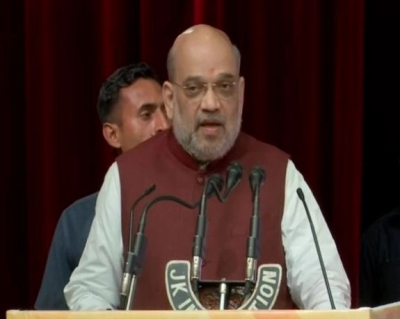
Jammu, April 6 (IANS) Union Home Minister Amit Shah will be on a three-day visit to Jammu and Kashmir starting Sunday, during which he will tour a forward post along the India-Pakistan border and review the overall security situation in the union territory.
Officials said that the union home minister will reach here this evening.
He is scheduled to review security, meet BJP MLAs and visit the international border. He will also meet the families of martyred policemen and take stock of developmental projects in the UT.
HM Shah is expected to arrive here around 6 p.m. Dr Jitendra Singh, the Minister of State for State (PMO), will also arrive in Jammu later in the day to join the home minister during his 3-day visit.
His meeting with the BJP MLAs is scheduled for around 8 p.m. at the party headquarters in the Trikuta Nagar area of the city.
He will visit the Vinay border outpost of the BSF on the international border in the Kathua district on the morning of April 7.
Families of policemen martyred while fighting the terrorists in Kathua will meet the home minister at the Raj Bhawan in the afternoon.
The Union Home Minister will give appointment letters to some of the members of the martyrs’ families at the Raj Bhawan.
He will leave for Srinagar late afternoon on April 7. He is scheduled to take stock of developmental projects at 11 a.m. at the Raj Bhawan in Srinagar on April 8.
This will be followed by a security review meeting at 1 p.m. again at the Raj Bhawan. He will review the security situation in J&K with special reference to the Jammu region, where infiltration attempts and movement of terrorists in the upper reaches of Kathua, Udhampur and other districts have taken place.
Officials said the home minister’s focus will be on zero infiltration and the elimination of terrorists from the mountains and forests of the Jammu region and the Kashmir Valley.
Union home secretary Govind Mohan, home ministry officials dealing with J&K, heads of Intelligence agencies and paramilitary forces will join the security review meeting in Srinagar.
HM Shah will return to New Delhi in the afternoon on April 8.
--IANS
sq/dpb
May Ram Navami bring new energy for strong, prosperous and capable India: PM Modi

New Delhi, April 6 (IANS) Prime Minister Narendra Modi on Sunday extended his heartfelt greetings to the nation on the occasion of Ram Navami, emphasising that the holy festival of Lord Shri Ram's birth would bring new consciousness and energy to the country.
Taking to the social media platform X, PM Modi wrote, "Many best wishes to all countrymen on Ram Navami. May this holy occasion of the birth anniversary of Lord Shri Ram bring new consciousness and new enthusiasm in your life, which will constantly provide new energy to the resolve of a strong, prosperous and capable India. Jai Shri Ram!"
PM Modi also announced his plans for the day, sharing his visit to Tamil Nadu, saying, "Looking forward to being in Rameswaram later today!"
As part of his Ram Navami celebrations, the Prime Minister is set to inaugurate the new Pamban Rail Bridge in Rameswaram, which will enhance connectivity between the mainland and the island, benefiting local communities and boosting regional development.
Earlier, PM Modi shared on X, “Tomorrow, 6th April, on the very auspicious occasion of Ram Navami, I look forward to being among my sisters and brothers of Tamil Nadu. The new Pamban Rail Bridge will be inaugurated. I will pray at the Sri Arulmigu Ramanathaswamy Temple.”
This marks the Prime Minister’s special visit to the holy city, where he will also lay the foundation stone and inaugurate development projects worth Rs 8,300 crore in Tamil Nadu.
Following his diplomatic trip to Sri Lanka and participation in the BIMSTEC summit in Thailand, PM Modi will spend Ram Navami in Tamil Nadu focusing on enhancing both India’s spiritual and infrastructural development.
The inauguration of the Pamban Rail Bridge is expected to significantly boost connectivity and economic development in the region.
--IANS
rs/
Ram is formula of India’s unity in diversity: CM Yogi extends wishes on Ram Navami
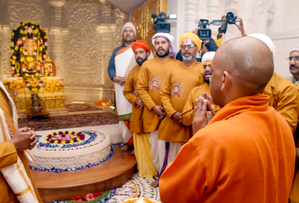
New Delhi, April 6 (IANS) Uttar Pradesh Chief Minister Yogi Adityanath extended his heartfelt wishes to the people of the state on the occasion of Ram Navami on Sunday, emphasising that Lord Ram is the formula of India’s "Unity in Diversity."
In a post shared on the social media platform X, CM Yogi described Ram as "the ideal of humanity, the best form of religion, our adorable dignity Purushottam Lord Shri Ram."
He further added, "Ram is in the faith, dignity and philosophy of India. Ram is the formula of India's 'Unity in Diversity.' May the grace of Lord Rama, the centre of faith of the people, rest upon the universe. I pray that everyone will be well. This holy festival of Shri Ram Navami is an opportunity to resolve to translate the teachings and ideals of the dignified Purushottam Lord Shri Ram into our personality. Hail to the merciful Lord Shri Ram!"
The celebration of Ram Navami is one of the most significant events, particularly in the holy city of Ayodhya, the birthplace of Lord Ram.
In light of the grand celebrations, authorities have made comprehensive arrangements to ensure the safety and convenience of pilgrims.
Ayodhya has been divided into different zones and sectors to manage the influx of devotees, with strict security measures in place.
IG Ayodhya range, Praveen Kumar, revealed that heavy vehicles would be diverted via the Purvanchal Expressway to prevent any inconvenience for the pilgrims.
Additionally, paramilitary forces, along with PAC and civil police, will be deployed to maintain law and order. NDRF, SDRF, and water police teams have also been placed on high alert around the Saryu River.
In order to ensure the smooth functioning of temple visits, special passes for the Ram Temple will be cancelled during peak hours, from 9:00 a.m. to noon.
Priority will be given to regular pilgrims during these hours. Ayodhya Divisional Commissioner Gaurav Dayal reassured the public that all preparations have been completed, with the administration fully geared up to ensure a hassle-free experience for the pilgrims coming to Ayodhya for the Ram Navami festivities.
--IANS
rs/
Waqf Bill now an Act after Presidential assent

New Delhi, April 6 (IANS) President Droupadi Murmu has given assent to the Waqf (Amendment) Bill, 2025, as announced by the Law Ministry in a notification dated April 5 (Saturday). The Bill was recently cleared by the Parliament after intense and lengthy debates in both the Lok Sabha and Rajya Sabha.
The landmark legislation has triggered a storm of debate, with its constitutionality being challenged in the Supreme Court by AIMIM (All India Majlis-e-Ittehadul Muslimeen) chief Asaduddin Owaisi and Congress Parliamentarian Mohammad Javed.
The government, however, has firmly refuted allegations that the amended law encroaches upon the religious practices of Muslims.
In a decisive intervention during the Lok Sabha proceedings, Home Minister Amit Shah elucidated the essence of the legislation.
He laid emphasis that Waqf, a sacred charitable endowment, and the waqif, or donor, are inherently rooted in the Muslim community.
The inclusion of non-Muslims in Waqf Boards or Councils, he clarified, is solely for administrative purposes, ensuring that every waqf donation is utilised for its “intended noble” cause.
Dispelling fears and addressing concerns, HM Shah said: “There is a deliberate attempt to sow confusion, suggesting that this law encroaches upon religious practices or alters the sanctity of donations."
The Union Home Minister said that such baseless fear-mongering, is a “calculated ploy” to manipulate public sentiment and “create a vote bank".
He further distinguished between the spiritual sanctity of Waqf and the administrative nature of Waqf Boards, asserting: “Waqf, as a charitable endowment,” remains a religious institution. However, Waqf Boards and Councils are administrative entities, “devoid of religious connotations".
This legislation, while stirring intense debate, underscores the government’s resolve to uphold constitutional principles while ensuring transparency and accountability in the administration of charitable endowments, the Union Minister said.
It marks a pivotal moment in the nation’s legislative journey, reflecting a delicate balance between tradition and modern governance, he had clarified.
The Parliament in the early hours on Friday (April 4) approved the Waqf (Amendment) Bill, 2025 after a lengthy and intense discussion in the Rajya Sabha which saw the Bill getting nod in the Upper House by a majority of 128 votes against 95 -- just a day after it was passed in the Lok Sabha following a marathon debate that continued for almost 12 hours.
Union Home Minister Amit Shah and Parliamentary Affairs Minister Kiren Rijiju had made a strong case for the Waqf (Amendment) Bill in the Lower House of the Parliament, while Leader of Rajya Sabha and Union Minister J.P. Nadda led a passionate debate in the Upper House on the Bill, while slamming the Opposition.
The debate that began on Thursday (April 3) ended with the majority of members voting for the Bill on Friday.
J.P. Nadda came down heavily on the Congress for its handling of the Waqf Act, accusing the grand old party of enacting the law in a way that allegedly facilitated land mafias.
He passionately defended the proposed amendments to the Waqf Act, stressing the urgent need for reform to protect national interests and prevent the misuse of Waqf properties, which should serve the welfare of poor Muslims.
Spotlighting the national importance of the issue and the need for in-depth deliberation, J.P. Nadda drew attention to the formation of a Joint Parliamentary Committee (JPC) under the Prime Minister Narendra Modi-led government.
Comprising 31 members, the committee has facilitated over 200 hours of debate on the bill.
This, he pointed out, stands in stark contrast to the JPC setup during the UPA government in 2013, which had only 13 members and lacked the same level of commitment.
J.P. Nadda asserted that democracy thrives on meaningful discourse and the inclusion of diverse perspectives, rather than simply accepting a single viewpoint.
Underscoring its national significance and the imperative for focused deliberation, the leader of Rajya Sabha, the leader of the House, highlighted the formation of a Joint Parliamentary Committee (JPC) under the PM Modi-led government, which comprised 31 members and facilitated an extensive 200 hours of debate on the Bill.
This, he noted, was a marked improvement over the JPC established during the UPA government in 2013, which had only 13 members and lacked the same level of commitment.
He emphasised that democracy thrives on logical discourse and the inclusion of diverse perspectives, rather than the mere acceptance of a singular viewpoint.
--IANS
sktr/pgh
HM Amit Shah highlights transformation in Bastar: Children use phones without fear

Raipur, April 6 (IANS) Union Home Minister Amit Shah, with a voice both resolute and impassioned, once again extended an earnest appeal to the Maoists, urging them to abandon their path of violence and reintegrate into the mainstream for the greater good of society.
The Union Home Minister has shared a heart-touching picture of two fearless children holding mobile phones on his X handle to showcase the transformation of development that has taken place in the state.
Sharing the picture on his X handle, Union Home minister Amit Shah wrote, “The Bastar-Sukma region which was once the bastion of Red Terror (Naxalism), where people did not leave their houses due to fear, today the heart is filled with joy to see children using their phones without any fear in Dondra Panchayat there.” “I am sharing with you this picture, which shows development and trust,” he said.
His visit to Chhattisgarh was marked by a series of significant engagements on Saturday, including the grand conclusion of the ‘Pandum Festival’ in Bastar and a high-level meeting on the anti-Naxal campaign with Chief Minister Vishnu Deo Sai, Deputy Chief Minister Vijay Sharma, and senior security officials.
In a series of posts on his X handle, HM Shah said, “Today in Raipur, I convened a review meeting on Left Wing Extremism with Chhattisgarh Chief Minister Shri Vishnu Deo Sai ji, Deputy Chief Minister Shri Vijay Sharma ji, senior officials, police officers, and CAPF officers. Under the visionary leadership of Modi ji, the double-engine government is sparing no effort in eradicating Naxalism. By the 31st of March, Naxalism shall be consigned to the annals of history, not only in Chhattisgarh but across the nation.”
He further lauded the valour of India’s security forces, stating, “Guided by Modi ji’s leadership, our brave forces have cornered the Naxalites. Whether traversing rugged forests or crossing turbulent rivers, enduring the biting cold or the searing heat, our valiant commanders have liberated millions from the shadow of Naxal influence. Today, I had the privilege of interacting with the operational commanders of the anti-Naxal operation in Dantewada.”
In a heartfelt plea to the Maoists, Shah envisioned a transformed Bastar, declaring, “Bastar is being reimagined as a land where its children shall rise to become inspectors, barristers, doctors, and collectors. Let every individual strive fearlessly to realise the dreams of development… under Modi ji’s government, there is no place for fear.”
Earlier on Saturday, addressing a vast gathering at the Pandum Festival, the Union Home Minister said, “By the dawn of April 2025, as many as 521 Naxalites have already surrendered, following the 881 who laid down arms in 2024. Those who choose to surrender will find a place in the mainstream, while those who persist with arms will face the resolute might of our security forces. Come what may, the Bharatiya Janata Party government is steadfast in its mission to rid the nation of this red terror by March next year. Bastar will no longer be synonymous with fear but with a promising future.”
--IANS
sktr/uk
SC Collegium recommends appointment of Justice Arun Palli as CJ of J&K and Ladakh High Court

New Delhi, April 5 (IANS) The Supreme Court Collegium, headed by Chief Justice of India (CJI) Sanjiv Khanna, has recommended to the Centre that Justice Arun Palli be appointed as Chief Justice of the High Court of Jammu and Kashmir and Ladakh.
“The Supreme Court Collegium in its meeting held on 4th April, 2025 has recommended appointment of Mr. Justice Arun Palli, Judge, High Court of Punjab and Haryana, as Chief Justice of High Court of Jammu and Kashmir and Ladakh,” said a statement uploaded on the website of the apex court on Saturday.
The incumbent Chief Justice Tashi Rabstan of the High Court of Jammu and Kashmir and Ladakh is due to retire on April 9 at the age of 62. Justice Palli, the senior-most judge in the Punjab and Haryana High Court, was elevated to the Bench in December 2013. He was appointed Additional Advocate General for Punjab on September 1, 2004, a position he held until March 2007. He was designated as a Senior Advocate on April 26, 2007. After completing the Bachelor of Laws from Chandigarh’s Panjab University, he commenced his legal practice at the Punjab and Haryana High Court across diverse areas of law, including civil, criminal, constitutional, revenue, industrial, and labour law. He also appeared before the Supreme Court and, Delhi High Court and argued several important matters in the Himachal Pradesh High Court.
Justice Palli has also been serving as Executive Chairman of Haryana State Legal Service Authority since May 31, 2023, and was nominated as a Member of the Governing Body of the National Legal Services Authority (NALSA) in October 2023, for a tenure of two years. His father, a Senior Advocate, served on the Bench of the Himachal Pradesh High Court, retiring in 1998. Justice Palli’s great-grandfather, Lachchman Dass Palli and grandfather Lajpat Rai Palli were esteemed lawyers of the Patiala District Bar.
--IANS
pds/uk