
Maha minister bats for name change of Khultabad, where Aurangzeb’s tomb is located, to Ratnapur

Chhatrapati Sambhajinagar, April 7 (IANS) The Maharashtra Minister of Social Justice and the Chhatrapati Sambhajinagar ‘District Guardian Minister’ Sanjay Shirsat on Monday said that the Khultabad, where Mughal Emperor Aurangzeb’s tomb is situated, will be renamed as Ratnapur.
“Chhatrapati Sambhajinagar was earlier known as Khadki. Over time, its name was changed to Aurangabad. Similarly, the name of Khultabad was previously Ratnapur. Over time, it became Khultabad. The MahaYuti government is undertaking the process of changing the names. The name of Khultabad should be Ratnapur as it was earlier. The name of Aurangabad has been changed. Similarly, Khultabad should be changed,” the Minister said.
He alleged that among the various deeds of Aurangzeb, he also changed the names of many cities.
“Osmanabad (now renamed as Dharashiv) and Ahmednagar (now Ahilyanagar) were also included in it. All the names of cities and places in our state that have the word ‘Baad-Baad’ (for example: Daulatabad) in their names will be changed,” he said.
Shirsat’s strong pitch to change the name of Khultabad to Ratnapur comes days after the controversy over the removal of Aurangzeb’s tomb.
The Bajarang Dal and Vishwa Hindu Parishad staged protests for the same, and thereafter the riots took place in Nagpur.
A large number of legislators from the MahaYuti alliance, especially from the BJP and Shiv Sena, are strongly demanding the removal of Aurangzeb’s tomb.
However, Chief Minister Devendra Fadnavis recently clarified that the tomb is protected by the Archeological Survey of India (ASI) and therefore it cannot be removed.
However, he added that Aurangzeb will not be glorified.
Deputy Chief Minister Eknath Shinde claimed that Aurangzeb’s tomb is a “stain” on Maharashtra, adding that the clamour of its removal reflects the people’s sentiments.
“Aurangzeb came to destroy Maharashtra. A true Muslim of our country would never glorify Aurangzeb, but does the opposition consider him their relative? Those who glorify Aurangzeb should be ashamed,” claimed the Deputy Chief Minister.
The veteran RSS leader and its former General Secretary Bhayyaji Joshi observed that the controversy over Aurangzeb’s tomb is unnecessary.
“He (Aurangzeb) died here and his grave was built. Chhatrapati Shivaji Maharaj had set an example by building Afzal Khan’s grave. This shows India’s generosity and inclusiveness. The grave will remain and anyone who wants to see it can visit it,” he added.
--IANS
sj/dan
Kavitha to sit on hunger strike tomorrow for Phule’s statue in Assembly

Hyderabad, April 7 (IANS) Bharat Rashtra Samithi (BRS) MLC and Telangana Jagruthi President K. Kavitha will stage a day-long hunger strike in Hyderabad on Tuesday to demand the installation of social reformer Jyotirao Phule’s statue in the Telangana Assembly.
Kavitha will sit on the hunger strike at Dharna Chowk, Indira Park, to press the demand immediate installation of the statue.
The hunger strike will begin at 11 a.m. and will continue till 5 p.m.
Leaders from the Telangana Jagruthi and the United Phule Front on Monday inspected the arrangements at the protest site.
Kavitha had earlier urged Speaker Gaddam Prasad Kumar and the state government to ensure the installation of the statue ahead of Phule’s birth anniversary on April 11. With no action taken so far, she is set to lead the protest to honour Phule’s legacy and his contributions to social justice.
United Phule Front (UPF) Convenor Bolla Shiva Shankar said the state government should make an announcement about the installation of Phule’s statue before Phule’s birth anniversary.
He said that if the state government failed to meet their demand, they would intensify the agitation under the leadership of Kavitha.
"Jyotirao Phule is a symbol of the self-respect of backward classes, and if the government continues to ignore him, we will not tolerate it," he said.
Shiva Shankar appealed to people to participate in Tuesday’s programmes in large numbers.
He said that round-table meetings were held in the district on the issues faced by the backward classes.
Kavitha launched and led a movement for the rights of backward classes. The sustained political campaign included 14 roundtable meetings across Telangana.
The MLC conducted extensive consultations across districts in Telangana to amplify BC concerns and demanded the implementation of the Kamareddy BC Declaration made by the Congress during the Assembly elections.
Kavitha has also been at the forefront of demanding the implementation of 42 per cent reservations for BCs in the state.
The state government has introduced two separate bills in the Assembly to provide 42 per cent reservations for BCs in politics, employment, and education.
--IANS
ms/vd
Wrong to say Cong appeases Muslims or that it ignored Antony panel’s findings: R.C. Khuntia
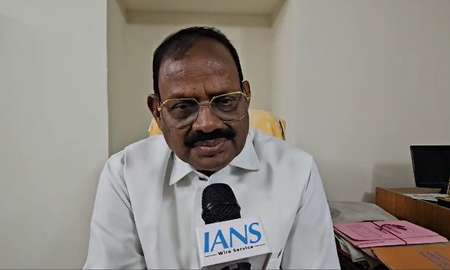
Bhubaneswar, April 7 (IANS) A decade after the A.K. Antony Committee cautioned the Congress on electoral risks of its perceived “minority-appeasement policy”, the panel’s former member R.C. Khuntia on Monday admitted that despite its secular stand, the party has failed to bag sizeable minority votes as these get divided among different parties.
Refusing to be drawn into the debate whether the Grand Old Party’s perceived minority-appeasement policy was proving counterproductive, R.C. Khuntia told IANS, “It is not correct to say that the Congress occasionally issues anti-Hindu statements to appease Muslims.”
“Appeasing the minority is not the Congress' policy. We are with all communities equally,” he said, slamming the rival political parties and their social media brigade for projecting the Congress as an appeaser of the minority community or as an anti-Hindu party.
“Even a majority of the Muslim vote is not with the Congress,” he said, adding, “The minority vote gets divided in West Bengal, Uttar Pradesh, Bihar and Maharashtra.”
“The Congress does not support or oppose anyone with the intention of winning votes of a particular community,” he said, highlighting the secular credentials of the party which does not indulge in politics based on caste, creed or religion.
Apart from Antony and Khuntia, Mukul Wasnik and Avinash Pandey were members of the Antony Committee which submitted its report to the All India Congress Committee in 2015.
Asked if the committee’s findings on the party’s perceived “minority-appeasement policy” were implemented, he said, “These questions should be put before the party President. Our job was to give the report and we had given it. To implement it was not our job”.
He said the committee’s findings were top secret and meant only for the party President and the Committee Working Committee.
“It is wrong to say that the Antony Committee report was not accepted. To what extent the report was implemented and what results it yielded is a different matter,” he said.
The Congress General Secretary said as per his knowledge the report’s implementation yielded good results in some states.
Khuntia admitted that the Congress finds itself at a disadvantage if politics in a particular state is done on the basis of caste or religion.
"The Congress finds itself at a disadvantage when radicals within the minority community and other parties try to get votes by issuing strong statements," he said.
“But if you analyse the last Lok Sabha elections in Uttar Pradesh, you find that voters do not permanently vote on the basis of caste and religion,” he said.
On being asked about the Congress’ perceived proximity to the minority community, Khuntia said, “The Congress is with everyone and will continue to support all communities equally.”
He agreed that a message needs to be communicated to the masses that the Congress is a party for all communities and not for the minority or any one community and urged the media and party leaders to focus on this aspect.
According to the leaked excerpts of the Antony Committee report, the Congress party’s decision to fight the 2014 Lok Sabha polls on a “secularism versus communalism” platform had a negative impact as the party was identified as pro-minority, resulting in substantial electoral gains for the BJP.
He also noted that the minority community also doubted the Congress’ intentions.
--IANS
rch/rad
PM Mudra Yojana has empowered millions: DFS Secretary M. Nagaraju

New Delhi, April 7 (IANS) As the Pradhan Mantri Mudra Yojana (PMMY) completes 10 years on April 8, M. Nagaraju, Secretary, Department of Financial Services (DFS) in the Union Finance Ministry, on Monday said that the scheme has touched a historic milestone of sanctioning over Rs 32.6 lakh crore through more than 52 crore loans.
The scheme has significantly contributed to self-employment and entrepreneurship across India, he said.
"The scheme has made a deep impact in the lives of people, especially women, SC/ST, OBC, and those in rural areas who lacked access to collateral and formal credit,” Nagaraju told IANS.
"Many beneficiaries had neither land nor collateral nor any financial track record. Yet, they got support through PM Mudra Yojana and have gone on to start and expand their businesses," he added.
Highlighting the economic empowerment brought in by the scheme, Nagaraju said: "More than 20 per cent of beneficiaries are first-time entrepreneurs. These are people who had never taken a loan from any bank or financial institution before. This is a big transformation."
He added that the scheme’s strong recovery rate, with NPAs at just 2.21 per cent as of last month, reflects the credit discipline among borrowers.
"Despite being collateral-free, the repayment record is impressive. This shows people are using Mudra loans wisely and for productive purposes," Nagaraju told IANS.
To further strengthen the ecosystem, DFS has introduced new schemes like ‘Tarun Plus’, under which eligible individuals can now avail loans up to Rs 20 lakh without any guarantee.
"We have also brought ‘Mudra Homestay’ into the fold to support tourism-related ventures under the scheme," he added.
Data from the Finance Ministry reveals that nearly 70 per cent of Mudra loans have been availed by women entrepreneurs which highlighted the role the scheme has played in promoting financial inclusion and gender equality.
In states like Jammu & Kashmir alone, over 20.7 lakh loans have been sanctioned, showing the widespread outreach of the scheme.
The International Monetary Fund (IMF) has also praised the scheme in its 2024 report, stating that Mudra has boosted the number of women-owned MSMEs and contributed to the formalisation of the Indian economy through self-employment.
--IANS
pk/vd
At Patna meet, Rahul Gandhi pushes for caste census, slams RSS-BJP

Patna, April 7 (IANS) Senior Congress leader Rahul Gandhi on Monday launched a sharp attack on the BJP-RSS leadership, accusing them of opposing a caste-based census and asserting that the Congress would ensure social justice by shaping policies based on ground realities.
Speaking at the Samvidhan Bachao Sammelan at Sri Krishna Memorial Hall in Patna, Gandhi directly targeted RSS chief Mohan Bhagwat, saying, “Mohan Bhagwat says there is no need for a caste census. I want to tell him -- a caste-based census is like an x-ray of society. It reveals the real picture of the population and helps frame inclusive policies.”
He cited the Congress-led caste survey in Telangana as a model, claiming it had the potential to reshape the state’s political landscape. “We’ve already seen its impact in Telangana. The same change is possible across the country,” he said.
Gandhi also highlighted internal reforms within the Bihar Congress, noting a shift in leadership representation. “Earlier, two-thirds of our district presidents in Bihar were from upper castes. Under Mallikarjun Kharge’s leadership, that has changed. Today, two-thirds come from OBC, EBC, Dalit, and Mahadalit communities. We’ve aligned leadership roles with population realities,” he said.
Urging party workers to connect with marginalized communities, Gandhi emphasized the need to build a people-centric political movement. “Bihar has always led transformative movements. This time too, Bihar will lead from the front,” he said.
In a pointed ideological critique, Gandhi said, “This Constitution is not just a document from 1947 -- it reflects the values of our ancient civilization. The ideology of Savarkar has no place in it; he never had the courage to face the truth.”
He praised Dr B.R. Ambedkar and Mahatma Gandhi for embedding justice, equality, and fraternity in the Constitution. “Ambedkar transformed the pain of Dalits into rights. Great leaders learn from people’s struggles and turn them into law. That fight for truth continues,” he said.
Commenting on the current political climate, Gandhi said fear and silence dominate national discourse. “It’s difficult to speak the truth these days. People know it, but many leaders are afraid to say it aloud,” he remarked.
He also took aim at growing economic inequality, questioning the relevance of the stock market for ordinary Indians. “The US President sneezes, and the stock market crashes. But how many of you invest in it? Less than 1 per cent of Indians. It’s not your tool -- it’s a playground for the rich,” he said.
Rahul Gandhi’s visit is part of the Congress’s intensified campaign in Bihar ahead of the 2025 Assembly elections, where the party is seeking to regain lost ground through a renewed focus on social justice and organizational overhaul.
After a day-long trip, Rahul Gandhi left for Delhi.
--IANS
ajk/skp
Tourists from Kerala, Gujarat struggle with severe heatwave in Delhi
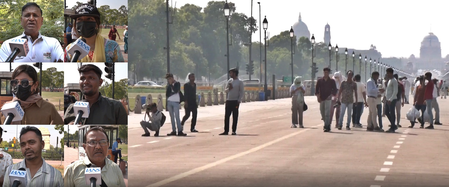
New Delhi, April 7 (IANS) The soaring temperatures in Delhi are making it difficult for both residents and tourists with the India Meteorological Department (IMD) issuing a yellow alert for a heatwave in the city from April 7 to 9, with maximum temperatures expected to reach between 40 and 42 degrees Celsius on April 7 and 8, and around 41 degrees Celsius thereafter.
Despite the oppressive heat, a few tourists continue to visit iconic landmarks like India Gate, although the number of visitors in the afternoon has significantly declined. Those who braved the heat took various measures to protect themselves from the scorching sun - some used umbrellas, while others wore sunglasses, masks, and light clothing.
IANS spoke to few tourists from Kerala and Gujarat where they shared their experiences of coping with the extreme temperatures in Delhi.
Visitors from Kerala noted that while the temperature in their state typically ranges from 35 to 38 degrees Celsius, Delhi’s heat felt far more intense.
"The temperature is very high today. In Kerala, we don’t usually experience temperatures above 35 degrees Celsius. We’re here for seven days to explore Delhi," said Jishan, a tourist from Kerala.
Another tourist from Kerala said: "It’s unbearable. The heat here is quite overwhelming compared to what we’re used to at home."
Deepesh Patel, from Gujarat, stated, "It’s quite hot today. We came to Delhi for sightseeing. Although the temperature in Gujarat is similar, the humidity in Delhi makes it feel hotter."
Smita Patel, another tourist from Gujarat, added: "Visiting India Gate is a wonderful experience. While it’s very hot, it feels slightly less intense here compared to Gujarat."
The heatwave has not only affected tourists but also impacted daily life in the city. The usual hustle and bustle around India Gate has given way to quieter scenes, especially during peak afternoon hours. Despite the discomfort, the determination of tourists to explore Delhi’s rich heritage remains strong.
With the heatwave expected to continue, the IMD has advised people to stay hydrated, avoid direct exposure to sunlight during peak hours, and take necessary precautions to prevent heat-related illnesses.
--IANS
jk/vd
CJI Sanjiv Khanna inks MoU for cooperation with Nepal’s Supreme Court
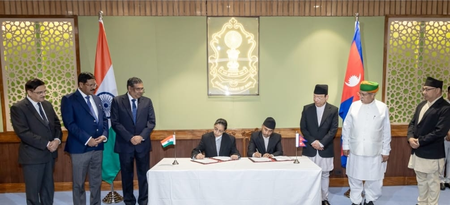
New Delhi, Apr 7 (IANS) The Supreme Court of India on Monday signed a Memorandum of Understanding (MoU) with the Supreme Court of Nepal to promote and strengthen the judicial cooperation between the two nations
"The MoU shall not only encourage mutual exchange of information on latest developments in the field of law and justice but also promote interaction among judges and officials at various levels of judiciaries through programmes such as exchange of visits, short-and long-term trainings, and academic programmes," said a press statement issued by the top court.
Inspired by the cordial and friendly relations existing between the two countries and their people, the MoU aims at developing, promoting and strengthening cooperation between the judiciaries of the two countries, the press statement added.
Recognising the importance of the use of technology in clearing backlogs, expediting court procedures and providing better services to stakeholders, the MoU provides for sharing information pertaining to technology employed in their respective courts and other institutions.
A Joint Working Group consisting of the officials of the two judiciaries will be formed to work out plans and modalities for promoting and further strengthening judicial cooperation.
The MoU was signed in the presence of Chief Justice of Nepal Prakash Man Singh Raut and Chief Justice of India Sanjiv Khanna.
In the past, the Union government and the Supreme Court of India had entered into MoUs for judicial cooperation with other countries, including the Supreme Court of Israel, the Supreme Court of Singapore, the Supreme Court of Bangladesh, and the Supreme Court of Bhutan.
CJI D.Y. Chandrachud (now retired), in September 2023, on his visit to Singapore, entered into an MoU with the Supreme Court of Singapore on judicial cooperation. "Both judiciaries signed an MoU on judicial cooperation. The SG Courts look forward to a continued friendship," a tweet issued from the official handle of the Singapore Judiciary had said.
--IANS
pds/vd
Software engineer dies in Gurugram road accident

Gurugram, April 7 (IANS) A 28-year-old software developer died in a road accident after her rented BMW sports bike was hit by a Hyundai Verna car here in Gurugram, police said.
Police identified the victim as Somita Singh, a native of Lucknow, who was on her way back home to Noida from Gurugram’s Leopard Trail area with her bike-riding group when a speeding Verna hit her bike, leaving her critically injured.
However, the bike has suffered minor damage. The police were informed about the incident by them, and the victim was shifted to the government hospital, where the doctors declared her dead after examination.
A team from the Badshahpur police station inspected the incident spot, informed the deceased’s family and sent the body for postmortem.
An official said that on Monday morning, the deceased father, Mahendra Pal, reached Gurugram and took the deceased’s body after an autopsy.
He added that based on his complaint, a case under relevant sections was registered against the bike rider group at the Badshahpur police station.
Reportedly, Somita joined the company in Noida about eight months ago. Some youth in her company used to go on rides in the ‘Let’s Ride India Group’, and she had recently joined that group.
Therefore, Somita was also taking sports bike training without informing the family.
‘Let’s Ride Group’ gives sports bike training to women and also rents sports bikes.
The bike with which Somita had an accident was also rented from this group. She came to Gurugram with a group of women riders from Sector 135 of Noida. There were 20 to 25 women riders in the group.
Police said that Somita had joined the bike rider group a few days ago, adding that she used to go out with her friends on weekends.
Investigating officer Naveen Kumar of Badshahpur police station said that they had received information that a woman had met with an accident and had died in Sector-10 Civil Hospital.
On receiving the information, he reached the hospital, and Somita's body was taken to the mortuary in a private ambulance.
“The victim was riding a red G310-BMW (DL3SEM-4946) sports bike. She had come to Leopard Cafe in Gurugram on Saturday evening with a bike-riding group from Noida. During this time, she had an accident with a Verna car (HR26EX-2514) on Leopard Trail Road. The girl was seriously injured in this accident and later died in the hospital,” Kumar said.
He said that a case in this regard has been registered.
“We will soon be questioning the bike-riding group to ascertain the actual reason for the accident and to collect the errant car driver,” he added.
--IANS
str/dan
Minor out for Kanya Bhoj treat in Chhattisgarh sexually assaulted and killed; body found in car

Raipur, April 7 (IANS) In a horrifying incident, a six-year-old girl was abused brutally, allegedly raped and electrocuted under Mohan Nagar police station area of Durg town, Chhattisgarh.
She went out to attend the Kanya Bhoj (feast for girls) organised on the auspicious occasion of ‘Navratri’ and ‘Ramnavmi’ on Sunday morning.
Her lifeless body was later discovered in the wee hours of Monday inside a car.
According to the police, the girl's hands were rigid, her face bore scratch marks, and blood was visible on her lips and nose.
“Three suspects have been detained and their interrogation is going on. The initial report has revealed that there was sexual assault on her,” a senior police officer told IANS.
The family has reportedly accused the suspects of brutal sexual assault, rape and murder.
Reports said the child was subjected to cigarette burns on her private parts and “possibly killed by electrocution.”
The case has sparked outrage among locals, leading to violent protests, including vandalism and arson of the suspect's car and house, as well as road blockades.
“The situation is under control now,” said the police officer, “A final report of the post-mortem will give a clear picture of the gravity of the crime.”
The child, along with other children of the area, attended the ‘Kanya Bhoj’ feast at a nearby temple.
When she failed to return home after a few hours, her family alerted the police.
Despite an extensive search throughout the day, the child remained missing until her body was found in a car belonging to a 28-year-old man, which was parked near his residence.
The police transported her body to Durg District Hospital, where doctors confirmed her death, citing electrocution as the preliminary cause.
The child's grandmother reported seeing the suspect loitering near the car earlier in the day. She later discovered the child’s body inside the locked vehicle, lying under the seat in a severely injured state, with visible wounds across her body.
Disturbingly, parts of her skin appeared to have been removed.
The discovery of the child's body ignited public fury. Enraged locals vandalised the suspect's car and gathered in large numbers, prompting a significant police presence to restore order.
--IANS
sktr/rad
CBI court sentences former Punjab cops in 2007 sex scandal

Chandigarh, April 7 (IANS) A CBI court in Mohali on Monday sentenced Punjab’s former Senior Superintendent of Police Devinder Singh Garcha and former Superintendent of Police, Headquarters, Paramdip Singh Sandhu to five years of rigorous imprisonment each, in connection with the 2007 sex scandal in Moga.
Besides the imprisonment under the provisions of the Prevention of Corruption Act, the court imposed a fine of Rs 2 lakh each.
Garcha and Sandhu were arrested and charged with blackmailing influential persons to extort money.
Former Inspector Amarjit Singh was sentenced to six-and-a-half years of rigorous imprisonment and fined Rs 2.5 lakh, while former Sub-Inspector Raman Kumar was sentenced to eight years of rigorous imprisonment and fined Rs 3 lakh.
Both were found guilty of implicating prominent businessmen in a false gangrape case to extort money from them.
CBI Special Judge Rakesh Gupta pronounced the verdict after convicting Garcha, Sandhu, Raman Kumar, and Amarjit Singh under Sections 13(1) (D) and 13 (2) of the PC Act on March 29.
Besides corruption, Raman Kumar was also convicted of extortion, while Amarjit Singh was convicted of attempting extortion.
The CBI court acquitted Barjinder Singh, alias Makhan, the son of former Punjab minister Tota Singh, and Sukhraj Singh of all the charges.
The CBI took over the probe on the Punjab and Haryana High Court’s direction on December 11, 2007. A day later, the central probe agency registered a fresh FIR in the case.
The sex scandal involved high-profile politicians and senior police officials extorting rich people by trapping them in a flesh trade case.
As per the investigation, the accused public servants abused their positions and entered into a criminal conspiracy to obtain undue pecuniary gain by corrupt and illegal means.
According to the charge sheet, two women, including Manjit Kaur, in connivance with the police officers and Barjinder Singh, extorted money from influential people by threatening to frame them in sexual abuse cases if they refused to pay up.
--IANS
vg/vd