
Earthquake measuring 5.8 occurs in Pakistan, tremors felt in J&K

Srinagar, April 12 (IANS) An earthquake measuring 5.8 on the Richter scale occurred on Saturday with an epicentre in Pakistan, while its tremors were felt in J&K.
Mukhtar Ahmad, Director of MET Department, told IANS that an earthquake measuring 5.8 on the Richter scale occurred on Saturday at 13:00:55 IST with latitude 33.63 degrees north and Longitude 72.46 degrees east.
“The epicentre of the earthquake was in the Pakistan region. The earthquake occurred 10 km inside Earth’s crust. Mild tremors were also felt in J&K,” he said.
Seismologically, Kashmir Valley is situated in an earthquake-prone region, where earthquakes in the past have wreaked havoc.
On October 8, 2005, an earthquake measuring 7.6 on the Richter scale occurred at 8.50 am with the epicentre in Muzaffarabad in Pakistan-occupied Kashmir (PoK).
Over 80,000 people were killed in the earthquake on both sides of the Line of Control (LoC).
The 2005 earthquake was also felt in Afghanistan, Tajikistan, India and in the Xinjiang region.
The severity of the damage caused by the earthquake is attributed to severe upthrust. Although not the largest earthquake to hit this region in terms of magnitude, the earthquake of 2005 is considered the deadliest, surpassing the 1935 Quetta earthquake.
It was the fifth-deadliest natural disaster of the decade. Sources indicate that the official death toll in this earthquake in Pakistan was between 73,276 and 87,350, with some estimates being as high as over 100,000 dead.
In India, 1,360 people were killed, while 6,266 people were injured, and four others died in Afghanistan.
Three and a half million people were left without shelter, and approximately 138,000 people were injured in the 2005 earthquake.
The Chenab Valley region of J&K has also been witnessing periodic tremors during the last ten years.
In some of those incidents, many private and government buildings developed cracks and became uninhabitable in Kishtwar and Doda districts.
Experts have advised people to ensure that earthquake-friendly structures are constructed in Kashmir Valley and the Chenab Valley region to minimise damage during earthquakes in future.
Traditional wood and mud structures built in the Valley in the past would suffer minimal damage due to earthquakes in the past.
As cement concrete structures replaced the traditional wood and mud structures, the vulnerability of such structures to earthquakes has increased manifold.
--IANS
sq/dan
UPI services suffer nationwide outage, NPCI cites ‘technical issues’

New Delhi, April 12 (IANS) Digital payments via Unified Payments Interface (UPI) service suffered a nationwide outage on Saturday which affected millions of users.
Digital services on several online payment platforms were disrupted, hindering local shopping, bill payments and business transactions.
According to the outage tracking platform Down Detector, there were 2,358 complaints by 1 pm. Most reported problems were for payments (81 per cent) and fund transfers (17 per cent).
The National Payments Corporation of India (NPCI), which operates the UPI services, said the disruptions were due to technical issues.
"NPCI is currently facing intermittent technical issues, leading to partial UPI transaction declines," the NPCI, shared in a post on social media platform X.
“We are working to resolve the issue and will keep you updated. We regret the inconvenience caused,” it added.
Major banking apps from SBI, ICICI, and HDFC were also affected, pointing to a broader issue within the UPI network infrastructure.
“UPI is down again. Good that I always carry cash. Cash is always King,” posted one affected user on X.
“This is becoming way too frequent nowadays. First UPI goes down, then banks declare their own ‘downtime’ for UPI transactions,” another user wrote.
The UPI saw a 13.59 per cent increase (on-month) in transaction volume at 18.3 billion in the month of March, from 16.11 billion in February, as per the latest NPCI data.
The month of March saw a record Rs 24.77 lakh crore worth UPI-based transactions, up 12.79 per cent from Rs 21.96 lakh crore in February.
On a daily basis, the UPI network recorded more than 590 million average transactions at Rs 79,910 crore daily transaction count, according to the NPCI data.
On a year-on-year basis, the record-breaking UPI transactions of Rs 24.77 lakh crore in March marked a 25 per cent surge in value and an impressive 36 per cent growth in volume, demonstrating the unstoppable momentum of India’s digital payments revolution.
UPI saw strong growth in both person-to-person (P2P) and person-to-merchant (P2M) payments.
--IANS
rvt/na
Chh’garh: Three Maoists killed in Bijapur-Dantewada encounter

Raipur, April 12 (IANS) With heavy loss to Maoists reported in the Indravati dense forest region of Bijapur district, Chhattisgarh, security forces have eliminated three Maoists.
“The bodies of the three in camouflage uniform have been recovered from the area during a joint operation of security forces launched on Saturday morning,” police officials said.
They said that heavy ammunition and explosives have also been recovered from the encounter site, adding that the bodies are being identified.
An official said that the encounter in the area is also going on.
He said that the operation is a part of the ongoing mission to make India Maoist-free by March 2026.
He added that despite the appeal of the Union Home Minister Amit Shah earlier this month in Bastar that Maoists should lay down their arms and come back home, they are still involved in criminal activities.
The joint team of security forces had launched an operation based on intelligence inputs at 9 am on Saturday, said police officials.
Recently, the Maoists had released messages that they want conditional surrender, but the Chhattisgarh government had responded that “until they do not lay down their arms, talks are not possible.
The Union Home Minister had appealed to all Maoists and called them to join the ongoing developmental activities, but none of the Maoist groups came forward.
Amit Shah had also warned that security forces are determined to make India Naxal-free by early next year.
In a significant development on March 20, 2025, two anti-Maoist operations in Chhattisgarh’s Bastar region led to the death of approximately 30 individuals identified as Maoists.
These operations were part of a series of 11 conducted by security forces throughout 2025, resulting in the neutralisation of 142 Maoists in total.
Among the major accomplishments of the year, security forces eliminated 31 Maoists on February 9 and 16 Naxalites on March 25, targeting various districts such as Bastar, Dantewada, Bijapur, and Narayanpur.
--IANS
sktr/dan
Landmark verdict: SC brings President under judicial review, sets three-month timeframe for assent to Bills

New Delhi, April 12 (IANS) While resolving a vexed constitutional situation in Tamil Nadu, the Supreme Court (SC0 is believed to have set a three-month deadline for Presidential and gubernatorial assent to bills passed by the legislature for the second time - a decision sparking an outcry over possible ‘judicial outreach’ by seeking to bring Presidential actions under judicial review.
A Bench of Justices J.B. Pardiwala and R. Mahadevan set aside Tamil Nadu Governor R.N. Ravi’s decision to withhold assent to pending 10 bills and, in the process, ruled that the President should also not take more than three months in arriving at a decision on bills referred by governors.
The Bench’s verdict, uploaded on its website on Friday evening, seeks to reinterpret the Constitutional scheme of things and casts a shadow on the federal relations between the Centre and states.
It said that the President’s functions are amenable to judicial review under Article 201 with the heading “Bills reserved for consideration”.
Article 201 states: When a Bill is reserved by a Governor for the consideration of the President, the President shall declare either that he assents to the Bill or that he withholds assent therefrom.
The Article goes on to state: Provided that, where the Bill is not a Money Bill, the President may direct the Governor to return the Bill to the House or, as the case may be, the Houses of the Legislature of the State together with such a message as it mentioned in the first proviso to Article 200 and, when a Bill is so returned, the House or Houses shall reconsider it accordingly within a period of six months from the date of receipt of such message and, if it is again passed by the House or Houses with or without amendment, it shall be presented again to the President for his consideration.
While deciding the Tamil Nadu deadlock in favour of the DMK-led state government, Justices Pardiwala and Mahadevan used the court’s inherent powers under Article 142 of the Constitution for the purpose of declaring the 10 withheld Bills as deemed to have been assented on the date when they were presented to the Governor after being reconsidered by the State legislature on November 18, 2023.
The court said that the Governor kept the 10 bills pending with him for unduly long periods in violation of the principles laid down by the Court in the Punjab Governor's case in November 2023.
He seemed to have been weighed by extraneous considerations in doing so, the Bench opined.
The Supreme Court, in its judgment, held that it is not open for the Governor to reserve a Bill for the consideration of the President once it is presented before him in the second round after having been returned to the house previously and then repassed by the legislature.
Constitutional experts and former law minister Kapil Sibal hailed the verdict.
Sibal said the delay in assent by governors over Bills passed by state legislators has long been used as a tool of harassment by the Central government, as the governor is an appointee of the federal government.
“The Supreme Court has ended the scope for unexplained delay and set a three-month deadline for governors to decide,” he said, adding that the Attorney General had opposed the decision over the setting of a deadline, but the apex court dismissed the government’s contrary stand.
Sibal called it a historic verdict and a boon for the federal structure of the country.
--IANS
rch/dan
Pinarayi Vijayan daughter’s case: War of words erupt between Communist parties
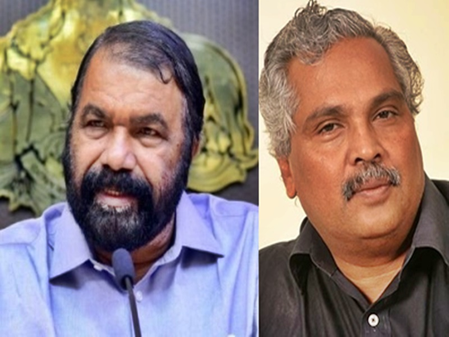
Thiruvananthapuram, April 12 (IANS) A war of words erupted between the two Communist parties in the ruling alliance of the Pinarayi Vijayan government on Saturday over the controversy surrounding his daughter Veena Vijayan’s now defunct IT firm Exalogic.
On Friday, CPI State Secretary Binoy Viswam said that the CPI will stand by the Chief Minister, and not his daughter. However, he added that the Chief Minister’s daughter has every right to run a company and enter into contracts with other companies.
Meanwhile, State Education Minister V. Sivankutty, considered close to Vijayan, on Saturday, hit back at Viswam, saying that the ideal place where Viswam should have raised his views was at the LDF meeting.
“Viswam should not worry about the case against Veena. Veena knows how to handle the case against her. The case is nothing but a political one, and the LDF has strongly supported Vijayan. Viswam should put his views at the LDF meeting,” said Sivankutty.
CPI is the second biggest ally of the ruling Vijayan government, and there have been times when it has discreetly expressed displeasure in the “big brother” attitude taken by the CPI-M and Vijayan and the way he (Vijayan) has been running the government.
Viswam and his party expressed their reservation on the implementation of the PM Schools for Rising India scheme, while the last Cabinet meeting on April 9 decided to defer it.
“What’s wrong with an infrastructure project of the Centre. Viswam has opposed it and things have come to a stage where he speaks like the Leader of Opposition,” said Sivankutty.
On Friday, state CPI-M Secretary M.V. Govindan said that the case against the Chief Minister’s daughter is nothing but a conspiracy targeting the Chief Minister.
“The party is strongly behind the Chief Minister against whom this witchhunt, unleashed by agencies, a section of the media, and a few political parties, is going on. We will fight this politically,” Govindan asserted.
"I wish to ask what happened to the gold smuggling case, when similar allegations came thick and fast. There was such a hue and cry that was made by many over it... finally, today, no one even talks of it. There is a deep-rooted conspiracy right now going and we, the CPI-M, will be lock, stock, and barrel with the Chief Minister," he added.
No sooner had Govindan finished his press conference, the news surfaced that a court in Kochi, where where the SFIO had filed its charge sheet against the illegal deal between Exalogic and Kochi-based Cochin Minerals and Rutile Ltd (CMRL), had accepted it, and a case was formally registered, after the court had a detailed examination of the charge sheet.
The SFIO has, by now, found out that Veena Vijayan's IT firm had allegedly received a monthly gratification of around Rs 2.70 crores from the CMRL for mining sanctions.
Vijayan had recently reportedly lost his cool when the media asked a flurry of questions about his daughter, and he responded curtly by saying: "You (media) want my blood, but will not get it easily."
--IANS
sg/dan
VHP denied permission for Hanuman Jayanti procession in Delhi’s Jahangirpuri

New Delhi, April 12 (IANS) Delhi Police on Saturday denied permission to the Vishwa Hindu Parishad (VHP) to carry out a 'Shobha Yatra' in the Jahangirpuri area of the national Capital on the occasion of Hanuman Jayanti.
The decision, according to the Delhi Police, came "in view of the sensitivity and its ramifications on law & order and security scenario in the area."
In an official statement, the police said, "Your request to grant permission for the 'Shobha Yatra' on the occasion of Hanuman Jayanti on 12.04.2025 from 12:00 PM onward commencing from A-Block to K-Block, Jahangirpuri, was considered but keeping in view the sensitivity and its ramifications on law & order and the security scenario in the area, the same could not be acceded to."
However, the police allowed celebrations to take place within the premises of the temple in the locality.
"However, you may have the celebration in the temple premises," it added.
The decision was taken as a precautionary measure following announcements by several Hindu organisations expressing their intention to hold religious processions in the area.
To avert any untoward incident, Delhi Police has already deployed Rapid Action Force (RAF) units along with additional personnel in Jahangirpuri.
Earlier, the police had granted conditional permission for a Hanuman Jayanti Shobha Yatra in the area, limiting the number of participants to 500, with strict guidelines prohibiting weapons and mandating a fixed route.
The procession was to take place under tight surveillance.
Security concerns in the area remain high due to the violent incident that occurred during Hanuman Jayanti in 2022.
Back then, communal clashes broke out during a procession, leading to stone pelting, arson, and even gunfire. At least eight police personnel and several devotees were injured in the violence.
Following the 2022 incident, Delhi Police filed a chargesheet against 45 individuals, alleging that the violence was premeditated. The investigation linked the riots to the earlier CAA-NRC protests and the 2020 North-East Delhi riots.
In total, 44 individuals were arrested, along with two minors who were taken into custody.
With Jahangirpuri remaining on high alert, authorities continue to monitor the situation closely to ensure peace and communal harmony during the religious occasion.
--IANS
sd/rad
Bengal Education Department gets contempt notice as job-losing teachers attend schools
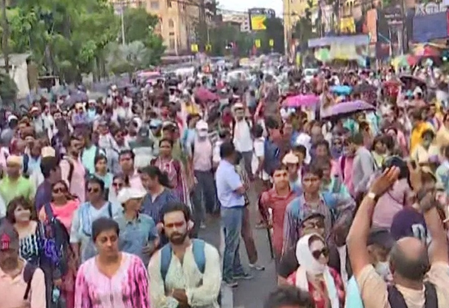
Kolkata, April 12 (IANS) Four senior bureaucrats attached to the West Bengal Education Department were served contempt of court notices for reportedly allowing a section of the teachers, who lost jobs after the Supreme Court's verdict, to attend the schools they were associated with.
Last week, a division bench of the Supreme Court upheld an earlier order by the Calcutta High Court last year cancelling 25,753 teaching and non-teaching staff on grounds that the state government and the West Bengal School Service Commission (WBSSC) had failed in segregating the "genuine" candidates from the "tainted" ones who allegedly secured jobs against payment of money.
After that, at a meeting with a section of the job-losing teachers, Chief Minister Mamata Banerjee appealed to them to continue attending their schools and offer voluntary services.
Even the updated salary portal for the teaching and non-teaching staff in state-run schools showed these job losers on the payroll.
The contempt of court notice to the four bureaucrats said that job-losing teachers attending their school is in direct violation of the Supreme Court order and hence tantamount to contempt of court.
The notices have been served to the Principal Secretary to the State School Education Department, Vinod Kumar, Commissioner of State School Education Arup Sengupta, WBSSC chairman Siddhartha Majumdar and the West Bengal Board of Secondary Education (WBBSE) president Ramanuj Gangopadhyay.
The notices have been served on behalf of five individuals, namely Babita Sarkar, Nasrin Khtaun, Laxmi Tunga, Setabuddin and Abdul Gani Ansari.
Earlier this week, a Delhi-based advocate, Siddhartha Datta, sent Chief Minister Banerjee a contempt of court notice over her recent comments on the verdict of the Supreme Court.
Dutta said: "Everyone is bound by the Apex Court's order, but the Chief Minister's recent comments indicate the state government will not implement the verdict."
--IANS
src/svn
APEDA, Arunachal govt promote agri, processed food product exports

New Delhi, April 12 (IANS) To promote agricultural and processed food product exports from the northeast region, the Agricultural and Processed Food Products Export Development Authority (APEDA), in collaboration with the Arunachal Pradesh government, hosted an international conclave cum buyer-seller meet (IBSM), the Ministry of Commerce and Industry said on Saturday.
Organised at Kalawangpo Convention Hall in Tawang, The event enabled direct interactions between 11 international buyers from three countries -- the UAE, Nepal and Bhutan -- with 17 Indian exporters from seven states and union territories (UTs) including Assam, Maharashtra, Delhi, Hyderabad, Karnataka, Gujarat and West Bengal.
The exporters from across the country also interacted with over 50 Farmer Producer Organisations (FPOs) and 200 farmers from Arunachal Pradesh who participated in the event to understand the agri produce quality, availability and production quantities.
At the event, State Chief Minister Pema Khandu committed to developing the agricultural and allied sectors, enhancing farmer’s livelihoods, empowering self-help groups and encouraged women-led development.
He envisions enhancing agri-exports of GI-tagged Khaw Tai Rice (known as Khamti Rice), Mandarin Orange, Kiwi, Apple, Persimmon, Yak Cheese (Churpi), among others, to South East Asian and ASEAN countries.
He encouraged domestic and international buyers to be a boon for the state and invest in the state’s untapped potential.
The event focused on the farmers of the region for their unwavering commitment in producing the state’s finest Kiwi, Mandarin Oranges, Apples, walnuts and Value-Added Products like wines, amongst others.
APEDA Chairman Abhishek Dev encouraged the identification of Farmer Producer Organisations (FPOs)/Farmer Producer Companies (FPCs) from Arunachal Pradesh for participation in key national and international Trade Fairs for market access, promotion and outreach.
He assured that APEDA and the state government are committed to working together closely for the identification and development of focused agriculture products from Arunachal Pradesh for exports to international markets, infrastructure development and training and capacity building of farmers.
APEDA facilitated meaningful trade discussions amongst policymakers, buyers, exporters, exhibitors, industry leaders and experts from key sectors.
--IANS
na/
Shiromani Akali Dal set to elect new President amid political tensions today
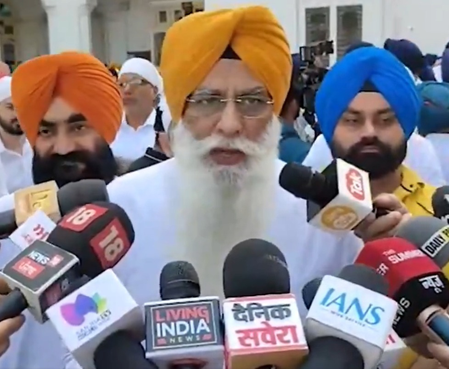
Amritsar, April 12 (IANS) The Shiromani Akali Dal (SAD), grappling to maintain its political relevance in Punjab, is set to elect its new party President and office-bearers on Saturday. The much-anticipated meeting is being held at the Shiromani Gurdwara Parbandhak Committee (SGPC) headquarters.
The election follows the resignation of Sukhbir Singh Badal as party President, prompting a series of internal discussions to determine the SAD’s next leadership.
A large number of party workers and senior leaders arrived early at the SGPC office to participate in the proceedings.
SGPC member Gurcharan Singh Grewal emphasised the significance of the event, noting that 500 representatives from all 117 Assembly constituencies across Punjab are present to cast their votes.
“This election is being held at the historical Teja Singh Samundri Hall, the administrative heart of the SGPC, as per tradition,” he said.
Grewal also addressed external criticism of the party, saying, “Today is the election for the SAD President, and yet we see leaders from the rebel faction, Aam Aadmi Party, Congress, BJP, and even MPs criticising us. We are neither in government nor hold a majority — why do these parties feel so threatened by us?”
He further stated that the Akali Dal is preparing for a political resurgence, asserting that the party will emerge as a major force ahead of the 2027 state elections.
J. Sohal, leader of the SAD women’s wing, echoed similar sentiments, expressing enthusiasm over the turnout.
“There is tremendous energy among the workers today. The Shiromani Akali Dal is the mother party of Punjab. No other government has delivered the development that we have,” she said.
Sohal also criticised the rebel faction within SAD, alleging the BJP’s backing.
“This so-called reform movement is tainted and backed by BJP forces. The same leaders criticising us are sitting under the shadow of the BJP. Today, they will realise where they truly stand,” she asserted.
The SAD has chosen a total of 567 delegates who will cast their vote for the new party chief.
Meanwhile, the SAD carries within itself a legacy of 105 years. It was established on December 14, 1920, with the support of the Gurdwara Management Committee, with the aim of becoming the religious, social, and political voice of the Sikh community.
After the implementation of the Gurdwara Act in 1925, the Akali Dal actively participated in the freedom struggle.
Inspired by the ideology of "Main Maran Te Panth Jive (Let me die, but let the Panth live)", the party initially kept a distance from politics. In the 1937 Provincial Elections, the party entered the political arena by winning 10 seats.
During the time of India’s Partition, the Akali Dal strongly opposed the division.
--IANS
jk/rad
No one is alone in India: PM Modi to divyang man whose daughter got treatment under PM-JAY

Rajkot, April 12 (IANS) A divyang (specially-abled) man from Rajkot, Vipul Pitroda, experienced a heartwarming moment when Prime Minister Narendra Modi personally responded to a letter he had written, expressing gratitude for the life-saving treatment his daughter received under the Ayushman Bharat Pradhan Mantri Jan Arogya Yojana (PM-JAY).
When Vipul's young daughter was critically ill and diagnosed with a six-inch-long tumour in her abdomen, he was financially incapable of affording the necessary medical treatment.
As a father responsible not just for his daughter but also for his wife, parents, and another child, Vipul was under immense stress.
Affected by polio and living with a physical disability, he felt cornered -- until a friend informed him about the benefits of PM-JAY.
The Ayushman Bharat PM-JAY scheme, a flagship initiative of the Narendra Modi-led central government, provides secondary and tertiary care hospitalisation coverage of up to Rs 5 lakh per family per year.
It is designed to ensure that even the poorest families in India can access high-quality healthcare without facing financial distress.
Sharing his story in a video message, Vipul said, "I am differently abled due to polio, but I've never lost hope. I have the responsibility of my wife, two children, and my parents. Unfortunately, my daughter was diagnosed with a serious illness. Her abdomen began to swell, and doctors detected a six-inch-long tumour. I had no money for her treatment, but a friend told me about PM-JAY."
He said that PM-JAY relieved him of all his financial burdens, and his daughter received the "best care, lifting a huge weight off my shoulders."
"I thanked the nurses, staff, and doctors. However, I couldn't thank the Prime Minister. So I wrote him a letter, expressing gratitude for saving not only my daughter's life but also giving me a new lease on life," he said.
The Prime Minister replied personally, assuring him that "no one stands alone in India."
"When I wrote the letter, I never imagined I'd get a reply. Out of millions of people in this country who write to him, PM Modi responded to me," Vipul said emotionally.
"It feels great to know that he cares even for common people, ensuring their well-being. No matter the situation, when PM Modi is with us, the entire nation stands with us. I truly feel grateful and thank him for launching such a scheme, because of which my daughter's surgery was successful, and she got a new life," he said.
In his reply, Prime Minister Modi reaffirmed the Centre's commitment to supporting citizens and ensuring access to free, quality medical care through Ayushman Bharat PM-JAY.
The scheme continues to make a significant difference in the lives of countless families across India, giving them not only medical relief but also hope and dignity in times of crisis.
--IANS
sd/rad