
Bihar: Central welfare schemes transform lives of people in Begusarai, beneficiaries praise Modi govt

Begusarai, April 13 (IANS) The people of Begusarai have praised the Narendra Modi-led Union government for transforming their lives with Central welfare schemes such as the Pradhan Mantri Awas Yojana and Pradhan Mantri Kisan Samman Nidhi Yojana.
The beneficiaries of the urban and rural areas of the district have expressed their gratitude towards PM Modi.
Among the beneficiaries are Kamo Devi, Pramila Devi, Renu Devi and Rita Devi, all residents of Municipal Corporation Ward Number 20 and 40 and Manoj Sharma, a resident of Matihani block.
The beneficiaries of the PM Awas Yojana in Begusarai told IANS and said, "Our living standards have improved a lot by benefitting from the Pradhan Mantri Awas Yojana. Earlier, living in a kutcha house was a huge problem during the rainy season and winters. There was always a fear of getting bitten by snakes and scorpions."
They also said, "Now that we have received a permanent house under the Pradhan Mantri Awas Yojana, our problems have ended. We are grateful to Prime Minister Narendra Modi for launching this welfare scheme."
The Pradhan Mantri Awas Yojana, launched in 2015, aims to provide affordable and permanent housing to the economically weaker sections, low-income groups, and middle-income families across both rural and urban India. By 2023, the programme is set to complete the construction of around 20 million houses.
Nandan Kumar and Chandan Prasad Singh, both residents of Badalpur village of Matihani block, who have also benefitted from the Pradhan Mantri Kisan Samman Nidhi Yojana, said, "We have benefitted a lot by getting a monthly assistance under the Pradhan Mantri Kisan Samman Nidhi Yojana. Earlier, we had to ask for money from moneylenders for fulfilling basic needs. Now that we receive Rs 6,000 per month under the PM Kisan Samman Nidhi Yojana, we have become 'Aatmanirbhar' (self-reliant). We don't need to beg anymore in front of anyone."
The money received from the Pradhan Mantri Kisan Samman Nidhi Yojana is providing economic strength and respect to poor farmers.
Under this flagship welfare scheme launched by the Modi government, a financial assistance of Rs 6,000 per year (in the form of three annual installments of Rs 2,000 each) is directly transferred to the bank accounts of farmers.
--IANS
sch/cbt/khz
Huge protest in Hyderabad against Waqf Amendment Act
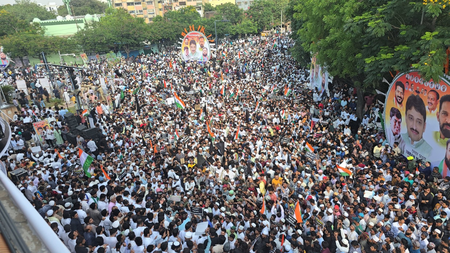
Hyderabad, April 13 (IANS) Thousands of people hit the streets in Hyderabad on Sunday in the biggest protest in the city so far against the Waqf Amendment Act.
Terming the Act as ‘unconstitutional’ and ‘discriminatory’, the protestors demanded that the BJP-led NDA government at the Centre withdraw it.
Numerous women, youth and students participated in Waqf Bachao March organised by the Congress.
The rally began at Nizam College Grounds and culminated at the Dr. B.R. Ambedkar statue at Tank Bund in the heart of the city.
The protestors, many of them carrying the national flag, raised slogans against the NDA government and Prime Minister Narendra Modi, accusing them of targeting Muslims by conspiring to snatch Waqf properties.
The protestors were carrying banners and placards with slogans like ‘Save Waqf, Wave Nation’, ‘We reject Waqf Act’, ‘Our Waqf our right’, and ‘Repeal Waqf Act’.
Congress MP Imran Masood, Telangana Pradesh Congress Committee (TPCC) president Mahesh Kumar Goud, Telangana government advisor and former minister Mohammed Ali Shabbir and Muslim leaders of the Congress party addressed the rally.
Cutting across party lines, people from various parts of the city and neighbouring districts participated in the protest, the biggest in the city so far.
The protestors were raising slogans ‘We want justice’ , ‘Inquilab Zindabad’ ‘Hindustan Zindabad’ and ‘Tanashahi Nahi Chalegi’.
Many protestors were carrying black flags and wearing black T-shirts with the slogan ‘We reject Waqf Act’.
The procession passed through Basheerbagh Junction and Liberty Junction before reaching Ambedkar Statue. Police had made tight security arrangements for the procession, which passed off peacefully.
Earlier, Imram Masood addressed a meeting organised by the All India Milli Council Telangana and the All India Muslim Personal Law Board.
AIMPLB president Moulana Khalid Saifullah Rehmani presided over the meeting.
The city witnessed protests at several places after Friday prayers. More protests are scheduled later this week.
AIMPLB will be holding a public meeting at Darussalam, the headquarters of All India Majlis-e-Ittehadul Muslimeen (AIMIM) on April 19.
AIMIM president and Hyderabad Asaduddin Owaisi and leaders of AIMPLB and several other organisations will address the public meeting.
Owaisi told the media on Sunday that they have invited MPs who were part of Parliament committee on Waqf Bill.
--IANS
ms/pgh
In a first, Himachal Day celebrations in remote Pangi Valley

Shimla, April 13 (IANS) For the first time in Himachal Pradesh’s history, the state-level Himachal Day celebrations will be held in the remote Pangi Valley of Chamba district on Monday.
The event in Killar, the valley’s headquarters, has created a wave of excitement and festive spirit throughout the region.
Locals have warmly welcomed the initiative, hailing Chief Minister Sukhvinder Sukhu’s decision to host the celebration in this tribal area.
Calling the Chief Minister’s visit “historic", Satish, the Pradhan of Gram Panchayat Killar (1), stated that no previous government had ever brought such a significant event to Pangi.
“The people of Pangi are ready to welcome our Chief Minister with open arms,” he said. “The administration is working tirelessly to ensure all preparations are flawless.”
Balbir, Pradhan of Kiryuni Gram Panchayat, echoed the sentiment, emphasizing the CM’s consistent outreach to tribal regions.
“We often read about his visits to remote parts of the state. His affection for tribal communities is evident. This visit will bring much-needed attention to the development issues of Pangi, and we are preparing a grand welcome,” he added.
Shiv Kumar, a local resident, praised the Chief Minister’s efforts for tribal welfare.
“His visit reflects a deep understanding of the challenges we face. In just over two years, he has done a lot for tribal communities. We’re confident he will continue working to ease our hardships.”
Since coming to power, the Congress government led by Sukhvinder Sukhu has shown a strong commitment to the welfare of tribal regions.
The first Himachal Day celebration under his government was held in Kaza of Spiti Valley, where the Chief Minister stayed and engaged deeply with local traditions and issues.
Not accessible by road throughout the year, the picturesque Pangi Valley remains cut off from the rest of the world for more than six months a year due to heavy snowfall.
The picturesque Pangi Valley is populated mainly by Gaddis, who are largely pastorals and grow barley, potatoes, and peas, besides off-season vegetables and exotic flowers.
The climatic conditions of the district are harsh as much of the land forms part of a cold desert where the mercury drops below minus 20 degrees Celsius during winter.
There are several hamlets where locals have to trek more than 10 km to reach the health centre.
(Vishal Gulati can be contacted at vishal.g@ians.in)
--IANS
vg/pgh
Manipur: Kuki tribals’ protest against annual Meitei pilgrimage

Imphal, April 13 (IANS) Hundreds of men and women belonging to the Kuki-Zo community have started protesting on Sunday in and around the foothills of Thangjing hill range against the Meitei community’s annual pilgrimage to the top of the hill in Manipur, which they consider a sacred site.
The protest began after the Umanglai Kanba Apunba Lup (UKAL) announced plans to carry out rituals atop the Thangjing hill in Churachandpur district, a Kuki-Zo-Hmar inhabited area.
The Indigenous Tribals’ Leaders Forum (ITLF), one of the leading tribal organisations, led the protest at Pholjang village, located at the foothill, with Kuki women, children, and civil society organisations, including Kuki Students Organisation (KSO).
Earlier, the Kuki community issued warnings that no one should enter their areas without a solid political solution.
The Meitei community views the Thangjing or Thangting Hills pilgrimage as an essential part of their cultural and religious heritage.
The north–south-running mountain range forms part of the western border of the Imphal Valley. However, the Kuki community sees the annual pilgrimage of the valley people as a potential threat and has been adamant that it will not be allowed to proceed without a political solution.
The situation remains tense, with both sides holding firm to their positions.
The Kuki tribal organisations in a joint statement said that the Meitei community people intend to cross the buffer zone for Ching Kaba at Thangting or Thangjing Hills.
“Unless a political settlement is reached by the government of India for the Kuki-Zo-Hmar community under the Constitution of India, no such friendly approach to the jurisdiction of Kuki-Zo-Hmar land would be allowed for the Meitei community,” they said.
The organisations said that to avoid further escalation, each community must maintain the status quo and respect the buffer zone.
“Any intention to cross the buffer zone would be opposed tooth and nail by the Kuki-Zo-Hmar community people,” the statement said and urged the government to take measures to safeguard the interests of the two communities.
--IANS
sc/dan
ED raids 9 locations in Delhi, Noida and Goa in money laundering case

Lucknow, April 11 (IANS) The Directorate of Enforcement (ED), Lucknow Zonal Office, carried out search operations at nine locations across Delhi, Noida, and Goa under the provisions of the Prevention of Money Laundering Act (PMLA), 2002.
The searches were conducted at the premises of M/s Bhasin Infotech and Infrastructure Pvt. Ltd., M/s Grand Venezia Commercial Towers Pvt. Ltd., and their key personnel.
The investigation was initiated following multiple FIRs registered by Gautam Budh Nagar Police in Noida, Uttar Pradesh, under various sections of the Indian Penal Code (IPC), 1860. The primary accused, Satinder Singh Bhasin, Managing Director of M/s Bhasin Infotech and Infrastructure Pvt. Ltd., is alleged to have defrauded investors in the “Grand Venezia Commercial Complex” real estate project.
According to the FIRs, the accused lured investors by showcasing grand advertisements and making false promises regarding the project.
Despite collecting large sums of money from several individuals, the company failed to hand over possession of commercial spaces as promised. It is alleged that the invested funds were misappropriated and siphoned off for other purposes.
During the raids, the ED seized various incriminating documents, electronic devices, and other digital evidence linked to the alleged money-laundering activities. In addition, keys to several bank lockers and unaccounted cash amounting to Rs 30 lakh were recovered.
Authorities also froze several suspected bank accounts tied to the accused and their companies.
Officials stated that the evidence collected during the search operations is being thoroughly analysed and will be used to further the investigation.
The ED is also likely to question key personnel involved in the companies to trace the money trail and determine the extent of the fraud.
The case underscores the growing scrutiny of fraudulent practices in the real estate sector and highlights the government’s efforts to clamp down on economic offences under PMLA.
Further action is expected in the coming days as the investigation progresses.
--IANS
brt/pgh
SC, OBC students to be given full scholarship in govt colleges: Haryana CM
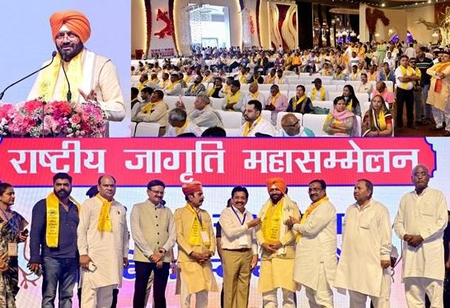
Gurugram, April 13 (IANS) Haryana Chief Minister Nayab Singh Saini said on Sunday that from the current academic session, all students from the Scheduled Caste and Other Backward Class communities studying medical and engineering courses in any government college of the country will be given full scholarship and a portal will be created for it.
The Chief Minister was speaking as the chief guest at a programme organised by the All India Saini Seva Samaj on the occasion of the birth anniversary of Mahatma Jyotiba Phule in Gurugram.
On this occasion, Uttar Pradesh Deputy Chief Minister Keshav Prasad Maurya, Bihar Deputy Chief Minister Samrat Choudhary, former Maharashtra Deputy Chief Minister Chhagan Bhujbal, MP Upendra Kushwaha and Kalpana Saini were also present.
Paying tribute to Mahatma Jyotiba Phule, Chief Minister Saini said: "Mahatma Jyotiba Phule worked to awaken the country and society at a time when India was in the shackles of slavery. He devoted his entire life to stop child marriage, supporting widow remarriage, giving women the right to education, eliminating untouchability and empowering the society. He raised his voice for the education of girls, widow remarriage and Dalit upliftment, that too in times when it was difficult to even think about these things. He used to say that "only education can uplift a person and a society"."
The Chief Minister said that Mahatma Jyotiba Phule along with his wife Savitribai Phule opened India's first girls' school in Pune.
"His wife was also a great social reformer and India's first female teacher," CM Saini added.
Savitribai Phule dedicated her life for women's education, empowerment and their rights, the Chief Minister said.
The Chief Minister also praised the All India Saini Seva Samaj for organising the National Awakening Maha Sammelan on Mahatma Phule's birth anniversary.
CM Saini said Mahatma Phule's ideals give us a direction in accordance of which Prime Minister Narendra Modi has given the mantra of 'Sabka Saath, Sabka Vikas, Sabka Vishwas and Sabka Prayas'.
"The history of Saini society is ancient and glorious. It has always considered labour, sacrifice and service as its religion. The contribution of this society in agriculture, horticulture and public service has been incomparable. Mahatma Jyotiba Phule, the pioneer of social revolution and Savitribai Phule, the first female teacher of India, are gems of Saini society," he added.
The Chief Minister said the welfare and upliftment of the poor was, is and will remain our resolve.
"Therefore, our basis of development is the empowerment of the poor. The focus on last mile delivery has changed the lives of these classes. This resolve to serve the deprived is true social justice."
He said the state government has increased the income limit of creamy layer for Backward Classes from Rs 6 lakh to Rs 8 lakh annually and has given reservation to Backward Class-B in Panchayati Raj institutions and urban local bodies.
"It is very difficult for the poor to bear the expenses of children's education. Therefore, loans up to Rs 15 lakh for studies in the country and up to Rs 20 lakh for studies abroad are given to children of Backward Class families with annual income up to Rs 3 lakh at 4 per cent annual interest," he added.
He described the state government as farmer-friendly and said Haryana is the first state in the country where it has decided to buy 100 per cent of the crops of farmers at the Minimum Support Price.
Under the 'Har-Ghar Grihini Yojana' of the Haryana government, gas cylinders are being given to 17 lakh poor families every month for only Rs 500.
The Chief Minister appealed to the people to educate their children and said that this would be a true tribute to Mahatma Jyotiba Phule.
--IANS
str/khz
‘Congress will fix it in an hour’: Imran Masood on Waqf Act
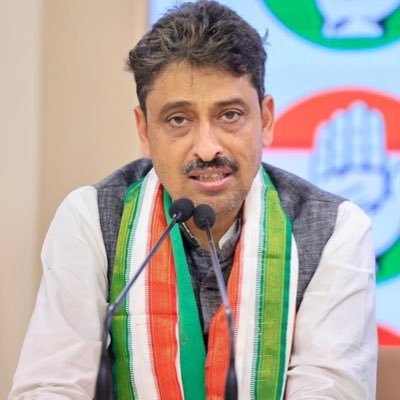
Hyderabad, April 13 (IANS) Terming the Waqf Amendment Act as ‘unconstitutional’, Congress MP Imran Masood on Sunday said that if Congress comes to power it would fix it within an hour.
“Pray that we come to power. I want to promise you when we come, we know how to fix this within an hour,” he said addressing a meeting organised here to oppose the Waqf Act.
Later, replying to a question from the media, he said that after coming to power democratically, the Congress would solve the problem in its own way.
“I want to ask you where will you offer namaz if there are no mosques, where will you bury your dead if there are no graveyards,” he asked participants at the meeting organized by the All India Milli Council Telangana and the All India Muslim Personal Law Board.
The Lok Sabha member from Saharanpur also gave an indirect call to leaders from other parties to join Congress, saying it alone can face the ‘storm in the sea’.
“When there is a storm in the sea, only a big ship can withstand it and not small boats. Therefore, leave the boats and be prepared to ride the ship. This is the only way. There is no other option,” he said.
The Congress MP said the BJP’s slogan of ‘400 paar remained’ a slogan and though Congress had crossed 400, it never trampled on the rights of any section of people. He said the Congress never gave a sense to any citizen that this country does not belong to him.
Imran Masood also stated that by voting against the Waqf Amendment Bill, 232 MPs slapped those who were spreading hatred in the country. “There are only 24 Muslim MPs but 232 MPs have voted to save Constitution,” he said.
On the Murshidabad violence, Imran Masood said that they were completely against violence.
The MP appealed to youth to not to do anything to take law into their hands. “This is the fight to save the Constitution, and if you go out of the legal limits, the fight will become meaningless,” he said.
He pointed out that the All India Muslim Personal Law Board has issued a nationwide call and Chairman Khalid Saifullah Rahmani has appealed to everyone to act in accordance with the law.
Imran Masood, who was also a member of the Joint Committee of Parliament on the Waqf Bill, has filed a petition in the Supreme Court, challenging the Waqf Act.
He argued that the amendment to the Waqf Act “strikes at the heart of India’s constitutional promise: that every community shall govern its faith, its institutions, and its property without fear of arbitrary state interference”.
--IANS
ms/pgh
‘Hotspot of silent suffering’: Gujarat’s suicide crisis deepens

Gandhinagar, April 13 (IANS) A case of suspected mass suicide in Gujarat’s Sabarkantha district has brought renewed attention to the growing mental health and social crisis unfolding quietly across the state.
On April 12, a family of five - parents and their three teenage children - allegedly consumed poison at their home in Vadali town. While the motive behind the extreme step is still unclear, police have confirmed the deaths of the parents, 42-year-old Vinu Sagar and his 40-year-old wife Kokilaben, while their children, aged 17 to 19, are undergoing treatment at the civil hospital in Himmatnagar.
Neighbours reported that all five family members began vomiting early Saturday morning. An ambulance was called, and the family was rushed to a private hospital before being referred to the district hospital for advanced care. The local police have registered a case of accidental death and are investigating the possible reasons behind the suspected suicide attempt. While no note has been recovered so far, officials have not ruled out financial or psychological stress as potential triggers.
On April 13, in Vadodara city, another tragedy unfolded. Abhishek Sharma, a 19-year-old engineering student from Jammu and Kashmir studying at the Maharaja Sayajirao University (MSU), was found hanging from a ceiling fan in the common room of his hostel.
CCTV footage revealed that he took the extreme step at around 6:30 am when no one was present. Police officials noted that Sharma had recently lost his father and had become withdrawn, emotional turmoil that may have led to the fatal decision.
These cases are not isolated ones. Gujarat has witnessed a steady and alarming rise in suicides over the past few years.
According to the latest report by the National Crime Records Bureau (NCRB), Gujarat reported 9,475 suicide deaths in 2022, an increase of over 1,000 cases compared to the previous year.
This makes Gujarat one of the top five states in India in terms of year-on-year growth in suicide numbers.
Major cities like Ahmedabad, Surat, and Vadodara continue to report high numbers, and rural and semi-urban districts like Sabarkantha are increasingly emerging as hotspots of silent suffering.
In comparison, states like Maharashtra (16,112), Tamil Nadu (15,724), and Madhya Pradesh (14,965) report higher absolute numbers, but Gujarat’s increasing rate is what has experts concerned.
“The state has historically had a lower suicide rate, but in recent years, we are seeing a sharp climb, especially among youth and in rural belts,” says a health expert.
One of the most concerning trends is the rise in family suicides and collective suicide attempts involving parents and children in the state.
India has witnessed a steep rise in student suicides, and Gujarat is no exception. NCRB data shows that over 13,000 students across India died by suicide in 2022, and Gujarat accounts for more than 800 of those cases, most aged between 15 to 25.
“The pressure to perform, isolation, and a lack of emotional literacy all combine into a dangerous mix,” says experts
Experts say that these are often driven by a complex mix of economic hardship, personal trauma, and lack of access to mental health support.
Sabarkantha, with its predominantly agrarian economy, has been affected by inconsistent rainfall and declining farm incomes. Many families have accumulated debts they struggle to repay, pushing them into a state of hopelessness.
“Mental health remains an under-addressed issue in Gujarat,” says health expert.
Gujarat has only 0.07 psychiatrists per 100,000 people, far below the national average. Public health systems are overstretched, especially in rural areas where there is limited awareness and accessibility to mental health care.
Also, stigma around depression and anxiety remains high, often deterring individuals from seeking timely help.
Moreover, the burden of expectations on youth is another growing pressure point. From academic performance to job insecurity, young people - particularly in families with limited resources - face an uphill battle.
Cases of student suicides and self-harm linked to exam stress or unemployment have seen a significant rise across the state.
In the above-mentioned cases, the fact that the children were teenagers raises further questions about the emotional environment they were navigating.
The state government has launched several initiatives aimed at suicide prevention and mental health support, including helplines and school counseling programs.
However, experts argue that these efforts fall short of addressing the scale and depth of the crisis.
What is needed is a more systemic approach that includes community-based mental health outreach, financial counseling, and social support for families in distress.
--IANS
janvi/dan
Banks want power to freeze mule accounts to stop cyber fraud: Report

New Delhi, April 13 (IANS) Banks have asked for the power to freeze bank accounts being used for cyber frauds without waiting for court or police approval, according to a report by a working group set up by the Indian Banks' Association (IBA).
At present, banks can only block accounts based on internal alerts, but under the Prevention of Money Laundering Act (PMLA), they do not have the legal authority to freeze or block customer accounts without proper authorisation from a court or a law enforcement agency.
The IBA report said this delay often gives fraudsters enough time to escape or transfer the illegal money. "In light of this, we may propose this as a suggestion for further consideration by the RBI," the report stated.
Mule accounts -- those used by cybercriminals to move stolen or illegal money -- are at the centre of this concern.
Even though banks freeze thousands of such accounts every year, fraudsters quickly open new ones by exploiting system loopholes.
To tackle this, banks are now considering ways to identify and limit accounts that are more likely to be misused as mule accounts.
The report suggested that banks could use the Election Commission’s database to verify customers who open accounts using voter ID cards or Form 60 (in cases where PAN is not available).
It also proposed capping the number of transactions that such accounts can carry out.
The report further recommended that banks adopt a technology-driven approach to deal with cybercrime.
By using artificial intelligence (AI) and machine learning in their transaction monitoring systems, banks can better predict and prevent fraudulent activities.
It added that a strong fight against mule accounts would require collaboration between banks, regulators, law enforcement agencies, and technology providers.
"Investments in advanced technology, regular staff training, and policy changes would be key," the report mentioned.
The report said these steps could help create a safer banking system and protect customers from cyber fraud involving money mule accounts.
--IANS
pk/vd
Six held for robbing man on pretext of offering escort service in Gurugram

Gurugram, April 13 (IANS) A crime branch team of the Gurugram police has arrested six accused, including two women, for robbing a man on the pretext of providing a call girl, police said on Sunday.
According to the police, on Saturday, a resident of Delhi filed a police complaint at the Sector-29 police station that he had booked a room in a hotel in Chakarpur, Gurugram.
During the night, he found an online number and contacted the number through WhatsApp to provide a call girl.
"After some time, a car came near the hotel, and he sat in that car. As soon as he sat in the car, the people sitting in the car asked for money from him. When he refused, they beat him up," the complainant told the police.
The complainant told the police that the suspects included two women.
The suspects beat the complainant, took his mobile phone, transferred Rs 59,500 online, and then they left him and ran away.
On receiving this complaint, a case was registered under the relevant sections in Sector-29 police station of Gurugram.
During the investigation, the police team of Sector-43's Crime Branch, Gurugram, took action and arrested six accused in the case from Sector-39 on Saturday.
The accused were identified as Muskan of Uttarakhand, Lalita of Uttar Pradesh, and Saurabh Arora, Pradeep Meena, Sonu Chaudhary, and Jaiprakash Sharma, all residents of Rajasthan.
"On examining the criminal records of the accused, it was found that a case has been registered against Pradeep in Gurugram in connection with robbery. One car and one knife used in the crime have been recovered from the possession of the accused," Sandeep Kumar, Gurugram police spokesperson, said.
The accused will be produced in the court and taken on police custody remand for further questioning and recovery. Further action is being taken in the case as per rules, he added.
--IANS
str/khz