
Israeli military says struck 35 sites in Gaza

Jerusalem, April 14 (IANS) The Israeli military said Monday it launched a new wave of strikes across the Gaza Strip, hitting about 35 targets, while Gaza health authorities said the death toll from renewed Israeli attacks had reached 1,613.
Among the sites hit were a weapons manufacturing facility in southern Gaza and a launch site containing rocket launchers aimed at Israeli territory, the military said in a statement.
In northern Gaza, Israeli soldiers identified an "ambush" of militants several hundred metres from their position, opened fire, and eliminated the "terrorists" in coordination with the Israeli Air Force, the military added.
It did not specify the location of the incident or the number of fatalities.
In southern Gaza's Rafah, where Israel has completed construction of a new "security zone" cutting off the city, Israeli troops destroyed a 20-metre-deep, several-hundred-metre-long tunnel route, the military said.
The tunnel had been used as "a gathering place for Hamas terrorists" and connected several tunnel routes in the area, it said.
Elsewhere in Gaza, Israeli troops located a Hamas weapons cache, including mortars, hand grenades, and explosives, according to the statement, Xinhua news agency reported.
Israel has blocked the entry of all humanitarian aid into Gaza since March 2. It then ended a two-month ceasefire with Hamas on March 18 and resumed deadly air and ground assaults on the enclave.
The renewed Israeli attacks have so far killed 1,613 Palestinians and injured 4,233 others, Gaza health authorities said Monday, adding that the death toll in the enclave since the war began in October 2023 has risen to 50,983, with 116,274 injured.
Last week, Israeli Defence Minister Israel Katz said that Israel will soon expand its operations to most of the Gaza Strip territory.
He told Gaza residents in a message that they have to evacuate due to the expected operations.
"For those who are interested, voluntary crossing to several countries will also be possible" under Washington's plan, which Israel is "working to implement," Katz said, referring to US President Donald Trump's controversial relocation proposal for Gaza residents.
"This is the last moment to remove Hamas, release all the Israeli hostages, and bring an end to the war," Katz remarked.
--IANS
int/as
US plans to hike tariffs on pharma products, China first in firing line

New Delhi, April 13 (IANS) The US is planning to go in for a tariff hike on pharmaceutical products, especially those being imported from China, in the next month or two, Commerce Secretary Howard Lutnick said in an interview with a media outlet on Sunday.
"We can't be relying on China for fundamental things that we need such as our medicines and our semiconductors which need to be built in America," Howard Lutnick said.
"We can't be beholden and rely upon foreign countries for fundamental things that we need," he said.
The statement comes close on the heels of President Donald Trump’s declaration at the National Republican Congressional Committee that the U.S. would soon impose a “major” tariff on imported drugs.
"So this is not like a permanent sort of exemption. He's just clarifying that these are not available to be negotiated away by countries. These are things that are national security that we need to be made in America," Lutnick said.
Pharmaceuticals have until now been kept out of the USA’s broader tariff rates as the country is dependent on cheap generic drugs available from countries like China and India to run their healthcare system. This is a great help as US multinationals sell the same medicines at very high prices that are often out of reach for common consumers.
Since China is locked in a trade war with the USA, drug exports from the communist country are clearly the first target. This would only increase the dependence on Indian generic drugs for the short term, according to industry sources.
More than 45 per cent of the generic drugs used in the US are made in India. India pharma giants such as Dr Reddy's, Aurobindo Pharma, Zydus Lifesciences, Sun Pharma and Gland Pharma earn up to half of their revenues from American consumers.
India's pharmaceutical industry is closely linked to the United States. In FY24, the U.S. accounted for $8.7 billion of India’s total $27.9 billion pharma exports, according to the Pharmaceuticals Export Promotion Council of India.
The US relies heavily dependent on low-cost Indian generics and hiking duties would push up prices and trigger shortages of essential drugs, especially antibiotics and common treatments.
Besides, India is engaged in talks with the US for a bilateral trade agreement. It is expected that the fact that essential generic medicines are available at cheap prices for American consumers will be kept in mind during the negotiations.
--IANS
sps/pgh
Ukrainian F-16 jet shot down, says Russian Defence Ministry

Moscow, April 13 (IANS) The Russian Defence Ministry on Sunday announced that its forces have shot down a US-designed F-16 fighter jet operated by Ukraine, but did not specify the location.
This is the first time that the Russian military has announced it had destroyed an F-16 since some European countries began deliveries of the fourth-generation fighter aircraft to Ukraine in summer last year.
"An F-16 aircraft of the Ukrainian Air Force was shot down by air defense means," the ministry said in its daily briefing without revealing any further details, RT reported.
On Saturday, the Ukrainian Air Force reported the loss of one of its F-16 fighters. An interdepartmental commission was then established to find out what caused the plane to go down, it added.
President Vladimir Zelensky later confirmed that Ukrainian pilot Pavel Ivanov had been killed "during an F-16 combat mission" and asserted that there would be a "strong and precise" response, hinting at Russia's role in shooting it down.
BBC Ukraine cited a Ukrainian source as saying that the F-16 had been shot down by the Russian military. "In total, the Russians fired three missiles at the plane. It was either a guided anti-aircraft missile from a S-400 ground-based system or an R-37 air-to-air missile," it claimed.
The source also ruled out friendly fire as a reason for the loss of the jet, claiming that Ukrainian air defenses have not been active in that area.
The fighter's destruction is the second confirmed loss of an F-16 by Ukraine. The first was destroyed and its pilot killed last August, but the report of the investigation into the incident was never revealed publicly. However, multiple media reports indicated that the plane was likely shot down by Ukrainian anti-aircraft defences by mistake.
Belgium, Denmark, the Netherlands, and Norway pledged to supply Kiev with up to 80 F-16s after receiving permission to do so from then US President Joe Biden's administration, though most of them will take years to arrive. In 2024, Ukraine received about 18 aircraft.
--IANS
vd
Separate tariffs coming on smartphones, chips imports: US Commerce Secretary

Washington, April 13 (IANS) A day after the US exempted electronics imports, including semiconductors, from reciprocal tariffs, Commerce Secretary Howard Lutnick said on Sunday the country is set to launch "separate tariffs" for imports of smartphones, computers, semiconductors, and other components in the next one to two months.
Lutnick also highlighted the need to build chips and flat-panel televisions in the US, compared to relying on imports from South Asian nations.
Speaking to ABC News, the Commerce Secretary said all those products are going to come under semiconductors, and they're going to have a special focus type of tariff to make sure that those products get reshored.
"We need to have semiconductors, we need to have chips, and we need to have flat panels -- we need to have these things made in America. We can't be reliant on Southeast Asia for all the things that operate for us," he was quoted as saying in the report.
The US Commerce Secretary highlighted that smartphone and computer imports are removed from the reciprocal tariff list but will now be added to the semiconductor tariffs within the next two months.
“What President Donald Trump is doing is that he's saying they're exempt from the reciprocal tariffs, but they're included in the semiconductor tariffs, which are coming in probably a month or two. So, these are coming soon,” he told the news portal.
On Saturday, the US government announced it would exempt smartphones and computers imported into the country from the latest tariffs.
According to a US Customs and Border Protection notice, the exemption applies to products entering the US or removed from warehouses as early as April 5.
The exemptions also include other electronic devices and components, including semiconductors, solar cells, and memory cards.
—IANS
na/vd
Strong winds sweep across S.Korea, causing damage

Seoul, April 13 (IANS) Strong winds swept across South Korea on Sunday, toppling structures and causing power outages in various parts of the nation, authorities said.
In Gyeonggi Province, where a strong wind advisory had been issued, gusts reached up to 22.9 metres per second earlier in the day, Yonhap news agency reported.
In Suwon, south of Seoul, a signboard in an entertainment district fell onto parked vehicles, and a wall near Suwon Station collapsed onto a pedestrian walkway. No injuries were reported in either incident.
Strong winds caused power outages in several regions.
The roof of an abandoned factory in Ulsan, about 410 km southeast of Seoul, was torn off by strong winds and struck a nearby utility pole, resulting in a power outage that affected around 50 households.
A broken tree branch damaged a high-voltage power line in Uijeongbu, north of Seoul, cutting electricity to more than 800 households.
As of Sunday evening, strong winds were expected to continue across most regions of the country through midnight, while gusts of 20 to 25 metres per second were forecast to persist on the southern resort island of Jeju through Monday.
With the fierce winds, outdoor structures collapsed one after another, causing vehicles to be covered. At about 10:50 a.m., a signboard installed in the entertainment district of Ingyedong in Suwon fell onto parked cars, and just 20 minutes earlier, a several-metre-long wall collapsed onto the pedestrian path near Suwon Station. Fortunately, there were no casualties.
In the Cheoin District of Yongin, a rest area at a gas station collapsed, isolating one person who was later rescued, and the fire department of Gyeonggi Province reported that they completed more than 100 safety measures due to structural overturns or collapses.
In Daejeon, shortly after noon at 12:07 p.m., a window was broken on the eigth floor of a mixed-use building in Jung-gu, prompting a response from the 119 rescue team. In Seogwipo City, Jeju, and Jocheon-eup, Jeju City, decades-old trees could not withstand the strong winds and fell onto the road.
--IANS
int/khz
Pakistan’s Punjab celebrates Baisakhi, Sikh pilgrims mark Khalsa’s founding

Lahore, April 13 (IANS) The age-old agrarian festival of Baisakhi, marking the start of the wheat harvest, was celebrated in Pakistan's Punjab on Sunday, though the observation was a bit low-key amid changing patterns of farming, reports said.
Observed annually on April 13, and sometimes on April 14, the festival remains deeply rooted in cultural fabric of rural Punjab, straddling both sides of the India-Pakistan border.
For farmers, it signifies the end of months of crop-watching and the joyous beginning of the harvest season, a day when hard work yields its long-awaited reward, the News reported.
Before the Partition, Baisakhi festivals were vibrant festivals steeped in folk tradition and farmers gathering to dholak beats, kick-starting the harvest, with menfolk performing the bhangra in the fields, while the women sang tapay and mahiye.
Now, mechanisation has altered the customs, with combine harvesters and threshers replacing the communal harvest, and has drained the day of its vibrancy, the News said.
Baisakhi also holds profound religious significance for the Sikh community, commemorating the founding of the Khalsa by Guru Gobind Singh in 1699.
Post-Partition, the festival became more closely associated with Sikhism, and it is now marked by a special ceremony held at Gurdwara Panja Sahib in Hasan Abdal in Khyber-Pakhtunkhwa province
However, this year, the central celebration is being held at Gurdwara Janam Asthan in Nankana Sahib, the birthplace of Guru Nanak.
Ahead of Baisakhi, the district administration of Nankana Sahib announced school holidays that all educational institutions in the district will remain closed from April 12 to April 16 as thousands of Sikh pilgrims began arriving from India to take part in the Baisakhi celebrations, ARY News had reported.
According to officials, the closure was aimed at ensuring smooth arrangements and tight security during the event.
The main Baisakhi celebration is scheduled for April 14, with preparations already underway.
As part of the security measures, over 2,000 police officers and personnel will be deployed and the District Police Officer issued a detailed security plan for the occasion.
Sikh pilgrims had started arriving in Pakistan from last week to attend the 326th Baisakhi Mela, which begins on April 10 and will continue till April 19.
The mela will host 20,000 local pilgrims, 3,000 from the diaspora and 7,000 pilgrims from India and other countries.
The Punjab Home Department has made comprehensive security measures to ensure the safety of thousands of Sikh pilgrims arriving from around the world for the Baisakhi Festival.
Ahead of the celebrations, the Pakistani High Commission in New Delhi issued more than 6,500 visas to Indian pilgrims, as per Charge d’Affaires Saad Ahmad Warraich.
The Indian pilgrims are visiting several revered gurdwaras across Pakistan, including Gurdwara Panja Sahib, Gurdwara Kartarpur Sahib, and Gurdwara Nankana Sahib.
These visits are facilitated under the Pakistan-India Protocol on Visits to Religious Shrines of 1974, which allows cross-border travel for religious purposes.
--IANS
vd
US says talks with Iran ‘very positive’

Washington, April 13 (IANS) The White House on Saturday said the first round of talks with Iranians, which took place in Muscat, Oman, were “very positive and constructive”.
US President Donald Trump's Special Envoy Steve Witkoff held talks with Iran’s Foreign Minister Abbas Araghchi in Muscat which were hosted by Omani Foreign Minister Said Badr.
These were talks between the Trump-led US and Iran, and marked an end of an impasse hit in relation in 2018 when President Trump walked out of the 2015 Joint Comprehensive Plan of Action (JAPOA), signed by US under President Barack Obama and remaining member of the UN Security Council ’s permanent members — the UK, France, Russia and China and German, on one side and Iran on the other.
The next round of talks are scheduled for next Saturday.
"The discussions were very positive and constructive, and the United States deeply thanks the Sultanate of Oman for its support of this initiative,” the White House said in a statement, adding: "Special Envoy Witkoff underscored to Dr. Araghchi that he had instructions from President Trump to resolve our two nations’ differences through dialogue and diplomacy, if that is possible. These issues are very complicated, and Special Envoy Witkoff’s direct communication today was a step forward in achieving a mutually beneficial outcome. The sides agreed to meet again next Saturday."
According to reports, the Iran’s state-run broadcaster reported that Witkoff and Araghchi “briefly spoke” together, the first such contact between the two countries at this level.
President Trump has expressed optimism he will be able to make a deal with Iran saying Friday that he wants to see Iran prosper but that he was committed to not allowing it to acquire nuclear weapons.
“I want Iran to be a wonderful, great, happy country, but they can’t have a nuclear weapon,” Trump said aboard Air Force One on the way to Florida.
--IANS
yrj/pgh
Bangladesh: Pro-Palestine protestors take out massive rally, slam Israel and US

Dhaka, April 12 (IANS) Thousands of protestors gathered in Bangladesh's capital Dhaka on Saturday under the banner of 'March for Gaza', expressing solidarity with Palestine and slamming the United States for backing Israel.
They chanted slogans like "Free Palestine", "Stop Israeli aggression", "Boycott Israeli products", "Boycott US and Donald Trump", and so on, local media reported.
Several media reports also suggested that the protestors beat the images of US President Donald Trump and Israeli Prime Minister Benjamin Netanyahu.
Leading political parties of Bangladesh - Bangladesh Nationalist Party (BNP), Jamaat-e-Islami, National Citizen Party (NCP), Hefazet-e-Islam Bangladesh and Amar Bangladesh Party - and several Islamic speakers came out in support of the event.
The protestors called on leaders of the Muslim world to cancel all existing agreements and diplomatic relations with Israel. They also demanded reinstatement of the 'except Israel' clause in Bangladeshi passports.
The country’s leading Bengali daily Prothom Alo reported that people started marching toward Suhrawardy Udyan from various places of Dhaka from the morning to join the mass gathering, halting traffic in Shabagh and adjacent areas.
On Thursday Khaleda Zia's BNP also brought out a rally in Dhaka expressing solidarity with the people of Gaza and Rafah in Palestine.
Earlier this week, similar pro-Palestine protests erupted in the country, leading to violence in several parts of the region. The mob targetted Israeli-linked businesses and also several outlets of foreign companies.
Security was beefed up in Dhaka's diplomatic enclave, particularly around the US embassy, following the protests in the area. Personnel from Border Guard Bangladesh, Armed Police Battalion, Special Branch, Criminal Investigation Department, intelligence agencies and Bangladesh army were deployed to monitor security in the highly-sensitive zone.
In addition, security measures were increased at other embassies in the Gulshan area.
Saturday's protests once again exposed the deteriorating law and order situation in Bangladesh even though the interim government led by Muhammad Yunus has said that people responsible for violence and destruction during the earlier pro-Palestine protests will be apprehended.
--IANS
int/scor/as
Trump says tariffs will be back on July 9 for no-deal countries; 26 pc for India

Washington, April 10 (IANS) US President Donald Trump on Thursday said trading partner countries that are not able reach an agreement with the US by July 9, when the 90-day pause ends, goods coming to the US from there will be tariffed at the reciprocal rate announced originally.
For India, it would mean the tariff will go back to 26 per cent from the revised 10 per cent. Rates for other countries similarly revised for all partner countries that chosen to launch negotiations with the US instead of retaliating with higher tariffs on American goods, such as China, which is under a 125 per cent US levy.
“If we can't make the deal that we want to make, or we have to make, or that's, you know, good for both parties, just got to be good for both parties, then we go back to where we were,” Trump said at a news conference following a meeting of the cabinet that was aired live.
“Go back to the numbers."
Asked if he may extend the pause, he said: “We'll have to see what happens at that time.”
President Trump announced a pause in the tariffs to a low of 10 per cent for imports from all trading partner countries that had not hit back with retaliatory levies on American goods, which would be upwards of 75 countries that have chosen to reach out to the administration to negotiate some kind of a deal, which included India that is discussing a Bilateral Trade Agreement with the US.
China is the most significant exception to Trump's abrupt reversal. He has raised the tariffs on Chinese goods to 125 per cent, in response to China’s retaliatory levy of 84 per cent on American goods.
These details became official in an executive order issued Wednesday evening. He first announced the pause and the revised levies in a post on Truth Social midday as the markets were in tumult for another day over the tariffs, this time with the sell off treasury bonds. Indexes roared up shortly after with the tech-heavy Nasdaq soaring to a two-decade high.
“I thought that people were jumping a little bit out of line,” the American president told reporters when asked for his reasons for the sudden reversal that took even his own officials by surprise. “They were getting yippie, you know, they were getting a little bit a little bit afraid.”
“You have to be flexible,” he added, when pressed.
While President Trump had indicated his readiness to negotiate when he announced the “reciprocal” tariffs, his top aides had insisted the levies were not negotiable. But the president was moving towards it and said he decided to do it on Wednesday morning.
“Based on the lack of respect that China has shown to the World’s Markets, I am hereby raising the Tariff charged to China by the United States of America to 125 per cent, effective immediately,” President Trump wrote on Truth Social.
“Conversely, and based on the fact that more than 75 Countries have called Representatives of the United States, including the Departments of Commerce, Treasury, and the USTR, to negotiate a solution to the subjects being discussed relative to Trade, Trade Barriers, Tariffs, Currency Manipulation, and Non Monetary Tariffs, and that these Countries have not, at my strong suggestion, retaliated in any way, shape, or form against the United States, I have authorized a 90 day PAUSE, and a substantially lowered Reciprocal Tariff during this period, of 10 per cent, also effective immediately,” he said further.
--IANS
yrj/pgh
Coal miners are real energy warriors of the nation: Union Minister
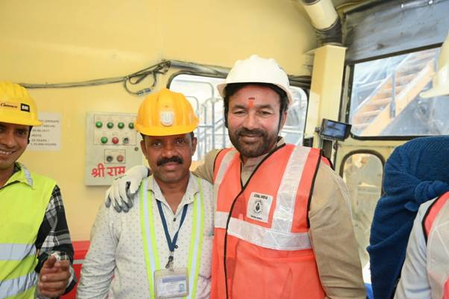
New Delhi, April 10 (IANS) Over 70 per cent of India’s electricity generation depends on coal, Union Minister of Coal and Mines, G. Kishan Reddy, said on Thursday, underscoring the need to balance development with sustainability, accelerate responsible mine closure practices, and continuously improve environmental benchmarks.
The minister visited the Gevra mine of South Eastern Coalfields Limited (SECL) in Chhattisgarh. Recognised as the world’s second-largest coal mine, Gevra stands as a symbol of India’s growing energy strength.
Describing Gevra as the pride of the country, the minister remarked, “One can afford to wait for food, but electricity cannot be delayed. It is our coal miners who ensure that the nation remains illuminated and energised.”
At the mine view point, SECL officials gave a detailed presentation highlighting key achievements and ongoing developments.
Reddy felicitated coal miners, including women workers, for their unwavering dedication to ensuring round-the-clock coal production — an indispensable pillar of India’s energy security.
The minister witnessed large-scale mining operations, including the deployment of mega equipment such as the 42-cubic-meter shovel and 240-ton dumper — among the largest Heavy Earth Moving Machines (HEMMs) used globally.
He also reviewed the blast-free surface miner technology in action and visited modern Silos developed under the First Mile Connectivity (FMC) initiative, aimed at sustainable and eco-friendly coal evacuation.
Reddy interacted with machine operators inside their cabins, boosting their morale and acknowledging their vital contribution to coal production.
During the visit, the minister also explored SECL’s green initiatives. He visited the Miyawaki plantation pilot site, where saplings have been planted using the innovative Japanese afforestation technique. Additionally, he inaugurated the newly built Kalyan Mandap — a multi-purpose facility dedicated to employee events and community functions.
Reddy’s interactions and on-ground engagement resonated deeply with the workforce, reaffirming the Centre’s resolve to empower the true energy warriors of the nation.
—IANS
na/