
PM Modi talks to India’s ‘first astronaut’ Shubhanshu Shukla, calls him ‘pride of 140 crore Indians’
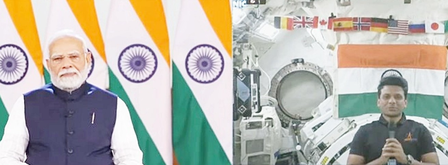
New Delhi, June 28 (IANS) Prime Minister Narendra Modi on Saturday spoke to astronaut Shubhanshu Shukla, who is currently on a landmark Indian space mission, orbiting 400 kilometres above the Earth.
The conversation, streamed live, reflected India's growing ambitions in space and the emotional connect between the nation and its first astronaut aboard an international space station.
“You may be far from us, but the hearts of 140 crore Indians beat with you,” said PM Modi, congratulating Shubhanshu for raising the nation’s pride globally.
“Your name itself carries the word ‘Shubh’ (auspicious). And your journey symbolises the direction in which ‘New India’ is heading,” he said.
Responding with humility, Shubhanshu said, “This journey is not mine alone. It belongs to every Indian. When I was young, I never imagined becoming an astronaut, but under your leadership, this dream came true.”
The young astronaut also lauded the rising development which the country is witnessing and said, “Today, what we are aiming at is now not far from reality. We need collective unity, and we need all the strength from our youth.”
He also shared the food which he had taken with him on this historic mission.
In a lighter moment, PM Modi asked if he shared Indian food with fellow astronauts.
“Yes, I brought some memories of India with me, gajar ka halwa, moong dal halwa, and aamras. I wanted my colleagues here to taste our rich culinary heritage,” Shubhanshu said with a smile.
As PM Modi praised the astronaut’s “down-to-earth” nature despite being in zero gravity, Shubhanshu described the awe of seeing Earth from space.
“From up here, there are no borders—just one planet, one humanity. India looks vast and unified. Borders vanish, and you realise Earth is our one shared home.”
Discussing scientific experiments that he will be conducting in this mission, Shubhanshu highlighted India's breakthrough research in zero gravity.
“I’ve brought here seven new experiments conducted by Indian scientists. We’re testing how stem cell supplements may help delay muscle loss, something that could benefit the elderly back home. We’re also studying micro-algae for agricultural and health uses.”
PM Modi emphasised India's twin strengths of science and spirituality. “Does meditation help in space, too?” PM asked. To this, Shubhanshu confirmed, “Absolutely. Mindfulness keeps us centred amid extreme conditions.”
When PM Modi asked Sudhanshu what message he would like to give to the youth, Shubhanshu replied: “Never stop trying. This journey proves that space is not the limit, it’s just the beginning.”
PM Modi emphasised by stating, “India is not just dreaming of a space station or moon landings, it is preparing to lead the next era of space exploration. Your journey will inspire generations.”
When PM Modi asked him how his learnings could benefit India’s space mission, Shubhanshu replied, “I’ve been making records. All my experience in this mission is being absorbed, and I would feel proud to use and channelise this experience in India’s future space missions.”
--IANS
sas/dan
US tariff hikes destabilise global economy: Kremlin

Moscow, April 7 (IANS) The Kremlin spokesperson Dmitry Peskov criticised the United States on Monday for its sweeping tariff hikes, accusing it of undermining global economic stability.
"We are closely monitoring the current situation, which remains highly volatile and emotionally charged," he said during a daily briefing on Monday.
The US-imposed tariffs on numerous countries have created a climate of economic tension and pessimistic global market projections, said Peskov.
"Of course, we are doing and will do everything necessary to minimize the consequences of this global economic turmoil for our economy," he added, Xinhua news agency reported.
US President Donald Trump signed an executive order Wednesday on so-called "reciprocal tariffs," imposing a 10 per cent "minimum baseline tariff" and higher rates on certain trading partners.
Stock markets across the Asia-Pacific traded sharply lower on Monday as financial turmoil sparked by the US decision escalated recession fears worldwide.
Earlier in the day, the Chinese Foreign Ministry said that the unilateral imposition of "reciprocal tariffs" by the United States effectively deprives countries, particularly those in the Global South, of their right to development, and is certain to face widespread opposition from the international community.
Chinese Foreign Ministry spokesperson Lin Jian said at a daily news briefing that the United States, under the guise of "reciprocity," acted in a manner that prioritizes its own interests at the expense of other nations' legitimate benefits. This approach places "America First" above international rules, exemplifying unilateralism, protectionism, and economic bullying.
Lin added that the Chinese government has issued its position on opposing US abuse of tariffs, making clear its solemn attitude.
Data analysis from the World Trade Organization indicates that, amid economic disparities and unequal power dynamics, US tariff policies will exacerbate the wealth gap among nations, with less developed countries facing particularly severe repercussions, Xinhua news agency reported. This trend poses a significant threat to the efforts intended to achieve the United Nations 2030 Agenda for Sustainable Development, Lin said.
--IANS
int/as
Lebanese President stresses need to disarm Hezbollah through dialogue

Beirut, April 7 (IANS) Lebanese President Joseph Aoun reaffirmed on Monday that disarming Hezbollah is a national and international priority, stressing that the only viable path to achieving this goal is through dialogue, a statement from the presidency said.
"As I said in my inauguration speech, there is no place for weapons or armed groups outside the framework of the state," Aoun stated. "These issues must be resolved through communication and dialogue. After all, Hezbollah is a Lebanese component."
He also revealed that work will soon begin on drafting a National Security Strategy, which will lay the foundation for a National Defence Strategy.
"We are all committed to the same objective," he added. "Differences in opinion are normal; that's the essence of democracy. What matters is that our goal is unified."
Aoun's remarks came during a meeting with a delegation from the American Task Force on Lebanon, led by Edward Gabriel, Xinhua news agency reported. The delegation delivered a clear message from Washington emphasising two urgent priorities: the disarmament of Hezbollah and the implementation of reforms necessary for Lebanon to access international financial aid.
Gabriel praised the efforts of the Lebanese army and the President personally, while also noting that "there is still much to be done." He added that the quicker reforms are implemented, the sooner the US can offer meaningful support.
Gabriel also disclosed that the US Congress is preparing a funding bill for Lebanon next year.
In addition, Aoun emphasized the need to ease tensions in the south, underlining that Lebanon needs both time and space to resolve issues calmly.
He called on the United States to pressure Israel to withdraw from the five points Israel continues to occupy, saying their presence complicates the situation further. To bolster security, he noted that the Lebanese government had recently approved the recruitment of 4,500 soldiers.
Since November 27, 2024, a ceasefire agreement between Lebanon's Hezbollah and Israel has been in effect, putting an end to more than a year of hostilities triggered by the war in Gaza.
Despite the agreement, the Israeli military occasionally carries out strikes in Lebanon, claiming that the operations target Hezbollah "threats".
--IANS
int/as
Trump says China panicked; markets slide deeper

Washington, April 4 (IANS) US President Donald Trump on Friday said China had “panicked” by retaliating to his reciprocal tariff with a matching levy of 34 per cent on all imported goods from America.
Market turmoil deepened on news of China's retaliation. All major US indexes dropped more than 3 per cent in morning trading. And the tech-heavy Nasdaq Composite had fallen by 4 per cent, and the Wall Street Journal said, it was on pace to close in a bear market, meaning it has fallen more than 20 per cent from a recent peak.
Trump announced a 34 per cent tariff on imports from China on Wednesday, along with levies on all of America’s trading partner countries, including India with 26 per cent. A base-line rate of 10 per cent has been levied on all trading partner countries with some of them such as China, India, Japan, the EU and others, were hit with higher rates.
"China played it wrong, they panicked - the one thing they cannot afford to do!" the American President wrote on Truth Social, his social media platform.
The unsaid implication seemingly was that the president either expected or preferred that Beijing had chosen negotiation over retaliation.
“Well, it depends,” he said in response to a question from a reporter on Thursday if he was open to negotiations.
“If somebody said that we're going to give you something that's so phenomenal, as long as they're giving us something, that’s good.”
He said earlier: “The tariffs give us great power to negotiate. I've always used them very well in the first administration, as you saw, but now we're taking it to a whole new level, because it's a worldwide situation, and it's very exciting to see."
But his position seemed at odds with his top aides, who have said these tariffs are not negotiable.
“I don’t think there’s any chance…that President Trump’s going to back off his tariffs,” Howard Lutnick, secretary of commerce and a key architect of the president’s tariffs, said on Thursday. “The world should stop exploiting the United States of America.”
Top trade aide Peter Navarro told a media outlet the tariffs are “not a negotiation”.
--IANS
yrj/pgh
Guterres calls for international help for Myanmar, ending brutal civil conflict

United Nations, April 4 (IANS) While appealing for international help to quake-ravaged Myanmar, Secretary-General Antonio Guterres has called for transforming the “tragic moment” into an opportunity to end the brutal civil conflict.
He asked the international community to immediately step up vitally needed funding to match the scale of this crisis.
And to the government and people of Myanmar, he said, “as they unite in grief, it’s also time to unite behind a political solution to end the brutal conflict”.
“There must be an end to the violence and human rights violations across the country and a pathway for democracy to take root,” he said while speaking to reporters at the UN on Thursday.
Guterres announced that he was rushing Emergency Relief Coordinator Tom Fletcher to Myanmar and his Special Envoy Julie Bishop will visit the country "to reinforce our commitment to peace and dialogue”.
India had already launched “Operation Brahma” immediately after the earthquake, flying relief supplies and personnel to Myanmar, which was the epicentre of the March 28 earthquake.
Guterres said, “The death toll is now 3,000 and climbing – with thousands injured, and many trapped under the rubble. This disaster has laid bare the deeper vulnerabilities facing people throughout the country,” he said.
He added that as communities across Myanmar unite in grief, it’s also time to unite behind a political solution to end the brutal conflict.
Welcoming the temporary ceasefire between the military government and the rebels in the civil war, he said, “This is essential to help aid flow and let rescuers do their jobs. But an end to fighting must quickly lead to a beginning of a serious political dialogue and the release of political prisoners.”
He said that the ceasefire should lead to an inclusive political process where all the people of Myanmar feel represented.
The UN Office for the Coordination of Humanitarian Affairs (OCHA) said that the quake has affected more than 17 million people.
Myanmar is ruled by the military, which overthrew the democratically elected government in 2021.
The regime has not been recognised and the representatives of the civilian government continue to hold Myanmar’s seat at the UN.
--IANS
al/dan
Cost of home-cooked food plate declined 5 pc in Feb: Report

New Delhi, March 10 (IANS) The cost of preparing both vegetarian and non-vegetarian thalis at home declined by 5 per cent in February compared to the corresponding figure for January this year, according to a Crisil report released on Monday.
For the vegetarian thali, the decline was driven by lower vegetable prices, particularly of onions, tomatoes and potatoes, while for a non-vegetarian thali, the cost eased with a decrease in broiler (chicken) prices, the report said.
Going ahead, the arrival of fresh rabi crops is expected to keep vegetable prices subdued, offering continued relief for vegetarian thali costs.
However, temperature conditions in March that have been above normal can impact the shelf life and quality of onions, which need to be stored for the next six months, as well as the quantity and quality of wheat -- the most significant crop of the rabi season, the report states.
The average cost of preparing a thali at home is calculated based on input prices prevailing in north, south, east and west India. The monthly change reflects the impact on the common man’s expenditure. The data also reveals the ingredients (cereals, pulses, broilers, vegetables, spices, edible oil and cooking gas) driving the change in the cost of the thali.
The ICRA report is in line with official figures that India’s retail inflation is on a downward trajectory. Inflation based on the Consumer Price Index fell to a 5-month low of 4.31 per cent in January as prices of vegetables and pulses eased during the month, bringing respite to household budgets, according to figures released by the Ministry of Statistics.
The easing of inflation reflects a steadily declining trend after having touched a 14-month high of 6.21 per cent in October. CPI inflation had declined to 5.48 per cent in November and 5.22 per cent in December.
The food inflation at 6.02 per cent in January 2025 is the lowest after August 2024.
RBI Governor Sanjay Malhotra announced a 25 basis cut in the policy rate from 6.5 per cent to 6.25 per cent in the monetary policy review to accelerate growth amid global uncertainties.
He said that inflation has declined and is expected to moderate further and gradually align with the RBI’s target.
Now, with the retail inflation continuing with its downward trend, the RBI will have more headroom to follow a soft money policy to make more credit available to businesses and consumers, which will propel economic growth.
--IANS
sps/dpb
Why India and Japan should deepen ties amid volatile geographical landscape

New Delhi, March 9 (IANS) Looking ahead, both nations must leverage their respective strengths -- India's strategic geography and expanding global influence, combined with Japan's technological prowess and diplomatic reach -- to secure the Indo-Pacific's stability.
Indo-Pacific is fast becoming the epicentre of global security, and for India and Japan, the urgency of deepening strategic cooperation has never been more pressing.
In an era where authoritarian expansionism threatens sovereignty and disrupts regional stability, both nations must take decisive steps to reinforce a rules-based order that ensures peace and prosperity.
This was at the heart of discussions at a New Delhi-based think tank, the Centre for Integrated and Holistic Studies (CIHS), which hosted an event at the India International Centre in New Delhi on February 18, 2025.
Titled "Indo-Japan Relations", the event featured Minister Noriaki Abe, Minister for Political Affairs at the Embassy of Japan, as the chief speaker, alongside a distinguished gathering of scholars, academicians, policymakers, and security experts.
Their discussions highlighted the necessity of fortifying India-Japan ties in an increasingly volatile geopolitical landscape.
Minister Abe provided critical insights into the evolving regional dynamics, emphasizing the need for deeper Indo-Japanese engagement. The discussions spanned economic collaboration, security partnerships, and technological cooperation—key pillars in ensuring regional resilience. A focal point was the increasingly assertive posture of the Communist Party of China (CPC) in the Indo-Pacific.
From aggressive military manoeuvres in the South China Sea to economic coercion and territorial incursions, CPC's expansionist strategies continue to challenge the sovereignty of nations across the region. Its militarisation of artificial islands, debt-trap diplomacy, and grey-zone tactics have further escalated tensions, making a robust India-Japan partnership indispensable.
As two of the region's leading democratic powers, India and Japan must intensify their security and economic cooperation to counter these challenges.
The informal Quadrilateral Security Dialogue (QUAD) grouping—which also includes the United States and Australia—has demonstrated its effectiveness in bolstering military interoperability, intelligence-sharing, and securing vital maritime corridors. However, a crucial area demanding greater attention is the security of the Malacca and Sunda Straits—chokepoints critical to global trade yet increasingly vulnerable to CPC's geopolitical manoeuvring.
CPC's growing influence in the region, particularly through its strategic presence in Myanmar and Cambodia, poses a direct challenge to freedom of navigation.
A coordinated Indo-Japanese approach—incorporating joint patrols, intelligence-sharing, and strategic infrastructure investments—is essential to maintaining stability. Japan's advancements in maritime technology, coupled with India’s naval capabilities and strategic location, create a formidable alliance for safeguarding sea lanes.
Both nations have also heavily invested in maritime domain awareness (MDA), an essential component of deterring territorial encroachments and securing vital trade routes.
Beyond military security, economic resilience is equally critical.
China's Belt and Road Initiative (BRI) has sought to entrench economic dependencies, eroding national sovereignty through unsustainable debt-driven projects.
In response, India and Japan have championed the Asia-Africa Growth Corridor (AAGC), a transparent and sustainable alternative that prioritises local economic empowerment over exploitative financing.
Strengthening this initiative is vital—not just to counter CPC's economic coercion but to foster long-term regional stability.
The success of the AAGC hinges on increased investment in sustainable infrastructure, digital connectivity, and capacity-building in partner nations.
By promoting economic independence rather than dependency, India and Japan can help developing nations build resilience against external economic pressures. This initiative also unlocks new avenues for trade and investment, benefiting not just the Indo-Pacific but also Africa's economic landscape.
The digital domain is another battleground where India and Japan must strengthen collaboration. China's dominance in 5G networks, artificial intelligence, and digital infrastructure presents a clear security threat.
Beijing's state-controlled tech firms have been instrumental in cyber espionage and geopolitical manoeuvring, necessitating a coordinated response.
By jointly investing in secure digital corridors, semiconductor supply chains, and advanced cybersecurity frameworks, India and Japan can safeguard critical technologies and infrastructure.
As the world moves toward an increasingly digital future, cyber threats loom large. Both nations must develop robust cyber resilience frameworks to counter state-sponsored hacking, misinformation campaigns, and intellectual property theft.
Japan's expertise in advanced technology, coupled with India's strong IT and cybersecurity capabilities, makes this partnership particularly well-suited to addressing emerging digital threats.
--IANS
int/scor/
Syria’s membership in Organisation of Islamic Cooperation reinstated

Riyadh, March 8 (IANS) Syria's membership in the Organisation of Islamic Cooperation (OIC) was reinstated, the OIC announced in a statement on Saturday.
The decision was taken during an extraordinary meeting of the OIC Council of Foreign Ministers, convened in Jeddah on Friday to discuss the ongoing Israeli offensive against the Palestinian people and the plans for annexation and forced displacement from their land.
The statement noted that the decision came at Syria's request, and necessary measures will be taken to implement the decision.
The meeting, held at the request of Saudi Arabia, Palestine, and Iran, supported all the OIC resolutions on Palestine and Jerusalem, most recently by the Extraordinary Arab and Islamic Summit in Riyadh last November, Xinhua news agency reported.
Meanwhile, Iran has expressed grave concern over escalating violence and insecurity in Syria.
Iran closely monitors Syria's internal developments and follows with great concern the reports of violence and insecurity in various parts of the Arab state, said Iranian Foreign Ministry spokesman Esmaeil Baghaei.
He made the remarks in response to intense clashes that erupted in Syria's coastal regions over the past 24 hours.
Baghaei stressed the need to ensure security and stability in Syria and create conditions for the peaceful coexistence of all Syrian groups. He also stressed the need to maintain Syria's territorial integrity in the face of Israel's aggression and threats.
Baghaei said that Iran firmly opposes insecurity and violence in Syria and the killing and maiming of the "oppressed" Syrians from any group or tribe.
Since Thursday, fierce clashes between Syria's interim government forces and armed opposition groups affiliated with the former government in coastal regions have left at least 147 people dead.
The Syrian Observatory for Human Rights reported that the clashes marked one of the deadliest escalations since the fall of the previous government last December.
--IANS
int/as
Trump threatens Russia with sanctions

Washington, March 7 (IANS) US President Donald Trump on Friday threatened far-reaching sanctions against Russia until a ceasefire and a final settlement is reached with Ukraine.
“Based on the fact that Russia is absolutely ‘pounding’ Ukraine on the battlefield right now, I am strongly considering large scale Banking Sanctions, Sanctions, and Tariffs on Russia until a Cease Fire and FINAL SETTLEMENT AGREEMENT ON PEACE IS REACHED,” Trump wrote on his social media platform Truth Social.
“To Russia and Ukraine, get to the table right now, before it is too late.”
Russia launched a wave of aerial bombings early Friday hitting Ukraine with 67 missiles and 194 drones, according to Kyiv. Most of them were intercepted but some did make it through, hitting gas and power facilities.
These threats were the first strong warnings for Russia from Trump, who had during the election campaign 2024 claimed the war would be over on the day he took office and even before. He had then, as now, also claimed Russia would have never invaded Ukraine if he was still president. The second claim cannot be tested but the first — his confidence in finishing the war — is being tested, as the war has been on for two months now after the start of his second term.
President Trump has managed to strong arm Ukraine getting ready for a ceasefire and a final settlement. After a heated exchange with President Volodymyr Zelensky at an Oval Office meeting he announced a pause in all US aid to Ukraine, stopping even the exchange of intelligence.
Mollified by a “regret” letter from Ukraine, Trump has said he is ready to work with Zelensky towards peace.Officials of the two sides are to meet next week for talks, including on a US-Ukraine agreement that will grant Washington rights in Ukraine’s rich reserves of rare earth minerals.
--IANS
yrj/pgh
Odisha could become next global hub for synthetic fibre-based textile industry: Oerlikon director Debabrata Ghosh

New Delhi, Jan 28 (IANS) Preparations for the 'Utkarsa Odisha: Make in Odisha Conclave 2025' scheduled to take place on January 28 and 29 in Bhubaneswar are in their final stages. Speaking ahead of the event, Debabrata Ghosh, Director and Marketing Head of Oerlikon, one of the largest textile machinery manufacturing companies in the world, shared his insights on Odisha's potential to become a global leader in the synthetic fibre-based textile industry.
While speaking to IANS, Ghosh said, "I am the Director and Marketing Head of Oerlikon in India, with our headquarters based in Switzerland and Germany. I am here in Odisha because I strongly believe that this state has the potential to become the next global engine for the synthetic fibre-based textile industry. Indian Oil and MCTI have announced a joint venture to establish a spinning plant in Odisha, which will serve as the foundation for the fibre-based industry and the development of government schemes in the region."
Ghosh highlighted that this move would position Odisha as a leader in the sector, as Eastern India has so far lacked a large integrated plant for the textile industry.
"Odisha has numerous advantages, including access to ports, mineral resources, and an affordable labour force. With more than 50 per cent of Eastern India’s population residing here, Odisha stands to benefit greatly from such an industrial boost."
He further emphasised Odisha’s bright future, especially in textiles and industries, due to its growing infrastructure and business-friendly policies.
"India is growing at a steady rate of 8 per cent annually. In 2000, the country's GDP was $442 billion, and by 2025, we are expected to reach nearly $4 trillion. By 2046, India’s economy could touch $30 trillion. This growth trajectory suggests that India’s manufacturing sector will see a 12 per cent increase in the next 20 years. India is now the world’s fastest-growing large economy, and under Prime Minister Narendra Modi’s leadership, it is set to emerge as a major industrial powerhouse with a strong manufacturing base,” Ghosh concluded.
His optimism about the future of Odisha and India aligns with the government’s push to attract investment and establish the region as a key industrial hub in the coming years.
--IANS
rs/