
Piyush Goyal takes stock of Invest India in bid to boost manufacturing sector
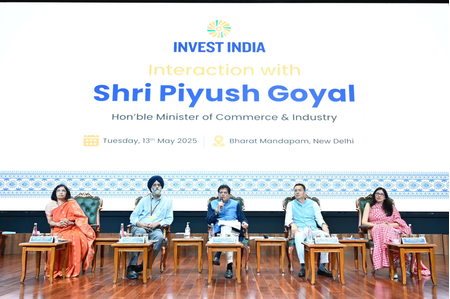
New Delhi, May 13 (IANS) Commerce and Industry Minister Piyush Goyal on Tuesday held a comprehensive review of Invest India at a meeting held at Bharat Mandapam here.
The minister emphasised on enhancing the performance, effectiveness and efficiency of Invest India to facilitate greater investments into India.
He also discussed avenues for further strengthening investor engagement, empowering MSMEs and boosting manufacturing in the country.
Invest India is the national investment promotion and facilitation agency of the Government of India and helps to expedite approvals for the setting up of manufacturing enterprises by speeding up clearances that are required, such as those for the allotment of land.
Invest India serves as the first point of contact for global and domestic investors. It provides comprehensive, end-to-end support across all stages of the investment lifecycle -- ranging from pre-investment advisory and facilitation to aftercare and expansion support -- with a strong emphasis on enabling manufacturing through the Make in India initiative.
India's manufacturing sector is a significant part of the country's economy, contributing about 17 per cent to the GDP and employing over 27.3 million workers. The government aims to increase its share to 25 per cent by 2025, driven by initiatives like the ‘Make in India’ policy and Production-Linked Incentive (PLI) schemes.
The Commerce and Industry Minister is keen to streamline Invest India processes further to attract more investments. His emphasis on MSMEs is part of the Government’s strategy to boost these labour-intensive enterprises as they have the highest potential for creating employment in the country.
To revitalise the manufacturing sector, the Make in India initiative was launched in September 2014 to foster innovation, and position India as a global manufacturing hub by attracting domestic and foreign investment, building best-in-class manufacturing infrastructure, enhancing skill development, protecting intellectual property, and streamlining regulatory processes to create a conducive environment for businesses to thrive.
Due to the sustained efforts of the government, during 2014-2023, Foreign Direct Investment equity inflow in the manufacturing sector increased by 55 per cent to reach $148.97 billion compared to $96 billion in the previous nine years (2005-2014).
This achievement is due to the various policy initiatives taken by the government over the years. Under the existing FDI policy, nearly all sectors allow for 100 per cent FDI, except for certain prohibited sectors. The defence industry allows 74 per cent FDI under the automatic route and 100 per cent under the government route.
For the broadcasting sector, FDI limits vary, differing between print and digital media. While the automatic route requires no approval from the Government of India for either non-resident or Indian companies, the government route necessitates prior approval from the Government of India before investment can proceed.
--IANS
sps/uk
X to block over 8,000 accounts in India after government order

New Delhi, May 9 (IANS) Billionaire Elon Musk-led social media platform X on Thursday said the Indian government has asked it to block more than 8,000 accounts in the country for violating laws, and it will comply with the law of the land.
While the platform did not specify names of the accounts, it includes "international news organisations and prominent X users", the media platform shared in a statement.
The move comes amid the India-Pakistan conflict, in the aftermath of the Pahalgam terror attack that killed 26 tourists, which has seen an increase in misinformation.
"X has received executive orders from the Indian government requiring X to block over 8,000 accounts in India, subject to potential penalties including significant fines and imprisonment of the company’s local employees," the statement said.
The statement said that the government did not specify which posts have violated laws.
"For a significant number of accounts, we did not receive any evidence or justification to block the accounts," X said, noting that it will comply with the order and "withhold" the accounts only in India.
Calling the decision "not easy", X said it has initiated process and sent the affected users "notice of the actions".
It also expressed disagreement with the Indian government’s demands over blocking entire accounts.
"It amounts to censorship of existing and future content and is contrary to the fundamental right of free speech," the statement said.
X said the platform is vital to Indians’ ability to access information.
"We believe that making these executive orders public is essential for transparency -- lack of disclosure discourages accountability and can contribute to arbitrary decision making. However, due to legal restrictions, we are unable to publish the executive orders at this time," the statement said.
The Musk led company said it is exploring all possible legal avenues available to the company.
It also encouraged the impacted users "to seek appropriate relief from the courts".
--IANS
rvt/na
Centre launches portal to boost non-ferrous metal recycling ecosystem

New Delhi, May 7 (IANS) Union Minister of Coal and Mines, G Kishan Reddy, on Wednesday launched a dedicated non-ferrous metal recycling website and stakeholders' portal, to promote a structured, transparent and sustainable recycling ecosystem in India.
It was launched in the presence of Minister of State for Coal and Mines, Satish Chandra Dubey and senior officials from the Ministry of Mines and JNARDDC.
Key features include National registry for dismantlers, recyclers, traders, and collection centres; tools to track raw material flows, product types, technology adoption, and workforce data; performance benchmarking mechanisms; identification of regional and sectoral infrastructure and skill gaps; and support for development of standards, certification systems, and awareness campaigns.
Developed under the implementation guidelines of the National Non-Ferrous Metal Scrap Recycling Framework, the platform is designed to bring together key stakeholders, improve data visibility, and support evidence-based policymaking in the recycling of aluminium, copper, lead, zinc, and critical elements.
Reddy said, “India is committed to building a circular economy that optimally utilises its resources. This portal will not only provide real-time visibility into the recycling landscape but also empower all stakeholders to make informed decisions, bridge gaps, and unlock the full potential of our non-ferrous metal sector.”
Minister of State Satish Chandra Dubey lauded the initiative, stating that “this portal is a much-needed step in strengthening the recycling value chain and enhancing industry participation through transparency and data-driven policy support.”
The website will act as a national hub for information dissemination, awareness generation, and engagement with recyclers, dismantlers, aggregators, industry associations, and research institutions.
It highlights government initiatives, provides updates on stakeholder meetings and policy developments, and offers access to national statistics, standards, and infrastructure-related achievements.
The integrated portal also enables registration of industry participants and collection of crucial data on raw material consumption, recycling capacity, technology usage, and workforce trends — supporting future interventions in R&D, infrastructure development, and skill enhancement.
—IANS
na/
India’s moment in science and innovation has arrived: Minister
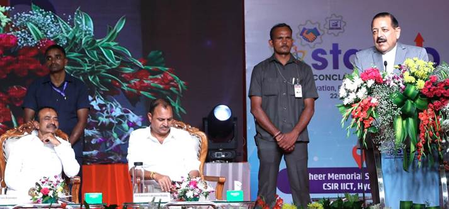
New Delhi, April 22 (IANS) Union Minister Dr Jitendra Singh on Tuesday called for greater synergy between innovation and industry for a sustainable startup ecosystem.
In a spirited call for greater synergy between innovation and industry for a sustainable startup ecosystem, Dr Singh said the time has come for Indian science to break silos and integrate with stakeholders including industry, investors, and the public.
Speaking at the ‘Startup Conclave’ in Hyderabad, Dr Singh highlighted that India’s moment in science and innovation has arrived.
Addressing a gathering of scientists, entrepreneurs, students, and policymakers, the minister lauded the rare joint initiative by the three Hyderabad-based CSIR labs, noting that “such an integrated scene of science and governance under one roof” reflects Prime Minister Narendra Modi’s vision of collaborative and inclusive innovation.
The Minister made a strong pitch for dismantling the outdated image of government labs as “ghost-haunted places where frogs are dissected,” narrating how villagers once misunderstood the work of CSIR labs due to lack of public outreach. “Science should not be confined behind gates. If your domain is agriculture, invite the farmers in. Let them see what you’re doing,” he asserted.
Dr Singh underlined the need for early and deep industry involvement in research and innovation, pointing to the success of CSIR’s Aroma Mission, where over 3,000 youth, many of them non-graduates, became successful agri-entrepreneurs with minimum annual earnings of Rs 60 lakh.
Referring to India’s rapidly growing biotechnology sector, the minister recalled that in 2014, there were only 50 biotech startups. Today, the number exceeds 10,000.
“It’s not just numbers. We’ve moved from $10 billion to nearly $170 billion in biotech valuation. This is not just growth, it’s a revolution,” he said, citing the government’s dedicated policies like Bio-E3 and the National Quantum Mission.
The minister also announced plans to open up the nuclear sector, noting that a new realism has replaced the secrecy that once shrouded scientific endeavours. “When Google can peek into our lives, what’s the point of denying access to potential collaborators in the name of confidentiality?” he asked.
—IANS
na/
Mid-Market GCCs set to drive next phase of growth in India: Report

Hyderabad, April 22 (IANS) India is home to over 480 mid-market global capability centres (GCCs), employing more than 210,000 professionals and over 680 mid-market GCC Units, a report said on Tuesday.
This segment has been instrumental in shaping India’s GCC narrative with accounting for 27 per cent of all GCCs and 22 per cent of total GCC units in the country.
GCCs continue to be a key growth sector for the tech industry in India, contributing nearly one-third of the industry’s total exports.
“The next wave of global capability will not come from size, but from speed, specialisation, and strategic influence. With world-class talent and a vibrant digital ecosystem, mid-market GCCs are no longer just delivery engines but are emerging as cultural innovation labs and centres of excellence, driving R&D, product innovation, and enterprise digitisation for global impact,” said Rajesh Nambiar, President, Nasscom.
Within this thriving ecosystem, mid-market GCCs are emerging as high-impact innovation hubs, driving agility, product excellence, and enterprise transformation at scale, according to the report by Nasscom and Zinnov.
Over 45 new mid-market GCCs have set up operations in India in the past two years alone, accounting for nearly 35 per cent of total GCCs, and 30 per cent of total GCC units during this period.
Despite operating at around 40 per cent the scale of their larger counterparts (Non-Mid-market GCCs), mid-market GCCs are consistently delivering transformative outcomes across product innovation, enterprise agility, digital maturity and deepening niche skill capabilities.
Their strategic focus and lean operating models have resulted in a 1.3 times higher presence in transformation hubs, with a maturity curve advancing 1.2 times faster than non-mid-market GCCs.
India is today home to 47 per cent of global product management talent for mid-market GCCs and over 25 per cent of their DeepTech workforce, cementing its position as a global hotspot for next-gen capabilities in AI/ML, cybersecurity, cloud, and data science.
In terms of market distribution, Bengaluru, Hyderabad, NCR, and Chennai remain leading destinations for mid-market GCCs, attracting 74 per cent of all new GCC units established, said the report.
—IANS
na/
‘WAVES 2025’ emerging as global connector between creators and buyers: Ashwini Vaishnaw

Mumbai, April 19 (IANS) The world of creators and their economy is going through a fundamental change and the ‘WAVES 2025’ event seeks to evolve itself as a global platform for media and entertainment, just as Davos serves as a global platform for economic policies, said Union Minister of Information and Broadcasting, Ashwini Vaishnaw, on Saturday.
Interacting with the media here ahead of the maiden World Audio Visual and Entertainment Summit (WAVES) scheduled in Mumbai from May 1-4, the Union Minister said that with the advent of technology, the old model is giving way to the new model, creating opportunities as well as challenges.
“The shape of the media world is changing, he said, and stressed on the collective need as a country to respond to the new model.
Giving an example, the minister said that gone are the days when a big studio was needed for creating content. Today, a creator from a remote village from Jharkhand or Kerala can create good quality content and get millions of views.
He mentioned that the creator's economy is growing exponentially.
The Minister said that “our visionary Prime Minister Narendra Modi acknowledged the work of the creators and their contribution in the economy by promoting India’s soft power globally”.
India’s creative economy has received an overwhelming boost, with more than 1 lakh registrations for WAVES 2025. The top innovators will be honoured with Awards, celebrating their contributions to the evolving global media and entertainment landscape.
Vaishnaw said that “we are finding a way to connect the world with our creators”.
WAVES is emerging as a global connector between creators, buyers, and markets for scalable creative solutions, the minister said. Through WAVES, buyers and sellers are getting a platform, where creators can offer their content and firms can source quality creative work.
—IANS
na/
Equity MF inflows double in FY25, AUM jumps 23 pc on SIP surge

Mumbai, April 19 (IANS) Active equity mutual fund (MF) schemes closed the financial year 2024–25 (FY25) with record-breaking inflows -- more than twice the amount seen in the previous year -- as fund houses capitalised on strong market sentiment, particularly in the first half of the year.
Despite market volatility, investor confidence remained strong, pushing overall assets under management (AUM) up by a remarkable 23 per cent for the year.
While existing equity schemes continued to see robust investor interest during the market rally, new fund launches added significant momentum.
Fresh offerings alone brought in Rs 85,000 crore to the overall equity MF kitty for FY25, according to the reports.
In total, 70 new active equity schemes were rolled out during the year, with most of the action concentrated in the sectoral and thematic categories.
Fund houses also expanded their offerings by adopting passive investment strategies within these thematic spaces, catering to growing investor demand.
A key driver of this growth was the sharp increase in SIP contributions, which reached Rs 2.63 lakh crore during April to February -- up over 32 per cent from Rs 1.99 lakh crore in FY24, according to data released by the Association of Mutual Funds in India (AMFI) last week.
In March alone, SIP inflows hit Rs 25,926 crore, contributing to the mutual fund industry's AUM rising to a historic high of Rs 65.74 lakh crore -- a jump from Rs 64.53 lakh crore in February.
Equity AUM alone expanded 7.6 per cent month-on-month, climbing from Rs 27.4 lakh crore to Rs 29.5 lakh crore.
Flexi-cap funds led the way with inflows of Rs 5,615 crore, followed by small-cap funds that drew Rs 4,092 crore -- reflecting continued retail interest in diversified and high-growth opportunities.
Midcap funds, too, saw steady inflows of Rs 3,438 crore, while dividend yield funds doubled their traction to Rs 140.5 crore during the month, the AMFI report said on April 11.
While most equity fund categories recorded healthy inflows, large-cap funds continued to face outflows of Rs 2,479 crore, although the pace of withdrawals slowed from February’s Rs 2,866 crore.
--IANS
pk/uk
S. Korea’s steel exports to US shrink 19 pc in March on Trump tariffs

Seoul, April 18 (IANS) South Korea's exports of steel products to the United States declined nearly 19 percent from a year earlier in March, data showed on Friday, a possible outcome of heavy tariffs imposed by the Donald Trump administration on all steel imports starting last month.
Outbound shipments of steel products to the U.S. came to US$340 million in March, down 18.9 percent from the same month last year, according to the data compiled by the Korea International Trade Association (KITA), reports Yonhap news agency.
The decrease came as the Trump administration began imposing 25 percent tariffs on all steel imports on March 12 (U.S. time) as part of its broader tariff scheme aimed at reducing America's trade deficits and bolstering local manufacturing.
Washington's duty-free quotas for steel imports from South Korea and other countries have also been abolished.
Industry watchers said it is difficult to assess the impact of U.S. tariffs on Seoul's steel exports as transactions are usually made months ahead, but that there may still have been some influence.
Korean steelmakers have been devising response measures to the U.S. tariffs, with some companies planning to increase their production in the U.S.
Hyundai Steel Co. plans to invest $5.8 billion to construct an electric arc furnace-based steel mill in Louisiana by 2029, its first overseas production facility.
South Korean exports will likely come under the substantive influence of U.S. tariffs starting in the second quarter, the trade minister said, pledging "swift" support measures for affected industries.
"Local industries are feeling a growing sense of unease as unprecedented uncertainties persist," Trade Minister Cheong In-kyo said in a meeting with export-related officials, noting the impact of tariffs imposed by the Donald Trump administration is anticipated to materialize in the second quarter.
Cheong said the government will work together with related authorities to closely monitor export conditions in each region and "swiftly" devise measures to ease challenges faced by local exporters.
The government has announced plans to inject trillions of won in financial support to help exporters weather the effects of Washington's hefty tariffs on key items, including steel, aluminum and automobiles.
In the first quarter, South Korea's outbound shipments decreased 2.1 percent from a year earlier to US$159.8 billion on the weak performance of the auto and machinery sectors, according to government data.
—IANS
na/
California sues Trump administration over ‘unlawful tariffs’
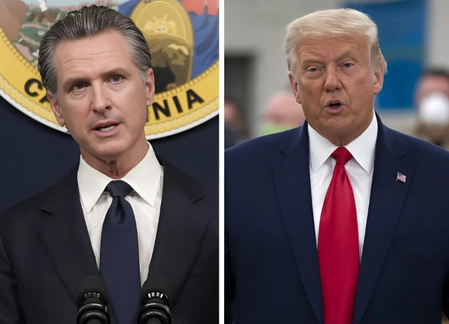
Los Angeles, April 17 (IANS) California Governor Gavin Newsom has announced that the western US state which has the largest economy in the nation is suing the Trump administration over the President's sweeping "unlawful tariffs" on international trading partners.
"President Trump's unlawful tariffs are wreaking chaos on California families, businesses, and our economy -- driving up prices and threatening jobs," Newsom said on Wednesday in a statement, adding that "We're standing up for American families who can't afford to let the chaos continue".
"Donald Trump does not have the authority to impose these destructive and chaotic tariffs. America stands to lose too much," said the Governor in a post on social media platform X.
"We're taking him to court," said the Governor.
"California is the largest manufacturing state in our union, one of the largest trading partners around the globe. No state will be impacted more than the state of California as it relates to the unilateral authority that's been asserted by the Trump administration to impose the largest tax increases in modern American history," he noted.
Newsom said that "In America, forty per cent of goods movements in this country come through two ports of entry in California. About 50 per cent of that from China itself".
In the lawsuit, expected to be filed in the US District Court for the Northern District of California, California officials will argue that the law, known as the International Emergency Economic Powers Act, which Trump cited to impose the tariffs, does not grant him the ability to unilaterally adopt those tariffs.
California, also the most populated US state, is the first state in the nation to sue Trump administration on tariffs, Xinhua news agency reported.
The Golden State is the largest importer among all US states, with more than $675 billion in two-way trade supporting millions of jobs throughout the state.
Mexico, Canada and China are California's top three export destinations, buying nearly $67 billion in California exports, which was more than one-third of the state's $183 billion in exported goods in 2024, according to the data released by the Governor's office.
--IANS
int/khz
Centre issues norms for setting up CoE to boost R&D in critical minerals

New Delhi, April 16 (IANS) The Ministry of Mines on Wednesday issued the guidelines for setting up of Centres of Excellence (CoE) under the National Critical Mineral Mission to promote research and technology development in critical minerals.
Critical raw materials form the crucial supply chain for emerging sectors of clean energy and mobility transition, in addition to advanced technology and strategic sectors like electronics, defence, electric vehicles and space.
In order to develop, demonstrate and deploy technologies in an end-to-end systems approach, it is essential to conduct R&D so as to reach higher Technology Readiness Levels (TRL). The Centres of Excellence (CoE) will identify, develop and implement extraction process and beneficiation technologies for a host of critical minerals from multiple sources and conduct directed R&D to reach TRL 7/8 pilot plant and pre-commercial demonstration and create a competency centre, according to an official statement.
Under this new initiative, reputed academic/R&D institutions, as per eligibility prescribed, will be evaluated and recognized as CoEs for R&D in critical minerals. CoEs will undertake innovative and transformational research to strengthen and advance the nation’s science and technology capability in the area of critical minerals. CoEs will aim at undertaking cutting edge research and promoting inter-/multi-disciplinary approaches to problem solving in critical minerals domain, the statement explained.
A CoE will operate as a consortium, on a hub and spoke model, to leverage R&D in critical minerals and pooling the core competence of each constituent under one umbrella. The CoE (Hub Institute) will bring in at least two industry partners and at least two R&D/ academic partners in the consortium.
As part of the process to recognize CoEs, the Ministry will call for proposals from eligible institutes shortly, the statement added.
The Union Cabinet had approved the launch of the National Critical Mineral Mission with an outlay of Rs.16,300 crore and expected investment of Rs.18,000 crore by public sector undertakings.
The mission aims to reduce the dependence on import of critical minerals and ensure self-reliance. Currnently China is the dominant producer of critical minerals and enjoys a near-monopoly over this crucial raw material required for advanced technology products.
The National Critical Mineral Mission encompasses all stages of the value chain, including mineral exploration, mining, processing and recovery from end-of-life products. The mission will intensify the exploration of critical minerals within the country and in its offshore areas. It aims to create a fast-track regulatory approval process for critical mineral mining projects.
Additionally, the mission will offer financial incentives for critical mineral exploration and promote the recovery of these minerals from overburden and tailings.
--IANS
sps/na