

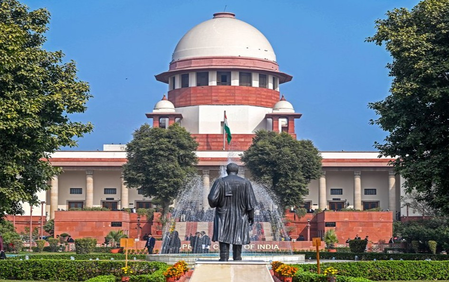
New Delhi, April 16 (IANS) The Supreme Court has clarified that persons excluded from the revised electoral rolls during the Special Intensive Revision (SIR) exercise in poll-bound West Bengal will be entitled to vote only if their appeals are allowed by the Appellate Tribunals before the stipulated cut-off dates.
While ruling that the mere pendency of appeals will not confer voting rights, a Bench headed by Chief Justice of India (CJI) Surya Kant said that if the Appellate Tribunals allow an appeal and direct inclusion in the electoral roll, such directions must be implemented before polling through the publication of a supplementary revised electoral roll.
“There is thus no gainsaying that… if an appeal is allowed by the Appellate Tribunal and a conclusive direction for inclusion or exclusion is issued, such directions shall be duly effectuated prior to the State of West Bengal proceeding to polling,” the apex court said in its order passed on Monday.
Invoking powers under Article 142 of the Constitution, the CJI Kant-led Bench directed the Election Commission of India (ECI) to give effect to appellate orders by issuing supplementary revised electoral rolls wherever appeals are decided by April 21 or April 27, depending on the relevant phase of polling.
“All necessary consequences with respect to the right to vote shall follow,” the top court said. However, the Supreme Court made it clear that excluded persons whose appeals remain pending before the Appellate Tribunals cannot claim voting rights merely on that basis.
“It goes without saying that the mere pendency of appeals preferred by excluded persons before the Appellate Tribunals shall not entitle them to exercise their right to vote,” the CJI Kant-led Bench observed.
The observations were made while dealing with a batch of petitions filed by individuals whose names were deleted from electoral rolls and who sought the interim restoration of their names pending adjudication of their appeals.
Rejecting the prayer, the apex court said that once judicial officers entrusted with the SIR verification exercise had found such persons to be not genuine, the earlier presumption attached to their inclusion in the electoral roll stood displaced.
“In our view, the prayers… run contrary to the scheme laid out by this Court, inasmuch as, upon verification by the Judicial Officers… the petitioners have been found to be not genuine,” the CJI Kant-led Bench said.
In its order, the top court recorded that over 34 lakh appeals have already been filed before the Appellate Tribunals, including by persons alleging wrongful exclusion as well as objectors challenging fresh inclusions in the revised voter list.
Observing that allowing excluded persons to vote merely because their appeals are pending would create an anomalous situation, the CJI Kant-led Bench said objectors may then similarly seek disenfranchisement of persons whose names remain on the rolls despite pending challenges.
“The resultant situation would effectively recreate the very state of affairs that existed prior to the entrustment of the verification exercise to the Judicial Officers,” it said.
The apex court further recorded that all 19 Appellate Tribunals constituted pursuant to its earlier directions are now fully functional and operating under a Standard Operating Procedure framed by a committee of former judges.
Earlier, the Supreme Court had directed constitution of Appellate Tribunals comprising former High Court Chief Justices and judges to hear appeals against exclusions from electoral rolls during the SIR process, holding that decisions of judicial officers conducting the revision exercise could not be challenged before executive or administrative authorities.
The batch of petitions challenging the SIR process in West Bengal is slated for further hearing on April 24.
–IANS
pds/dan