

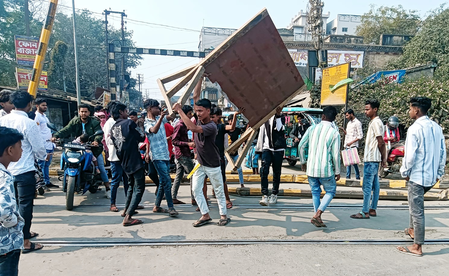
Kolkata, April 20 (IANS) The National Investigation Agency (NIA) on Monday approached the Calcutta High Court in the Beldanga violence case, challenging the decision of a lower court, which had granted conditional bail to 15 accused people.
The NIA has alleged that the accused were granted bail, ignoring the Supreme Court’s directives. The agency claimed in the High Court that the lower court cannot grant bail in this way during the investigation.
The 15 accused were given bail after the agency failed to file a charge sheet within 90 days.
According to the law, the charge sheet must be filed against the arrested persons within a specified period. But even after 90 days, the National Investigation Agency (NIA) had not been able to file a final charge sheet or a relevant report on the investigation. The officials of the agency even failed to answer the court’s questions about the progress of the investigation. In this situation, the lawyers of the arrested persons applied for bail. A special court granted bail to the 15 accused on a bond of Rs 10,000. However, several conditions were imposed on their movements.
The matter will come up for hearing on Tuesday. It will be clear whether the lower court’s verdict will be upheld or the NIA will get back the custody of the 15 with the intervention of the High Court.
On Saturday, a special court of the NIA granted conditional bail to 15 of the 35 accused in connection with the violence that erupted at Beldanga in West Bengal’s minority-dominated Murshidabad district earlier this year.
The violence and riot-like situations surfaced at Beldanga in January this year over the death of a migrant worker in neighbouring Jharkhand. The tension flared up after the body of the migrant worker reached Beldanga.
The local protesters alleged that the migrant worker was lynched in Jharkhand because of religious and linguistic reasons. The protests started with the blockade of railways and roads at Beldanga.
When the police tried to lift the blockade, the protesters set up an ambush with the security personnel. Some journalists were also attacked by the protesters, some of whom got severely injured.
Later, the Jharkhand Police issued a statement, citing the post-mortem report that termed the migrant worker’s death a case of suicide.
Cricketer-turned-politician and the local Trinamool Congress Lok Sabha member, Yusuf Pathan, faced scathing criticism for not being present in the area or even in the state when the entire place was burning.
Later, the Leader of Opposition in the West Bengal Assembly, Suvendu Adhikari, filed a petition in the Calcutta High Court demanding deployment of Central Armed Police Forces (CAPF) at Beldanga and also handing over the investigation in the matter to the NIA.
The matter went to the Supreme Court, which also agreed with the Calcutta High Court that if the Union Home Minister thought it necessary, it might ask the NIA to start the investigation into the matter.
Finally, the NIA started the investigation into the matter.
–IANS
sch/dpb