

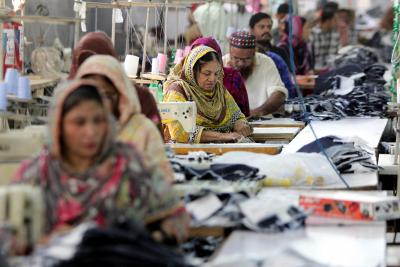
New Delhi, Nov 16 (IANS) Amid prolonged labour unrest in Bangladesh’s readymade garment (RMG) sector, the country’s apparel exports to the European Union fell 11.91 per cent to Euro 13.48 billion in January-September 2026, compared with the corresponding period last year.
According to ‘The Daily Star’, exports were down 20.89 per cent in January-April and nearly level in May-August at 1.25 per cent; in September alone, they fell 9.49 per cent, the report said, quoting Eurostat data.
During this period, the volume fell 5.74 per cent, and the unit price fell 6.54 percent to Euro 13.70 per kg, about 30 percent below the EU average, it stated, adding that lower prices caused slightly more than half of the lost value, while Bangladesh’s share of EU imports fell from 21.10 percent to 19.06 percent.
Separate reporting indicated that heavy reliance on cotton products, limited investment in artificial fibre, and growing energy and sustainability demands are undermining Bangladesh’s competitiveness in the EU market.
The RMG sector accounts for more than four-fifths of Bangladesh’s export earnings, making any disruption a matter of national economic concern, these add. Quoting industry voices, reports pointed to Bangladesh’s concentration on cotton-based products leaving it at a disadvantage against competitors with stronger man-made fibre capabilities.
China and Vietnam develop more extensive facilities for producing man-made fibre garments and benefit from integrated supply chains, including access to fabric from China, these add.
Meanwhile, RMG workers’ protests continue with demands centered around a substantial increase in the minimum monthly wage.
Protesting workers argue that the current minimum wage is no longer sufficient to cope with rising living costs, food prices, housing expenses, and inflation. It has evolved into a broader crisis involving inflation, factory closures, political uncertainty, and concerns over the sector’s long-term competitiveness.
Political developments have also contributed to the volatility: following the widespread unrest and transition of power in 2024, labour movements reportedly gained momentum across several industrial zones.
Industry observers note that the changing political landscape created an environment in which long-standing grievances regarding wages, employment security and working conditions resurfaced with renewed intensity.
In addition, reports of layoffs, delayed wage payments and factory closures have further fuelled worker dissatisfaction. The EU is also the most prominent market for Indian garment traders, with apparel exports peaking at USD 4.66 billion (approx. Euro 4.23 billion) during the 2025-26 fiscal year.
Available data suggest that while Bangladesh’s RMG sector is dominant globally, India features sixth amongst the largest apparel exporters.
India’s apparel exports to the EU and UK received a fillip with new trade agreements, where possible tariff reductions may address long-standing disadvantages. Currently, Indian exporters reportedly face a duty disadvantage of 10 to 12 percent as compared to rivals such as Bangladesh, Pakistan, and Turkey. But India’s advantage lies in its supply chain and its domestic production of large amounts of cotton and yarn.
For Dhaka, the path to tread is between reconciling garment workers’ demand for wage hikes and factory owners’ fear of losing the low-cost advantage that helps make Bangladesh a global apparel powerhouse.
The Bangladesh government has thus initiated several steps to address the crisis. Authorities have sought to restore order while maintaining production in export-oriented manufacturing zones, as policymakers argue that a negotiated settlement is essential to preserving investor confidence and sustaining export growth.
A Minimum Wage Board has been tasked with reviewing the payment structure for garment workers, urging workers to return to their jobs amid indications that a revised recommendation will be implemented following consultations with labour representatives and factory owners. Additionally, security has been beefed up in major industrial districts to prevent violence and keep factories operational.
–IANS
jb/dan