

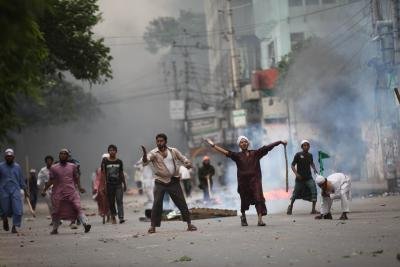
Dhaka: Bangladesh’s return to electoral politics has done little to settle the deeper questions surrounding its democratic future. The February 12 victory of the Bangladesh Nationalist Party (BNP) may have produced a government, but it has not resolved the growing crisis of political exclusion, institutional imbalance, and the steady contraction of democratic space.
At the center of this concern lies the exclusion of major political actors from the democratic process. The Awami League, one of the country’s oldest and most influential parties, along with several secular political groups, was prevented from participating in the elections. This followed a sweeping decision by the interim administration led by Muhammad Yunus to ban all activities of the Awami League under the Anti-Terrorism Act, pending the outcome of proceedings at the International Crimes Tribunal (ICT).
The Election Commission’s subsequent suspension of the Awami League’s registration formalised one of the most dramatic political exclusions in the country’s history. But the erosion of democratic space did not stop with political parties.
The legal basis for this move was reinforced through a May 2025 amendment to the Anti-Terrorism Act, which expanded the government’s authority from banning organizations to prohibiting all their activities. While governments may justify such provisions under exceptional circumstances, their sweeping application raises serious concerns about proportionality, due process, and political neutrality.
Equally troubling are developments concerning media freedom. International watchdogs and rights organizations have documented allegations of harassment, criminal cases, and administrative restrictions targeting journalists. Although Muhammad Yunus has acknowledged that some cases were initiated hastily, meaningful corrective action has yet to materialize.
Further concerns were raised by Deutsche Welle, which cited a report documenting widespread persecution of journalists during this period. According to the report, more than 354 journalists were harassed, 74 incidents of violence were recorded, 113 criminal cases were filed, and press credentials were revoked for 167 journalists. Officials of the interim regime dismissed the report as “misleading disinformation”, but such denials have become increasingly routine.
The resulting climate has created uncertainty and fear within sections of the media. The cumulative effect of these developments is a growing perception that Bangladesh’s political and institutional environment is becoming less inclusive. The most troubling paradox is that while independent journalists and secular political forces have been suppressed, Islamist extremist groups have enjoyed greater freedom. Ansar Al Islam, the Bangladesh affiliate of Al Qaeda, has openly justified the killing of secular writers and bloggers by labeling them “enemies of Islam”. At the same time, Islamist political platforms have grown increasingly assertive in calling for the implementation of sharia-based governance, with some explicitly invoking the model of Taliban-ruled Afghanistan.
Historically, the country’s resilience against extremism has depended on its pluralistic political culture, active civil society, and relatively vibrant media landscape. Weakening these pillars risks creating a vacuum in the public sphere. Such a vacuum rarely remains empty. Analysts warn that it can be exploited by extremist groups seeking to expand their influence.
It may be noted that on December 29, 2025, Ben Saul, Special Rapporteur on the promotion and protection of human rights and fundamental freedoms while countering terrorism; Matthew Gillett, Vice-Chair on communications of the Working Group on Arbitrary Detention; and Margaret Satterthwaite, Special Rapporteur on the independence of judges and lawyers at the Office of the High Commissioner for Human Rights (OHCHR), in a letter addressed to Muhammad Yunus, Chief of the interim administration of Bangladesh, expressed concern over the banning of the Bangladesh Awami League through amendments to the Anti-Terrorism Act 2009 and the International Crimes (Tribunals) Act 1973.
The letter stated that these measures “reportedly impose unnecessary and disproportionate restrictions on the rights to freedom of association, peaceful assembly, expression, and participation in public affairs, and affect the right to a fair trial, contrary to Bangladesh’s obligations under the International Covenant on Civil and Political Rights (ICCPR)”.
In the letter, the OHCHR stated: “While we do not wish to prejudge the accuracy of these allegations, we are concerned that the reported restrictions on the activities of the Awami League and its leadership—including bans and limitations affecting their communications, and legislative measures enabling the suspension, dissolution, or asset seizure of organizations—may amount to unnecessary and disproportionate interference with the rights to freedom of association, peaceful assembly, expression, and participation in public affairs, as protected under Articles 19, 21, 22, and 25 of the ICCPR, ratified by Bangladesh on 6 September 2000. These measures may risk entrenching restrictions on political pluralism and democratic participation”.
Despite a clear request for a response, the administration of Muhammad Yunus chose silence over accountability. In the context of a detailed and formal communication from United Nations human rights mandate holders, such silence is not neutral—it is consequential. It signals not merely a reluctance to engage, but a deeper unwillingness to justify actions that stand accused of violating fundamental freedoms. In doing so, the government leaves unchallenged the grave assertion that its policies impose “unnecessary and disproportionate restrictions” on core democratic rights, including freedom of association, peaceful assembly, expression, political participation, and the right to a fair trial.
Recent developments suggest that certain Islamist organisations have become more vocal, advocating for a more rigid ideological framework for the state. While these groups do not represent mainstream public opinion, their ability to operate within a constrained political environment is a matter of increasing concern.
Parallel to these trends is the evolving role of the International Crimes Tribunal. Established to prosecute atrocities committed during the 1971 Liberation War, the tribunal has long symbolised Bangladesh’s commitment to historical justice. However, its expanding focus in the current political context — particularly in cases involving contemporary political figures — has prompted debate about its institutional credibility and long-term role.
Supporters of the government’s approach argue that accountability must extend to recent political developments, including those surrounding the unrest of 2024. Critics, however, caution that the perceived politicization of judicial processes risks undermining public trust and weakening institutions that were once widely respected.
For India, these developments are not merely internal matters within Bangladesh. As Dhaka’s closest neighbour and a key regional partner, New Delhi has a clear stake in a stable, democratic, and pluralistic Bangladesh. Political instability or ideological radicalization in Bangladesh has historically had spillover effects, including implications for border security, regional cooperation, and counterterrorism efforts.
The broader challenge for Bangladesh, therefore, lies in striking a balance between accountability and inclusivity. Democratic consolidation requires more than the conduct of elections; it depends on the participation of diverse political voices, adherence to the rule of law, and protection of fundamental freedoms, including press freedom.
Encouragingly, Bangladesh retains strong societal foundations and a history of resilience. However, the current trajectory suggests the need for course correction. Restoring confidence in institutions, ensuring a level political playing field, and safeguarding space for dissent will be essential steps toward preventing further polarization.
Without such measures, the risk remains that political exclusion could deepen divisions — and in such an environment, extremism often finds its opportunity. The choices made now will shape not only Bangladesh’s democratic future but also the stability of the wider region.
History is clear: extremism does not rise in a vacuum — it rises when democratic space is deliberately closed. By sidelining secular politics, intimidating journalists, and blurring the line between justice and retribution, Bangladesh risks enabling the very forces it once fought to contain. If corrective steps are not taken now, today’s political contraction could become tomorrow’s security crisis.
(The writer is an award-winning journalist, writer, and editor of the newspaper Blitz. He specialises in counterterrorism and regional geopolitics. Views expressed are personal)
–IANS
/as