

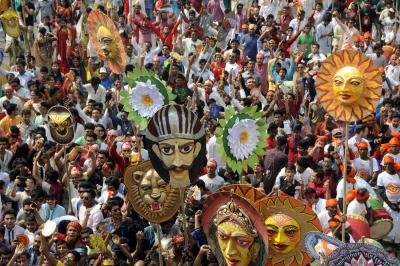
Dhaka, April 13 (IANS) Extending greetings to the people of Bangladesh on Pohela Boishakh marking the Bengali New Year, former Prime Minister Sheikh Hasina on Monday said that “anti-liberation and unconstitutional” forces have repeatedly sought to undermine the festival — a trend she said continues to persist.
“Pohela Boishakh is the foremost festival of Bengali national heritage. On this day, with the message of renewal, people awaken in joy, leaving behind sorrow, decay, failure, and gloom. What began as a harvest-based calendar during the Mughal era has, over time, evolved into a defining cultural celebration for all Bengalis. Regardless of religion or ethnicity, it is now a festival of the global Bengali community,” read a statement issued by Hasina which was posted by the Awami League on its social media platforms on Monday.
Recalling the cultural repression in East Pakistan, Hasina said, “In undivided Bangladesh, the Pakistani government attempted to sever Bengalis from their roots by obstructing the celebration of Pohela Boishakh. They also tried to prevent the centenary celebration of Rabindranath Tagore, the foremost literary figure of the Bengali language. As a result, in independent Bangladesh, Pohela Boishakh became a symbol of national awakening, unity, and harmony among the people.”
The former Bangladesh PM highlighted that the Mangal Shobhajatra, a traditional mass procession during Pohela Boishakh, has been inscribed as part of world heritage, with UNESCO granting the recognition during the tenure of the Awami League government.
She added that her government also introduced the “Boishakhi allowance” for employees on the occasion of the festival.
Expressing concern, Hasina said, “We have observed that anti-liberation and unconstitutional forces have sought to undermine this festival — efforts that continue even today. They have even dared to attempt renaming the Mangal Shobhajatra. Rooted in the agrarian traditions of harvesting new crops, this celebration has evolved over centuries into the New Year festival. In many countries — such as China and Iran — New Year celebrations remain the principal national festivals.”
Asserting that the festival reflects an “anthropological tradition”, she said, “Using religion as a tool to obstruct this celebration is simply another form of division.”
Hasina expressed hope that the continued celebration of Pohela Boishakh would contribute to the re-emergence of a secular Bangladesh.
–IANS
scor/as