

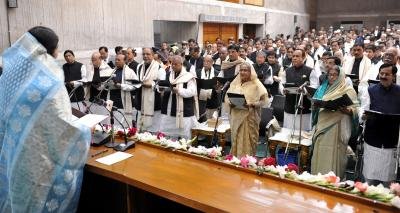
Dhaka, April 8 (IANS) Bangladesh’s electoral landscape highlights a persistent gender gap, with women active as voters, but their transition to leadership roles remains alarmingly slow, the United Nations Development Programme (UNDP) had recently highlighted.
A dialogue held in Dhaka last month opened with a symbolic performance titled ‘Women to Discover, Develop, and Lead’, jointly presented by UNDP and the Bangladesh Election Commission (BEC) to promote women’s voices in the democratic process.
Highlighting the striking disparity, the UNDP noted that Bangladesh’s Representation of the People Order (RPO) mandates 33 per cent female representation in political party committees by 2030, while the current level stands at a mere 2.33 per cent, prompting calls for immediate and concerted action.
Bangladesh’s Election Commissioner, Anwarul Islam Sarker, placed the responsibility squarely on political parties, stating, “Political parties must take more initiatives regarding nominations for women candidates. The Election Commission acts as a referee; without initiatives from both sides, progress is not possible.”
The UN agency said that other leaders also echoed the call for a cultural shift within political structures during the session.
The dialogue emphasised that the solution extends beyond quotas to creating an environment where women can safely and confidently step into public life.
Election Commissioner, Tahmida Ahmad, emphasised that “good governance and proper implementation of law enforcement are essential to ensure safety, which will encourage women’s participation.”
The gains from this shift extend far beyond political equity, with Bangladesh Chief Election Commissioner A M M Nasir Uddin offering a “compelling economic perspective”, noting that “if women’s unpaid household work were monetised, Bangladesh’s GDP could triple”.
UNDP’s Resident Representative, Stefan Liller, added, “When women lead, democracy becomes stronger, and communities and societies prosper. International Women’s Day reminds us that a strong democracy depends on women participating fully, not only as voters but also as leaders and decision-makers.”
The dialogue concluded with a renewed partnership between UNDP and the BEC, signalling a shared commitment to advancing the institutional reforms and sustained advocacy.
Emphasising the broader message, the UNDP said, “Advancing women’s political leadership is not just a matter of rights or justice, but a fundamental necessity for the prosperity and strength of Bangladesh’s democracy.”
–IANS
scor/as