

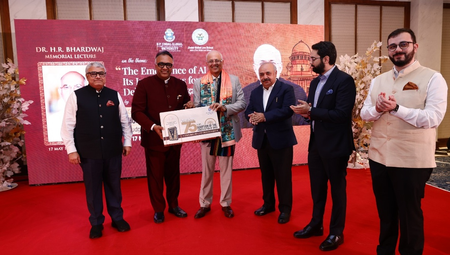
New Delhi, May 19 (IANS) “AI needs institutional oversight and enforceable accountability in law”, said the Hon’ble Justice Manmohan, Judge, Supreme Court of India, at the Dr. H.R. Bhardwaj Memorial Lecture on the theme: The Emergence of AI and Its Implications for Justice Delivery and Legal Systems held at O.P. Jindal Global University.
“What is needed is that human judgment must remain central, even with the use of AI. India requires a clear regulatory framework for judicial AI, and it must be developed in the Indian context. Capacity building within the judiciary will be required, and universities will have to develop courses on ethical, constitutional, and procedural dimensions of AI deployment,” he added.
Justice Manmohan paid tribute to Dr. H.R. Bhardwaj and said, “Dr. H.R. Bhardwaj was a multifaceted personality. He was an author and a senior advocate designated by the Supreme Court. He was a Member of Parliament five times and a minister for 15 years under three Prime Ministers. He belonged to a generation where people across the political divide could be friends. His question across five decades was always the same: How do we bring justice to every Indian? And he believed in technology. In fact, the first phase of the programme, the e-Mode Phase One, which is being implemented in the Supreme Court, was launched while he was the law minister. Technology and law have always had a very symbiotic relationship, where technology has challenged fundamental concepts of law. All our laws, when they were promulgated, we were dealing with a physical world. Today we live in a digital world. So, when we are applying these laws, are we doing the right thing by applying the same principles? Or do we need a different set of principles?
“AI, the artificial intelligence as we call it, is also demanding the same reckoning, but at a pace which is unimaginable and at a scale which is also unbelievable due to its evolving nature. If a computer software programme operates according to rules defined in advance by the programmers, it is not an AI system. But if a system is built using techniques that allow the programme to create rules of its own based on input data or data sets provided to the programme, then it is an AI system. Today, the question is no longer whether they will be used or not. The question is whether their use will be structured by clear principles of institutional oversight and enforceable accountability. Keeping in view the importance of AI, the Supreme Court has constituted an AI committee, chaired by a sitting judge of the Supreme Court, to lay down a broad strategy and policy with adequate guardrails.”
“The Supreme Court’s White Paper on AI and judiciary, released by the Centre for Policy Research and Planning in November 2025, is an authoritative statement of where the institution currently stands. The paper positions AI as an assisted technology capable of supporting legal research, transcription, translation, filing, scrutiny, and administrative analytics, while firmly stating that judges must remain the ultimate decision makers with every AI output subject to human verification. In consonance with our constitutional mandate, there is human oversight throughout the process. There is also the issue of privacy. Data is collected by consent or not, but what are the inferences that are being drawn, and whether the individual who has given their consent is even aware of the downstream consequences?”
In his Welcome Address, Prof. (Dr.) C. Raj Kumar, Founding Vice Chancellor, O.P. Jindal Global University, said, “This is an occasion of remembrance, gratitude, and reflection, a tribute to a statesman, a constitutionalist, a mentor, an institution builder, and above all, a remarkable human being. It was a dream to be able to come to India and be part of an effort to build a world-class university. I had not known H.R. Bhardwaj before. I wrote to him and shared with him the idea of creating a university in India. This is how the idea of establishing O.P. Jindal Global University began. I want to begin by expressing this deep sense of institutional gratitude from the bottom of my heart and also from the hearts of more than 16,000 students, 4,000 faculty members, and the staff of O. P. Jindal Global University. Dr. Bhardwaj believed that India deserved a truly global university. A university rooted in Indian values but globally engaged. A university committed to constitutional morality, public service, and intellectual excellence. He had extraordinary faith in the transformative power of youth and education. Bharadwaj’s contribution is quite extraordinary. He had a deep commitment to the Constitution of India and dedicated his life to preserving democratic values. He oversaw significant legal and judicial reforms and promoted modernization within legal institutions. He supported the expansion of legal aid and initiatives and was a strong advocate for world-class legal education in India. A number of his writings, including books, reflected the idea of India’s history, civilization, and heritage. He believed education must cultivate humanity and compassion. Legacies survive not only through institutions, but through families preserved through values and memories, and today I also pay tribute to his family for their support.”
Karn Bhardwaj, Advocate, shared his reflections on his illustrious grandfather, Dr. H.R. Bhardwaj, and said, “Today is very meaningful for us because not only are we here with our near and dear ones, but it’s also the birth anniversary of my grandfather, Dr. H.R. Bhardwaj. The digitization of the courts and the use of AI are very new and very fast-evolving aspects of legal practice. And it is something that everybody is engaging with. New entrants into the legal profession come with a very different mindset: they are technology-driven. They believe in electronic case management. And they are really very differently evolved as professional individuals. And as a lawyer in my generation, I believe that this mindset transition has come not just because of access to technology but because of the integration of technology into the legal profession. Today, technology is so deeply integrated in law, and I’m proud to say that the late Dr. H. R. Bhardwaj has had a founding role in the implementation of technology in our justice system as it stands today.”
Also present at the Memorial Lecture were members of his family, including his wife, Dr. Prafullata Bhardwaj, his son Arun Bharadwaj (Senior Advocate), and grandchildren Karn Bhardwaj (Advocate) and Gautam Bhardwaj (Advocate).
Dr. Hans Raj Bhadwaj (17th May 1937 – 08th March 2020), former Governor of Karnataka and Kerala (2012-13), former Union Minister of Law and Justice (2004-2009), was an inspirational leader, eminent lawyer, humanitarian, educationist, and politician who leaves behind a remarkable legacy.
In a legal and political career spanning over five decades, as a five-time Member of Parliament (Rajya Sabha, 1982-2009), Dr. Bhardwaj served under several Prime Ministers. Dr. Bharadwaj also played a founding role in establishing the International Centre for Alternative Dispute Resolution (ICADR) and has been at the helm of legal and judicial reforms, including women’s right to property, introduction of rural courts for doorstep justice, reservation for women in the House of the People (Lok Sabha) and legislative assemblies, perks and privileges for the judiciary, etc.
The Concluding Remarks were given by Prof. Dabiru Sridhar Patnaik, Registrar, O.P. Jindal Global University.
–IANS
skp/