

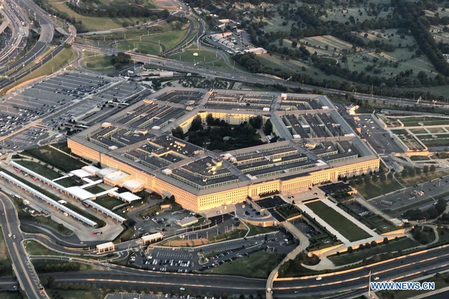
Washington, May 15 (IANS) The Pentagon is aggressively restructuring its science and technology apparatus around artificial intelligence, autonomous systems and low-cost weapons as senior US defence officials warned lawmakers that future battlefields will be defined by speed, data dominance and mass deployment of affordable combat systems.
At a House Armed Services subcommittee hearing on science, technology and innovation posture, senior Department of Defense officials said the US military was racing to integrate AI-enabled systems across combat operations while competing against rapid advances by China and other adversaries.
“We’re moving from a fragmented, siloed innovation ecosystem to a single, unified model designed to transition technology from the lab to the warfighter,” Emil Michael, Under Secretary of Defence for Research and Engineering, told lawmakers.
Michael said the Pentagon had reduced its list of “critical technology areas” from 14 to six to sharpen focus on what he described as the technologies most likely to define future conflicts. Those areas include applied artificial intelligence, contested logistics technologies, quantum systems, battlefield information dominance, directed energy and scaled hypersonics.
The hearing reflected growing bipartisan concern in Washington that the US risks losing its technological edge as China rapidly expands investments in AI, autonomous weapons and military-industrial capacity.
Cameron Stanley, chief data and artificial intelligence officer at the Pentagon, said AI-enabled systems had already been deployed extensively during “Operation Epic Fury”, helping US forces strike “more than 13,000 targets in 38 days”.
“What once took days now takes seconds,” Stanley said.
He said Pentagon engineers and warfighters were now working side by side to rapidly deploy battlefield AI tools through systems such as the Maven Smart System, an AI-enabled command-and-control platform already being used across combatant commands and operational theatres.
Stanley also warned that China was investing “upwards of $300 billion in energy and compute infrastructure to develop sovereign AI”, describing global competition over AI infrastructure as an emerging arms race.
Lawmakers from both parties repeatedly referenced lessons from the Ukraine war, particularly the rapid evolution of drones, electronic warfare and autonomous systems.
Owen West, director of the Defense Innovation Unit, said the Pentagon was shifting away from reliance on expensive “exquisite” weapons towards a mix that included cheaper mass-produced systems.
“While we are winning every engagement, we are losing on the cost exchange,” West said.
He said the Pentagon’s new “Drone Dominance” initiative was designed to accelerate deployment of low-cost autonomous systems using commercial technology and venture-backed start-ups. According to West, 23 of the 25 finalists in the programme were new entrants or start-ups.
Michael said the Pentagon had recently signed contracts with five new companies to build low-cost munitions using fixed-price arrangements instead of traditional “cost-plus” contracts.
Several lawmakers raised concerns about autonomous weapons oversight and civilian harm mitigation as AI systems become more integrated into military targeting operations. Pentagon officials insisted that human decision-making remained central to the use of force.
The hearing comes as the Pentagon faces mounting pressure to modernise faster amid growing military competition with China in the Indo-Pacific. US defence planners increasingly view AI, drones, cyber warfare and autonomous systems as decisive technologies for future conflicts, particularly after battlefield lessons emerging from Ukraine and the Middle East.
–IANS
lkj/rs