

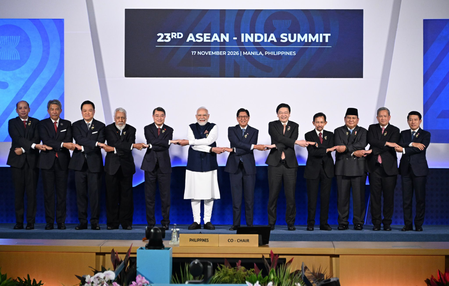
Manila, Nov 17 (IAS) The member states of the Association of Southeast Asian Nations (ASEAN) and India on Tuesday agreed to enhance cooperation on early warning systems for earthquakes, tsunamis, floods, cyclones and landslides, including through the sharing of satellite data, seismic monitoring information and meteorological forecasts, on a voluntary basis and in accordance with national laws and regulations.
A Joint Statement on Disaster Preparedness and Management was adopted between the two sides during the 23rd ASEAN-India Summit in the Philippines’ Manila with the participation of leaders of ASEAN Member States, Prime Minister Narendra Modi and ASEAN Secretary-General Kao Kim Hourn.
Both sides reaffirmed commitment to strengthening cooperation in disaster management and enhancing regional resilience and also agreed to support the use of space-based data and applications, building on ongoing ASEAN-India Space Cooperation, for disaster risk assessment, monitoring and forecasting. They agreed to strengthen regular consultations between the ASEAN Committee on Disaster Management (ACDM), the AHA Centre and India’s National Disaster Management Authority (NDMA) to promote complementarity between respective disaster management mechanisms.
According to the statement on Cooperation in Disaster Management, India and the member states of ASEAN agreed to explore modalities for regular consultations within existing ACDM mechanisms to review cooperation and identify priority areas for joint action.
The two sides agreed to strengthen joint preparedness through regular training exercises, simulation drills and the exchange of disaster response personnel between ASEAN Member States and India, including through joint exercises. Both sides agreed to facilitate the rapid deployment of Humanitarian Assistance and Disaster Relief (HADR) upon the request or with the consent of the affected Member State, utilising existing mechanisms.
India and the ASEAN member states agreed to enhance armed forces and civil defence agencies within the ADMM-Plus framework on humanitarian assistance and disaster relief in accordance with their respective mandates, recognising the primary role of civilian authorities and the use of military assets as a last resort, according to the joint statement.
Both sides agreed to share experiences and best practices on post-disaster recovery and environmentally sustainable practices. They agreed to support capacity building for people in vulnerable situations, and promote the meaningful participation of women, youth, older persons and persons with disabilities in disaster preparedness and recovery, consistent with relevant work programme.
“Promote cooperation in advancing sustainable resilience, including through risk-informed governance, investment in resilience, resilient infrastructure, science, technology and innovation, and people-centred approaches, in line with national laws and regulations,” the ASEAN-India joint statement on Cooperation in Disaster Management stated.
–IANS
akl/as