

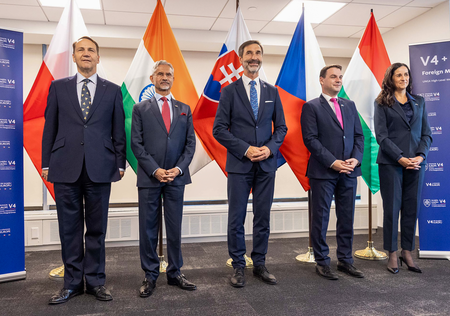
New Delhi: The meeting between Indian External Affairs Minister (EAM) S Jaishankar and the foreign ministers of Poland, Hungary, the Czech Republic, and Slovakia on the sidelines of the 81st session of the United Nations General Assembly (UNGA) in New York on September 21 has been described as a “historic occasion”.
In some way, it is: the Visegrad-4, the group of these four countries, has agreed to hold annual foreign minister-level meetings. It has also agreed to establish an annual business forum to deepen cooperation in technology, defence, space, and connectivity.
Slovakia’s Foreign Minister Juraj Blanar said that all four V4 countries agree that India should have a permanent seat in the UN Security Council. It is a general consensus amongst policy planners, scholars and journalists that while most of the UNGA side meetings are part of routine diplomacy and function as a stocktaking of the relationship, some of them become historic, so a closer reading always provides a fresh perspective and that too at a time when the V4 is trying to work as a regional grouping after a great rupture and India is working out a different kind of relationship with Europe’s Central Eastern flank.
Talking about the history, India’s ties with this part of Europe are older than the Visegrad grouping and even before India’s independence. During the Second World War, the Maharaja of Nawanagar sheltered hundreds of Polish children at Balachadi near Jamnagar, and a larger Polish settlement emerged at Valivade near Kolhapur, a story that Warsaw still remembers with gratitude. Rabindranath Tagore travelled to Hungary in 1926, and Amrita Sher-Gil was born to a Hungarian mother. Her Hungarian husband lived and died on the outskirts of Eastern Uttar Pradesh. In the Cold War years, when all four were in the Soviet bloc, the relationship took a more practical shape, as Czechoslovak industry and Polish shipyards and aircraft factories supplied the Indian armed forces with everything from armoured vehicles to Iskra jet trainers and landing ships.
When EAM Jaishankar mentioned in New York that India has a very strong defence history with every V4 country, he was alluding to these historical facts. This strong trade and defence relations with India to these countries, which changed after the fall of the Iron Curtain, as these states looked more Westward for their economic expansion, and V4 was the result of the same, formed at Visegrad, Hungary in 1991 with a simple purpose, to help these post-communist states return to Europe. This purpose was fulfilled when all four joined, first NATO and then the European Union in 2004.
The grouping served as a regional pragmatic minilateral among the EU, NATO, and the UN but took a different avatar after the 2015 migration crisis. The populist zeitgeist already taken shape in this part of the world, the V4 became known in Brussels as the bloc that said no to refugee quotas, to what it saw as interference on the rule of law, and to a more federal Europe, with Viktor Orban’s Hungary and the PiS government in Poland setting the tone. For almost a decade, the V4 was read, fairly or not, as the capital of European populism. Russia’s full-scale invasion of Ukraine in 2022 broke that alignment. Warsaw saw Moscow as an existential threat while Budapest kept its lines to the Kremlin open, and the grouping more or less stopped functioning.
The reset in the V4 grouping came this year as Peter Magyar won a landslide election in April, ending Orban’s 16-year tenure, and in June the four Prime Ministers met at Godollo, where they agreed to coordinate in EU forums, including resuming regular consultations ahead of European Council meetings. The reset must not be read just from ideological point of view because while Poland’s Prime Minister Donald Tusk and Magyar belong to the same centre-right European People’s Party, the other two heads of state, namely Andrej Babis of Czechia and Robert Fico of Slovakia, are sovereigntist populists who would have been at home in the old V4.
While their ideas may or may not collide, they come together to preserve their interests within the wider EU framework. At the next EU budget scheduled for December, they signalled a joint challenge to EU policies that are increasing energy prices. Till now, the V4 states used the grouping very pragmatically as a pressure group when required, but when interests diverged while being part of the group, they have kept individual state preferences at the forefront. The group’s Indian engagement is important for it, as it will elevate the group’s standing as a regional stakeholder post-rupture.
This is where Russia’s question becomes an important part of India’s European puzzle. India’s engagement with Europe currently moves on two tracks. With France, Germany and the Nordic countries, the relationship is largely about trade, technology and investment. With the frontline states, Russia is the existential fact of their politics. The sequence of the last month shows how India is handling this second track. EAM Jaishankar was in Moscow on August 23 and 24, where he co-chaired the intergovernmental commission and met Russian President Vladimir Putin at the Kremlin.
Within 10 days, he was in Warsaw and Kyiv, his first standalone mission to Ukraine since the war began in February 2022. Putin then came to New Delhi for the BRICS summit, and a week later, EAM Jaishankar was with the V4 Foreign Ministers in New York.
India has always kept its relations with Russia and the rest of Europe in a very compartmentalised manner. As recently as January, when Radoslaw Sikorski was in New Delhi, the exchange was sharp, with EAM Jaishankar telling him that Poland should not help fuel terrorist infrastructure in India’s neighbourhood and that singling out India over Ukraine was unfair and unjustified.
Eight months later, Poland is part of a collective V4 endorsement of India’s Security Council bid, and preparations are underway for Tusk’s expected visit to India. There is a gradual de-hyphenation of India-Russia for Poland, which was a thorny issue in India-Poland’s relations.
It must also be noted that the V4 is not a single actor on Russia. All four share the geography of the eastern flank, but not the threat perception. Poland and, to a lesser extent, the Czech Republic see Moscow as the main danger, while Fico’s Slovakia holds views closer to New Delhi’s than to Warsaw’s, and Hungary under Magyar is still recalibrating.
Oddly, this works in India’s favour, because India can deal with a grouping whose members read Russia differently precisely because it does not ask any of them to choose. EAM Jaishankar seemed aware of this when he said that how the V4 come together is for them to decide, a careful line that protects India if the grouping fractures again. Poland, by its size and security role, is the pivot of this engagement rather than its typical member. But while the Polish media finds Prime Minister Narendra Modi’s ‘endless war to end of war’ remark as an anchor to reimagine the relationship, Slovakia’s which is still dependent on Russian gas, echoed energy security as a common point of interaction. This tells that differences in the grouping’s understanding of India vary depending upon their policy choices and constraints, but all of them want to make the arrangement work.
Japan and South Korea have had V4 Plus formats for years and their companies are already embedded in the region’s automotive and battery supply chains. The defence relationship can be refreshed through co-production under ‘Make in India’, drawing on old familiarity with platforms and industries. The business forum can make Central Europe an entry point into the wider EU market, and EAM Jaishankar himself linked the V4 initiatives to India’s deepening relationship with the European Union.
Politically, regular dialogue with four EU members on the central-eastern flank gives India a hearing in a region that, until recently, saw it mainly through the lens of its ties with Russia. The risks are equally clear. The revival is only a few months old, differences over Ukraine and other contested political issues among the four have not gone away, and the grouping could stall again.
Thus, the meeting in New York must be read as a stepping stone toward a working mechanism for dialogue with the region. If the annual meetings take place and Tusk’s visit goes ahead, the frontline track may prove to be the more durable part of India’s European story, though that will depend as much on whether the V4 stays together as on anything New Delhi does.
(The writer is a doctoral at the Centre for European Studies, School of International Studies, JNU. Views expressed are personal)
–IANS
/as