

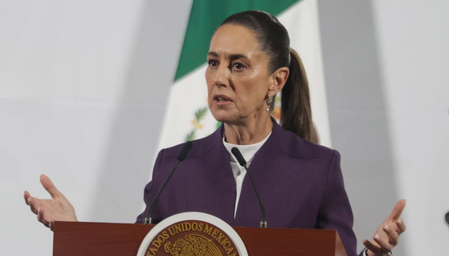
Mexico City, Sep 19 (IANS) Mexican President Claudia Sheinbaum said that she spoke by phone with US President Donald Trump on Wednesday to discuss progress in bilateral trade talks related to the United States-Mexico-Canada Agreement (USMCA).
Speaking at her daily press conference, Sheinbaum said the talks focused on bilateral relations and negotiations aimed at providing greater financial certainty for trade between the two countries, Xinhua news agency reported.
“We are making progress on trade issues,” Sheinbaum said, adding that the possibility of reaching a Mexico-U.S. agreement is advancing well and that the call with Trump was “very positive.”
Sheinbaum said the two sides had reached some agreements but that details would not be released until a final agreement is reached.
The next USMCA review meetings are scheduled for September 28 and 29 in Washington.
Earlier this month, President Sheinbaum vowed to defend the country’s sovereignty, dignity and independence.
“In Mexico, we want cooperation, dialogue and understanding with all nations, but cooperation does not mean submission, friendship does not mean renouncing our principles,” Sheinbaum had said during her second State of the Union Address held at the National Palace.
“And as long as I have the honour of serving as President of the Republic, I will steadfastly defend our sovereignty, our dignity, and our independence,” she said.
Sheinbaum acknowledged “difficulties” in Mexico-US relations, particularly those arising from the US mistreatment of migrants.
She noted 17 Mexican nationals have died at US immigration detention centres and many others have been arrested in immigration raids across the United States, adding that Mexico’s government has filed complaints and demanded respect for migrants’ rights.
In response to Washington’s mass deportations, according to Sheinbaum, her government has launched “Mexico te abraza” (“Mexico Embraces You”), a program that has helped more than 281,000 deported or repatriated Mexican nationals, offering them hot meals, transportation to their communities, medical and psychological care, and identification documents.
–IANS
int/rs