

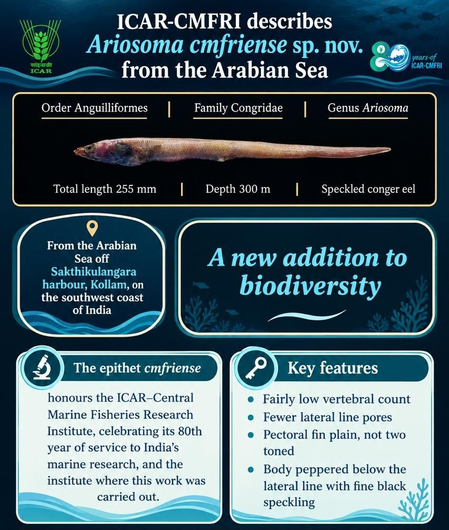
Kochi, Sep 16 (IANS) Scientists from the ICAR-Central Marine Fisheries Research Institute (CMFRI) have identified a new species of conger eel from the deep waters of the Arabian Sea and named it Ariosoma cmfriense after the institute.
The discovery comes in CMFRI’s 80th anniversary year.
The new species was collected from waters off Kollam at a depth of about 300 metres in January this year.
Scientists identified it as a distinct species through detailed morphological studies and molecular analysis.
The species was found to be different from the 12 recognised Ariosoma species reported from Indian and neighbouring waters.
The new eel has several distinct features. These include a relatively low total vertebral count of 135 and 127-130 lateral-line pores.
Its preanal length is nearly half its total length.
It also has two supraorbital pores and a dorsal fin that begins just ahead of the pectoral fin base.
The fish has a plain pectoral fin, a dark patch over the operculum, and fine black speckling below the lateral line.
The last feature has not been observed in the other related species, scientists said.
“The discovery is expected to offer new dimensions to India’s deep-sea research by strengthening scientific understanding of biodiversity and generating baseline information for resource conservation,” CMFRI Director Dr Grinson George said.
The discovery was made as part of research under the Deep Ocean Mission (DOM), a national programme of the Ministry of Earth Sciences.
Dr Rekha J. Nair, Principal Scientist at CMFRI and leader of the research project, said the commercial potential of the new species could be assessed only after detailed studies.
The holotype, or the specimen used as the reference for describing the new species, has been deposited at the CMFRI Marine Biodiversity Museum.
It will add to the institute’s collection of documented marine biodiversity.
A scientific paper detailing the discovery has been published in Zootaxa, an international journal specialising in animal taxonomy.
The discovery adds another species to the marine biodiversity recorded from the Arabian Sea and provides fresh data for understanding the region’s deep-sea ecosystems.
–IANS
sg/vd