

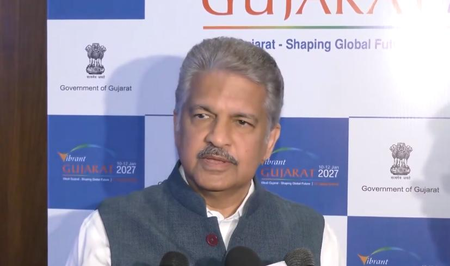
Mumbai, Sep 3 (IANS) Gujarat’s established industrial base and the scope for expanding into new sectors such as electric mobility, shipbuilding, advanced textiles and sustainable manufacturing emerged as key themes at a Mumbai investor interaction ahead of the Vibrant Gujarat Global Summit (VGGS) 2027.
Gujarat Chief Minister Bhupendra Patel held one-to-one meetings with senior industry leaders on Thursday and invited them to participate in the 11th edition of the summit, which will be held in Gandhinagar from January 10 to 12, under the theme ‘Viksit Gujarat – Shaping Global Future’.
The meetings also provided industry leaders an opportunity to reflect on their experience of investing in Gujarat and outline areas where they see scope for further expansion.
Mahindra Group Chairman Anand Mahindra recalled that his first meeting on investing in Gujarat took place in the same room with Prime Minister Narendra Modi, who was then the state’s Chief Minister.
“First of all, I am reminded that the first ‘Vibrant Gujarat Roadshow’, which was conducted by the then Chief Minister Modi, was held right here in this very room, and we were there. And look at the journey since then, what vision he had at that time and how far we have come,” Mahindra said.
He said he was pleased to meet Patel and discuss future investment plans in Gujarat.
Mahindra & Mahindra Managing Director and CEO Anish Shah said the group already had a presence in multiple sectors in the state, including tractor manufacturing, renewable energy, hospitality and industrial parks. “Gujarat is one of the most dynamic states, and we have a presence across multiple industries,” Shah said.
He added that the discussions covered larger industrial parks, manufacturing, GIFT City, culture and tourism, including opportunities to expand the group’s resort business.
Swan Energy Managing Director Nikhil V. Merchant said the company is “extremely satisfied” with its presence in Gujarat and currently operates three different businesses in the state — an LNG terminal, Pipavav Shipyard, now known as Swan Defence and Heavy Industries, and an older textile mill at Narol.
“All three businesses are doing well, and with the support and proactive policies of the government, I think we should be in good shape,” Merchant said.
He also spoke about the potential of India’s shipbuilding sector, saying the industry could create employment for lakhs of people.
He said India needed more shipyards to address the outflow of about USD 85 billion and estimated that at least 10 to 12 new shipyards would be required.
For Welspun, Gujarat remains central to its manufacturing operations. Welspun India CEO Dipali Goenka said around 80 per cent of the group’s investment was in Gujarat and that discussions with Patel focused on the company’s future expansion.
“So many FTAs are opening up for India now, which presents a huge opportunity for us. If Welspun expanded further, five per cent of the world’s home linen will come from Gujarat and Welspun,” she said.
Goenka also pointed to Gujarat’s wider industrial ecosystem, including green energy, start-ups, pipes and new technologies, saying the state was moving beyond traditional manufacturing.
Her comments came days after India reported real GDP growth of 7.8 per cent in the April-June quarter of 2026-27. Official data showed nominal GDP growth of 10.3 per cent during the quarter.
On the growth figures, Goenka said India’s expansion was being driven by consumption, industrialisation, manufacturing, artificial intelligence and smart factories.
“India’s growth story will also come from consumption. India’s growth story will also come from manufacturing and a self-sustaining ecosystem,” she said.
NAREDCO President Kamlesh Thakur also described the 7.8 per cent growth figure as a “pleasant surprise”, given the geopolitical challenges facing the global economy.
“The figure reinforced investor confidence in India’s ability to maintain growth despite external headwinds,” he said.
Thakur also outlined issues the real estate sector wanted the government to consider, including the cost of premiums and land acquisition for developers and GST rationalisation for redevelopment projects.
He said the industry had already made a representation to the RBI on the issue of premiums.
He further discussed the proposed ‘Mumbai 3’ vision, under which projects such as education and medical cities are being developed.
“‘Mumbai 3’ is a brilliant concept. CM’s advisor, Kaustubh Dhavse, was here. He made a presentation about making Edu City and Medi City. They have already signed contracts with 12 international universities. All of us have an aspiration to send our children abroad, so it’s becoming expensive, it’s draining the foreign exchequer, and with the kind of geopolitical… Adani’s going into supporting this type of ‘Mumbai 3’ vision of Government of Maharashtra is a great help, because not only they are making airports, they are making seaports, they are also making Aero Cities, which they just did the presentation. So, the whole ecosystem around the airports, Aero Cities in so many cities they are doing,” he said.
The Mumbai interaction comes as Gujarat intensifies preparations for VGGS 2027. The summit’s agenda includes emerging sectors such as artificial intelligence, semiconductors, green hydrogen, green energy and technology, alongside manufacturing and investment.
The roadshow thus brought together companies with long-standing operations in Gujarat and businesses examining their next phase of expansion, with discussions ranging from industrial parks and shipbuilding to textiles, renewable energy, EVs, GIFT City and tourism.
–IANS
mys/uk