

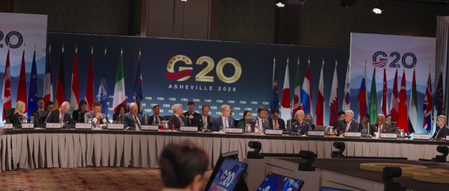
Asheville, Sep 2 (IANS) China blocked consensus at a meeting of G20 finance ministers and central bank governors after objecting to proposals targeting persistent trade imbalances and non-market economic practices, US Treasury Secretary Scott Bessent said.
The remaining 19 members backed a chair’s statement calling for countries with excessive external surpluses to remove policies that constrain domestic consumption and create an overreliance on exports. India was among the members supporting the statement.
“It is clear that the country with the world’s largest and unsustainable current account surplus, the People’s Republic of China, was the dissenter,” Bessent told reporters on Tuesday (local time) after the two-day meeting in Asheville, North Carolina.
“We have 19 other voices, and as I said, my chairman’s statement will echo that,” he said.
The statement said excessive and persistent imbalances could distort markets, weaken supply chains and create adverse effects in other economies. It called on countries to eliminate non-market policies and practices that deepen such imbalances.
China objected to four sections covering energy trade and the Strait of Hormuz, global economic imbalances, International Monetary Fund surveillance and sovereign debt restructuring.
Bessent said the agreement among the other members reflected growing international concern about economies that depend heavily on subsidised production and exports.
“Around the globe, we believe that non-market-based economies pushing out a never-ending stream of cheap exports is not sustainable,” he said.
“I think that the fact that 19 countries did want to address this shows the sheer enormity of the problem and that we agree,” Bessent added.
He stopped short of saying whether individual G20 members would introduce tariffs or other trade protections in response.
“I’m not going to presume to say what the other countries would do,” he said. “So the way forward will be for all the individual countries, but we do see that there is great alignment.”
The chair’s statement said countries with excessive external surpluses should remove distortions that restrict domestic consumption and make exports an outsized source of growth. It also called on countries with persistent deficits to support domestic savings and pursue fiscal consolidation.
The members asked the IMF to strengthen its examination of the causes of global imbalances, including distortive economic policies and their spillover effects. They also sought more detailed scenario analysis showing the cost of failing to act.
Bessent said the inability to secure unanimity did not diminish the outcome of the meeting.
“I do think it is incredible to get 19 countries to agree to anything,” he said.
The meeting also addressed private sector-led growth, sovereign debt, financial literacy, artificial intelligence and financial regulation. Business leaders joined finance ministers and central bank governors for the first time in the history of the G20 Finance track, according to Bessent.
“For the first time in G20 history, business leaders joined ministers and central bank governors to discuss the practical barriers they encounter as they invest, innovate, and grow,” he said.
The G20 brings together 19 major economies along with the European Union and African Union. Its members account for most of the world’s economic output, international trade and population. Members normally reach decisions by consensus, but they are not legally binding.
India held the G20 presidency in 2023 and secured a leaders’ declaration in New Delhi despite divisions over the war in Ukraine. The United States holds the presidency in 2026, with economic growth, global imbalances, sovereign debt and financial innovation among its Finance track priorities.
–IANS
lkj/sd/