

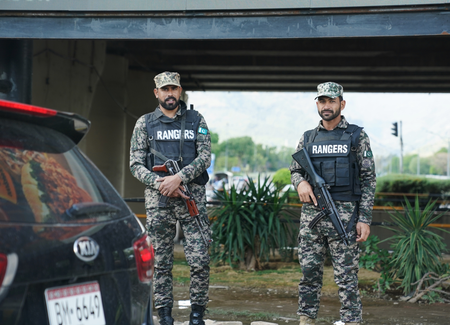
Kabul, July 15 (IANS) Pakistan has been facing insurgency inside its territory despite fencing the border, closing the crossings and conducting strikes inside Afghanistan, a report has highlighted.
“Pakistan can demonstrate military reach across the Durand Line, pressure Kabul, restrict trade and deport Afghans. But none of these measures explains why militant violence inside Pakistan keeps regenerating after years of operations, surveillance and emergency laws,” Afghan researcher and Fulbright scholar Dawood Safi wrote in an opinion piece for Afghanistan’s leading media outlet Tolo News.
“Pakistan has genuine security concerns. Armed groups have killed civilians, police officers and soldiers, and Kabul should not permit Afghan territory to be used against neighbouring states. But sanctuary is only part of the picture. It cannot explain the persistence, geographic concentration and political resilience of militancy within Pakistan itself,” he added.
According to the Pakistan Institute for Conflict and Security Studies (PICSS), the country witnessed 1,066 militant attacks in 2025 — the highest since 2014 and 17 per cent more in comparison to the previous year.
Security forces carried out 482 operations and 2,138 militants were reported killed — more than double the previous year — yet attacks still increased. Majority of violence remained concentrated in Khyber Pakhtunkhwa and Balochistan.
Safi mentioned that military action can disrupt network and stop attacks but cannot do the work of political legitimacy. People have faced military brutality and state coercion in Pashtun areas. Pakistani authorities banned Pashtun Tahafuz Movement (PTM) and arrested its several activists as the group demanded accountability for extrajudicial killings, information about missing people, removal of landmines and an end to collective suspicion.
Similarly, people in Balochistan – a province which supplies gas, minerals and strategic value to Pakistan – have remained poor, politically marginalised and excluded from decisions over their own resources. Enforced disappearances occur in Balochistan and the life sentence imposed on Baloch rights activist Mahrang Baloch in June highlights the danger of this approach.
Pakistan can speak about cross-border networks, demand action from Kabul and present each new military operation as defence against an imported threat. The external dimension becomes convenient when used as the explanation for a crisis with deep domestic roots, the opinion piece in Tolo News stated.
Pakistan said militant camps and a large number of fighters were killed in its airstrikes inside Afghanistan. However, no named senior Tehreek-e-Taliban Pakistan (TTP) commander has been independently confirmed killed in the publicly available record since October 2025. Instead, United Nations Assistance Mission in Afghanistan (UNAMA) reported that 372 Afghan civilians were killed and 397 others injured in cross-border violence during the first quarter of 2026, with airstrikes accounting for majority of fatalities.
“Bombing Kabul and Kandahar did not resolve Pakistan’s strategic problem at home. Closing border crossings, weaponising trade routes and forcibly deporting millions of Afghans neither ended the insurgency inside Pakistan nor forced the Taliban to capitulate. Nor did these measures rebuild public trust in Khyber Pakhtunkhwa or Balochistan. The campaign demonstrated Pakistan’s military reach, but also the failure of its diagnosis,” wrote Safi in Tolo News.
“Pakistan may continue bombing Afghanistan to project strength and distract its own public from the failures of its security doctrine. But as long as militancy draws strength from alienation within Pakistan, the insurgency will continue. Hence, the centre of the crisis is not Kabul. It is the widening distance between the Pakistani state and many of its own citizens,” he added.
–IANS
akl/as