

Kolkata, July 2 (IANS) Researchers at Hyderabad’s International Advanced Research Centre for Powder Metallurgy and New Materials (ARCI), an autonomous institute of the Department of Science and Technology (DST), have come up with a crack-free bi-metallic structure developed by researchers using a technique called laser-based powder bed fusion additive that can help reduce the overall use of expensive superalloys and import dependency.
Stainless steels and nickel-based super alloys are widely used in aerospace, nuclear, as well as thermal power plants.
Certain regions of a gas turbine may experience temperatures as high as 2000°C, while adjacent sections are exposed to lower temperatures during service conditions.
Therefore, combining stainless steel (good toughness and corrosion resistance) with nickel-based superalloys (excellent high-temperature strength and creep resistance) in a single component is technologically attractive.
However, conventional welding of Stainless steel (SS316L) and the Inconel superalloy (IN718) is challenging due to differences in chemical composition, melting temperatures, and thermal expansion coefficients.
These differences often lead to solidification cracking, porosity, segregation of Nb/Mo-rich phases, and formation of brittle intermetallics.
While joining dissimilar metals is not uncommon, achieving a crack-free, compositionally graded, mechanically robust interface using powder bed fusion, with tensile validation across the interface, remains challenging.
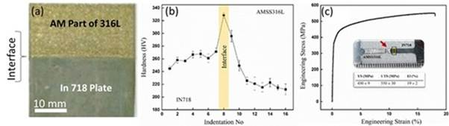
“The bi-metallic structure SS316L was fabricated using a laser-based powder bed fusion system through additive manufacturing and building directly onto the surface-ground IN718 plate with no visible cracks or porosity at the interface. The material exhibited a peak hardness of nearly 310 HV at the interface and an ultimate tensile strength (UTS) of 550 ± 30 MPa, with failure occurring on the softer SS316L side, away from the bi-metallic junction, demonstrating superior interfacial integrity,” a statement by the Union Ministry of Science and Technology said.
The research by the team comprising S. Narayanaswamy, Gururaj Telasang, Nokeun Park and Ravi Bathe was published in the journal Progress in Additive Manufacturing.
It enables the fabrication of multi-material components for demanding industrial environments.
Potential applications include boiler tubes, heat exchangers for nuclear and ultra-supercritical coal-fired power plants, and advanced energy systems, where different sections of a component experience varying temperature and stress conditions.
The technology is also relevant for nuclear reactors and oil and gas processing industries, where corrosion resistance and high-temperature strength are simultaneously required.
“In the aerospace sector, a bi-metallic structure can be used, with a steel side serving as the load-bearing component, while the Inconel side provides high-temperature resistance. Additive Manufacturing also opens the door to internal structures, enabling the strategic placement of superalloys only in regions subjected to extreme thermal exposure and improving component performance,” the statement added.
–IANS
jg/khz