

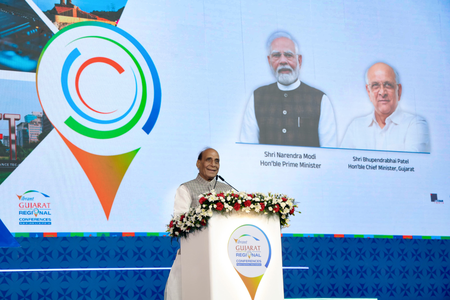
Vadodara, June 30 (IANS) Defence Minister Rajnath Singh on Tuesday noted that the rapidly changing geopolitical environment made India’s self-reliance, technological capability and national security increasingly important, describing all three as essential to determining the country’s future global role.
Speaking at the valedictory ceremony of the Vibrant Gujarat Regional Conference (VGRC) in Vadodara, Singh said the country’s ambition of becoming a developed nation by 2047 extended beyond economic growth and required advances in technology, industry and strategic capability.
“Today, the entire world is facing a rapidly changing geopolitical environment. At such a time, India’s self-reliance, its technological capability and our collective resolve will determine what India’s role on the global stage will be in the coming decades,” he said.
Singh said Prime Minister Narendra Modi had set a national objective of making India a developed country by 2047.
“I believe this is not merely a goal of economic development, but a resolve to build an India that is economically prosperous, technologically fully capable and socially fully empowered,” he said.
The Defence Minister said history showed that every major nation rested on three interconnected foundations: economic strength, technological capability and national security.
“Where there is progress in economics, prosperity and technology, that country, that state, will be strong from the perspective of security. And where national security is strong, industry and innovation can function properly and flourish,” he said.
He said defence should not be viewed solely through the lens of military equipment but as a sector supporting broader economic activity.
“The development of the defence sector is not limited merely to manufacturing weapons. It drives a much broader economic ecosystem. The creation of defence corridors generates new opportunities in infrastructure, logistics, industry and employment,” he noted.
Singh added that research, technology development and innovation in defence strengthened the country’s industrial base.
He said the government was encouraging indigenous capabilities through initiatives including Atmanirbhar Bharat, Make in India, the Defence Acquisition Procedure and the Technology Development Fund.
According to Singh, reforms such as the Srijan Portal, iDEX, Defence Testing Infrastructure, Green Channel Certification and Self-Certification had increased participation by MSMEs and start-ups in defence manufacturing.
He also stressed that India’s approach to self-reliance was not intended to isolate the country. “For us, Atmanirbhar Bharat means an India that is full of self-confidence, stands firmly on its own feet and works with the world as an equal partner,” he said.
The Defence Minister said India welcomed collaboration with foreign original equipment manufacturers, technology transfers, and joint ventures, while ensuring that capabilities and economic benefits were created within the country.
“Our endeavour is always to ensure that the real benefits accrue on Indian soil, to the people of India, and that India’s own capabilities are built here,” Singh said.
Referring to future technologies, he said semiconductors, artificial intelligence, quantum computing, cybersecurity and space technology would become increasingly important for both the economy and defence.
“Ecosystems being developed in Sanand and Dholera would contribute to India’s technological sovereignty,” the Defence Minister added.
Singh urged industry stakeholders to transform regional industrial strengths into national capabilities and local innovation into global competitiveness while supporting India’s long-term strategic objectives.
–IANS
mys/uk