

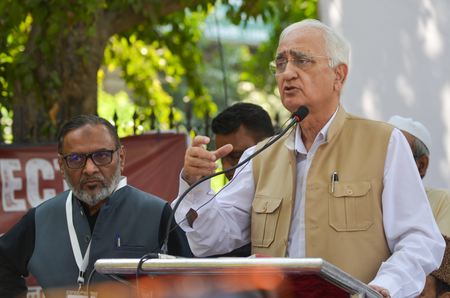
New Delhi, June 25 (IANS) As India marks the 51st anniversary of the Emergency, Congress leader Salman Khurshid on Thursday noted that the people of the country already gave their verdict on its imposition by removing the party from power in the elections conducted soon after it was lifted in 1977.
In an exclusive interaction with IANS, the senior advocate spoke about BJP’s observance of ‘Samvidhan Hatya Diwas’, the NCERT inserting a chapter on Emergency and also on the row that a passport is not proof of citizenship.
Excerpts from the interview:
IANS: BJP is observing ‘Samvidhan Hatya Diwas’ to mark the 51st anniversary of the 1975 Emergency. Your take?
Salman Khurshid: We believe the Constitution gives everyone the right to express their views. Whether those views are right or wrong is ultimately for the people to decide. But the right to speak comes from the Constitution. If you have the freedom today to make such statements, then at least acknowledge that the Constitution is alive.
The real question today is what is being done to the Constitution now. Allegations are being raised that the Constitution is being undermined. These questions should be answered first. Many people across the world are talking about an ‘undeclared Emergency’ (in the country).
The Emergency itself was a constitutional provision. If someone believes that the provision was misused, then the matter must be judged either by the courts or by the people. In that case, both happened. There was a judicial verdict as well as a political verdict from the people.
Given the situation in Bihar, is it a way to protect the Constitution? The way police have killed a person (Bharat Tiwari) and also the crisis faced by NEET aspirants, do these things strengthen the Constitution or instead raise questions on it?
IANS: What do you have to say about the NCERT introducing a section on the Emergency in the Class 9 Social Science textbook?
Khurshid: Today, they have the authority and the power to include chapters and questions in NCERT textbooks. The issue is not whether the topic is included; rather, the question is how it is presented and what commentary accompanies it. No one can deny the historical fact that the Emergency took place. That reality has to be accepted.
But are the reasons behind the Emergency being explained, or its consequences being discussed? Is there any mention that elections were held after the Emergency, that Congress lost those elections, and that later Congress returned to power with a two-thirds majority? If you want to write about historical facts, no one is objecting to that. But the complete picture should be presented. The entire reality should be included. It should not be selective or what is commonly called ‘cherry-picking’ of facts.
IANS: The Ministry of External Affairs (MEA) has said that a passport is not proof of citizenship. Your views?
Khurshid: One thing is very clear in the Passport Act: a passport can be denied if a person is not a citizen. If non-citizenship is a ground for refusing a passport, then the issuance of a passport must have some relevance to citizenship as well.
At the same time, it is also true that the formal determination of citizenship is governed by the Citizenship Act. However, if both laws are read together, a passport must carry some significance…I do not think an ordinary person would easily understand this distinction. Simply making such an announcement is not enough. The government should explain why this clarification is being issued now and why it is being stated in this manner after so many years.
IANS: About Prime Minister Narendra Modi recently completing 12 years in office, becoming the longest continuously serving PM?
Khurshid: I know that the atmosphere of prosperity and confidence that once existed in the country, and which should exist, is not visible today. The sense of trust, satisfaction, and contentment that people should feel is missing. There is politics around bulldozing, and incidents of police firing raise concerns. It appears at times that institutions have become unrestrained. The expectations people have of the establishments are not being fulfilled.
Why is this happening? Why is there a sense of unease in the country? Why are so many people migrating abroad, taking their wealth and investments elsewhere? Why is it that those nations that we considered as allies are distancing themselves from us?
There are many such questions. Based on my experience and my assessment of the situation, I cannot say that the last 12 years have been good for the country.
IANS: How do you look at India’s foreign policy amid the US-Iran tensions?
Khurshid: I do not know what the government’s policy is. I have not been able to understand India’s policy towards Iran. India and Iran have shared longstanding ties and have been close friends. Many people believe there is a civilisational link between the two countries.
Iran has shown considerable goodwill towards India over the years. Even during difficult periods, including issues related to the Strait of Hormuz and periods of American military action, Iran maintained its friendship with India without placing major expectations on us. The question is whether we have been able to reciprocate that friendship. When Iran was facing severe attacks and difficult circumstances, did we engage with our friends and partners in a way that could have helped provide some relief or support to Iran?
Therefore, I do not see any foreign policy towards Iran.
–IANS
cg/vd