

New Delhi, June 12 (IANS) The Indian Institute of Technology Madras (IIT Madras) on Friday said it has released ANCHOR (Atlas of Neurochemical Characterisation of the human brainstem with 3D Reconstruction), the world’s most detailed three‑dimensional atlas of the human brainstem.
ANCHOR was developed by the Sudha Gopalakrishnan Brain Centre through its high throughput brain imaging and computing platform that transforms whole human brains into 3D cell-resolution atlases, the statement from IIT Madras said.
ANCHOR comprises the most comprehensive, multimodal, 3D maps and atlases of the human brainstem to date spanning from prenatal period to childhood and adult brains.
The researchers have made ANCHOR publicly available through a website to ensure that this cutting-edge research benefits researchers, clinicians and patients around the world.
The statement noted that the publicly available atlas encompasses over 200 brainstem nuclei and fibre tracts reconstructed from hundreds of serial sections, using eight complementary immunostains overlaid across more than 500 sections, enabling detailed mapping.
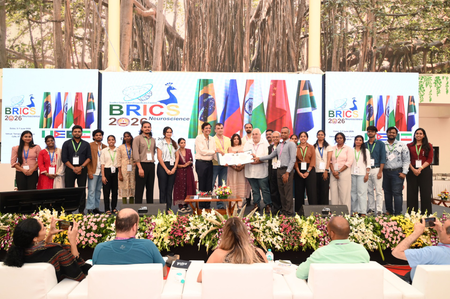
ANCHOR was released at the 3rd BRICS Neuroscience Symposium, held from June 5-7, 2026, at the IIT Madras campus.
SGBC aims to build the most comprehensive set of cell resolution human brain maps across life span and diseases.
The centre aims to image over 100 whole brains across human lifespan and neurological diseases.
The centre has become a truly global interdisciplinary team featuring over 200 researchers, engineers and technicians working with 20 collaborators from different countries, the statement added.
“This is a significant accomplishment in the field of neurobiology. This is a multimodal framework integrating MRI, histology and detailed chemo‑architecture,” said Prof. Ajay Kumar Sood, Principal Scientific Adviser to the Government of India.
These maps will help in identifying specific cell populations affected in brain stem lesions which could be critical for clinical applications, he added.
“The centre is a unique example of how risk taking by a public agency led to an advanced technology platform for doing big science and that was then scaled by private and philanthropic support to produce world-class results in frontier areas of human brain sciences,” Sood noted.
—IANS
aar/pk