

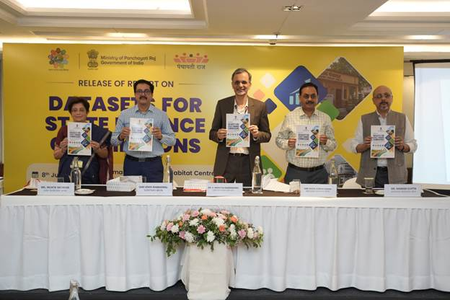
New Delhi, June 8 (IANS) In a significant step towards advancing data-driven fiscal decentralisation and strengthening grassroots governance, the Centre on Monday released the report of the Committee on Datasets for State Finance Commissions prepared by the Ministry of Panchayati Raj.
While releasing the report, Chief Economic Advisor to the Government V. Anantha Nageswaran said that citizens experience governance through the availability of basic services such as drinking water, roads, street lighting and Anganwadi services, making empowered Panchayats central to effective governance.
He noted that fiscal decentralisation is ultimately about bringing governance close enough to people that it actually touches their lives, and that State Finance Commissions can only make sound recommendations when they have access to reliable, timely and granular data, adding that better data leads to better governance.
Nageswaran emphasised that the quality of decisions on resource allocation is directly determined by the quality of data and analysis available, and described the report as an important step towards strengthening the information architecture for local governance.
He also highlighted the report’s recommendation that the Comptroller and Auditor General undertake a performance audit of the implementation of the 73rd Constitutional Amendment across States to assess the extent of functional, financial and administrative devolution to Panchayati Raj Institutions, an initiative that will further reinforce accountability and deepen the gains of constitutional decentralisation.
Commending the Ministry of Panchayati Raj for preparing the report, he expressed confidence that its recommendations would contribute significantly to strengthening fiscal decentralisation, enhancing local public finance, and supporting informed decision-making for sustainable development in rural areas.
Secretary, Ministry of Panchayati Raj (MoPR), Vivek Bharadwaj, emphasised the need for greater coordination between the State Finance Commissions and Central Finance Commissions. He stated that reliable and accessible data is fundamental to improving the quality and timeliness of SFC recommendations.
Bharadwaj reflected on the growing centrality of Panchayati Raj institutions in India’s governance landscape. He emphasised that sustainable decentralisation requires not only financial transfers but also robust institutional reforms. Strengthening the data ecosystem for local governments, he noted, will enable evidence-based decision-making and enhance the effectiveness of fiscal devolution to Panchayati Raj Institutions.
Bharadwaj highlighted two key outcomes of the Ministry’s sustained engagement with the Sixteenth Finance Commission. First, recognising the governance needs of India’s rapidly expanding peri-urban areas, the Commission has proposed an Urbanisation Premium of Rs 10,000 crore to support local bodies managing the transition of census towns into urban entities. He described this as the first dedicated national initiative aimed at addressing the challenges and opportunities of peri-urban transformation.
Second, he noted that the Commission has reintroduced a performance-based grant framework, allocating Rs 87,000 crore exclusively for Panchayats. The grants will be linked to annual growth in own-source revenues of at least 2.5 per cent, reflecting confidence in the increasing financial capacity and self-reliance of local governments.
–IANS
sps/uk