

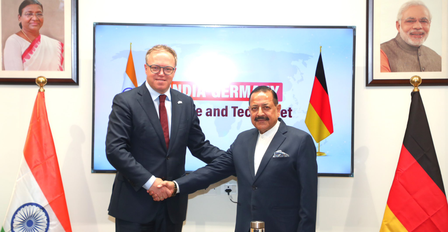
New Delhi, June 3 (IANS) India and Germany have advanced a new phase of bilateral cooperation in frontier technologies, with both sides agreeing to deepen collaboration in quantum communications, photonics, secure networking, and commercial space technologies during the visit of Thuringia Minister-President Mario Voigt to New Delhi.
The discussions, held with Union Minister of State Dr. Jitendra Singh on June 2, brought together senior leadership from the Department of Science and Technology (DST), the Department of Space, and key research institutions to strengthen strategic cooperation in emerging technologies.
The dialogue marks a shift in the long-standing India-Germany scientific relationship towards a more operational partnership focused on deep-tech sectors such as quantum communications, advanced manufacturing, aerospace technologies, and secure digital infrastructure, according to The Policy Edge report.
A major area of focus during the talks was quantum communication and photonics infrastructure, as per the report.
India and Germany agreed to expand cooperation between the Indian Space Research Organisation (ISRO) and the German Aerospace Centre (DLR) on quantum satellite communication systems and secure networking technologies.
Both sides also discussed closer alignment with Europe’s EuroOGS (European Optical Ground Station) network, which aims to standardise and interconnect optical ground station infrastructure across regions.
Officials said the goal is to develop interoperable communication systems capable of supporting future secure space and quantum communication networks, as per the report.
The partnership is expected to combine Thuringia’s expertise in precision optics, lasers, and photonics manufacturing with India’s major strategic technology programmes, including the National Quantum Mission, IndiaAI Mission, and the National Green Hydrogen Mission.
Apart from research collaboration, both countries also explored ways to strengthen commercialisation and talent mobility, the report stated.
Through frameworks such as the Anusandhan National Research Foundation (ANRF) and the Indo-German Science and Technology Centre (IGSTC), the two sides discussed industry-linked research partnerships and startup collaborations aimed at converting laboratory research into commercial technologies.
Germany also proposed expanding doctoral researcher exchanges, dual-degree academic programmes, and institutional collaborations between Indian and German universities to build a long-term pipeline of skilled researchers in quantum science, aerospace engineering, photonics, and related sectors.
–IANS
pk