

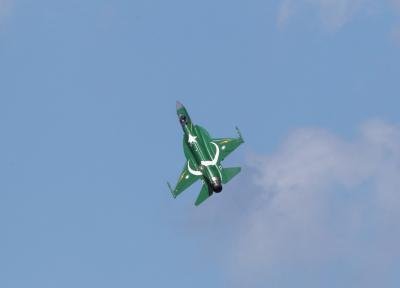
Dhaka, June 2 (IANS) Several retired Bangladesh Airforce veterans have raised serious questions on the country’s proposed purchase of China-Pakistan made JF-17 fighter jets, highlighting their ineffectiveness in case of war, as it was also witnessed during India’s decisive Operation Sindoor last year.
“Pakistan clearly failed to counter the Indian precision strikes conducted mostly beyond visual range during Operation Sindoor. That forced Pakistan to seek US help to push India to stop the war,” Eurasia Review quoted a retired Bangladesh Air Commodore as saying on the condition of anonymity who stated further that the equipment “came a cropper” against India in the four-day war.
The report mentioned that, despite making profits from selling “faulty military equipment” to Bangladesh, China has been less than truthful with Dhaka and only wants to increase its sales, often by greasing palms in the right quarters.
“With Bangladesh’s new prime minister Tarique Rahman scheduled to visit China in June, his first foreign visit after assuming office, the grapevine is abuzz about finalisation of a deal with Bangladesh to sell China-designed and Pakistan-manufactured JF-17 fighters for boosting its air warfare capabilities. The highly active Chinese Ambassador in Dhaka, Yao Wen, seems to have already lined up the military top-brass including the Army and Air Force Chiefs to back the deal,” noted political analyst Anjuman A Islam wrote in Eurasia Review
Recently, a high-level delegation from Pakistan visited Bangladesh to push the possible purchase of JF-17 fighter jets by Bangladesh. However, the latest crash in Pakistan has raised questions about Bangladesh’s decision to purchase the jets.
A systematic and prompt state-sponsored cover up started in Pakistan and China to hide the aircraft’s country of origin after the training aircraft of the Pakistan Air Force crashed on May 20.
“Similarly, when reports emerged about another crash, this time of a much-touted JF 17 fighter jointly produced by China and Pakistan, both countries sought to cover up news of the crash near Kamra, close to the aircraft’s production hub in Pakistan,” Islam wrote in Eurasia Review.
“That desperate bid to keep the international community in the dark about technical flaws of China’s much hyped battle tested’ jets can only be explained by fears that exposure may adversely affect efforts by both China and Pakistan to market these aircrafts to third countries like Bangladesh,” the author further stated.
In 2025, Bangladesh witnessed its deadliest aviation disaster in years after a Chinese-made F-7 Air Force training aircraft crashed into the Milestone School and College in Dhaka due to technical glitch, which claimed lives of over 20 students and injured hundreds.
Meanwhile, another report claimed that Bangladesh’s foreign policy has long been guided by the principle of ‘friendship towards all, malice towards none’. However, its commitment of up to USD 720 million to a Sino-Pakistani aviation system, amid economic fragility and geopolitical realignment, severely tests that doctrine.
It also raises questions about the quality of the national conversation, given that a decision of this magnitude, with long-term implications for Bangladesh’s strategic posture, fiscal space, and geopolitical relationships, requires rigorous parliamentary scrutiny, independent economic analysis, and open public debate, a report in the Australian Institute of International Affairs detailed.
“In May 2026, a Pakistan Air Force C-130J landed quietly in Dhaka carrying a single heavy crate. Inside was a full-scale JF-17 Thunder Block III combat simulator — the first piece of Pakistani military aviation hardware to enter Bangladesh since 1971. The simulator, delivered during the first formal Air Staff Talks between the two air forces, is being framed as a training tool ahead of a potential procurement of 16 to 48 JF-17 Block III multirole fighters, estimated at between USD 400 and 720 million,” it said.
According to the report, policymakers and defence commentators have largely focused on the operational considerations, noting that “the Bangladesh Air Force’s fleet is ageing; its F-7BGs and MiG-29s are approaching end of life; and the Forces Goal 2030 modernisation plan demands credible air power.”
Stressing that the operational logic is limited in its scope, it said that the move overlooks the political alignments implied by such procurement, the long-term fiscal burdens it would entail, and the strategic consequences of tying Bangladesh’s defence future to a Sino-Pakistani supply chain at a time of severe economic vulnerabilities.
“A fighter jet is never merely a weapons platform. It is a political instrument, an economic commitment, and, over the long arc of defence dependency projects, a statement of alignment that outlasts governments. Bangladesh is not simply buying an aircraft. It may be buying into a strategic orbit from which exit will be difficult, expensive, and diplomatically consequential,” the report noted.
–IANS
akl/as