

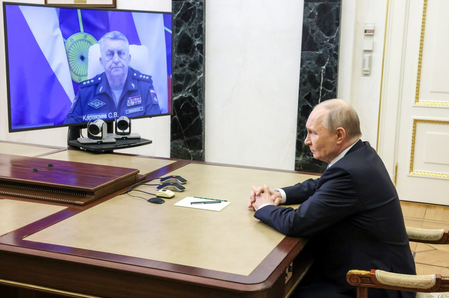
Moscow, May 12 (IANS) Russia has successfully tested the Sarmat intercontinental ballistic missile, according to Russia’s Commander of the Strategic Missile Forces, local media reported.
Sergey Karakayev, Commander of the Strategic Missile Forces, stated in a report to Russian President Vladimir Putin that the results of the tests of the Sarmat missile system confirmed the specified characteristics and the correctness of the decisions incorporated into it.
The missile “will significantly increase the combat capabilities of the ground-based strategic nuclear forces to guarantee the destruction of targets and solve strategic deterrence problems”, Karakayev stated in the report to the President, Russia’s state-owned TASS news agency noted.
Putin congratulated the Russian military on the successful test of the Sarmat intercontinental ballistic missile.
Putin emphasised that this is “the most powerful package system in the world, equal in power to the Soviet-era Voevoda missile system in our arsenal”.
“The total yield of the delivered warhead is more than four times greater than any existing, most powerful Western equivalent,” Putin stated.
Putin highlighted that “the missile can travel not only along a ballistic but also a suborbital trajectory, which allows for a range of over 35,000 km while simultaneously doubling its accuracy and the ability to penetrate all existing and future anti-missile defence systems”.
Karakayev stated that the test confirmed the missile system’s flight range, throw weight, launch readiness, and the countermeasures employed.
The first successful launch of this system was carried out on April 20, 2022, from the Plesetsk Cosmodrome in the Arkhangelsk Region.
Putin also confirmed that the Sarmat system will be deployed at the end of the year.
The RS-28 Sarmat, an advanced ground-based silo-based missile system capable of carrying nuclear warheads and a heavy liquid-propellant orbital intercontinental ballistic missile, has been under development since the 2000s, the report noted.
Putin stated that Moscow was forced to “consider ensuring its strategic security in the context of the new reality and the need to maintain a strategic balance of power and parity” in 2002 after Washington withdrew from the Anti-Ballistic Missile Treaty.
–IANS
ksk/dan