

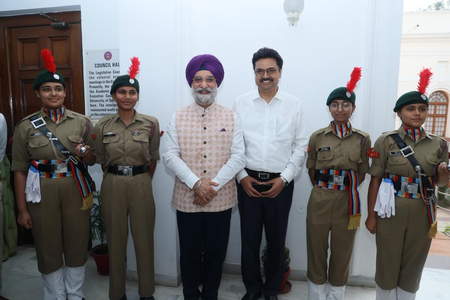
New Delhi, May 11 (IANS) Describing Yamuna’s restoration as a “civilisational priority”, Delhi Lieutenant Governor T.S. Sandhu said on Monday that the integration of technology, sustainability, and self-reliance will define the future of India’s urban landscape.
Speaking at the National Technology Day event organised by Indraprastha Vigyan Bharati at the Vice Regal Lodge, University of Delhi, the Lieutenant Governor identified scientific research and intellectual confidence as the primary drivers of an Atmanirbhar Bharat.
Addressing scientists, academicians, and students, he noted that technology must move beyond the laboratory to address real-world challenges in public health, mobility, and environmental governance.
The Lieutenant Governor underlined that the partnership between science and governance is essential for creating responsive and efficient civic solutions.
He stressed that big achievements in nation-building ultimately require patience, discipline, and the courage to innovate.
Sandhu shared insights on the technology-driven public health system and called for the creation of AI-driven early-warning systems to transform Delhi’s public health infrastructure.
“By utilising predictive sampling, PCR testing, and AI forecasting for illnesses like Dengue and Malaria, the city can transition from reactive measures to a proactive healthcare model,” he said.
Stressing ecological restoration, Sandhu said urban sustainability is essential for quality of life.
The Lieutenant Governor highlighted the restoration of the Yamuna as a critical ecological and civilizational priority.
He also advocated scientific interventions in decentralised waste management, source segregation, and local composting to reduce pressure on landfills and bolster urban greenery.
Talking about Integrated Urban Mobility, he said Delhi’s transformation will depend on intelligent traffic management and unified mobility.
The LG envisioned a commuter experience defined by real-time GPS transit systems, common transit cards, and strengthened last-mile connectivity to reduce congestion and pollution.
With the rise of urban heat islands and water scarcity, Sandhu urged urban planners and scientific institutions to collaborate on climate-smart approaches and expand green infrastructure.
Reflecting on India’s ancient scientific traditions, the Lieutenant Governor remarked that modern progress must remain rooted in social purpose and human values. He noted that organisations like Vigyan Bharati serve as a vital bridge between academia, research labs, and society.
“Your generation will shape how India advances in AI, biotechnology, and clean energy. Our true strength lies in combining innovation with responsibility and modernity with sustainability. That balance will define the future of India’s scientific rise,” said Sandhu.
–IANS
rch/dan