

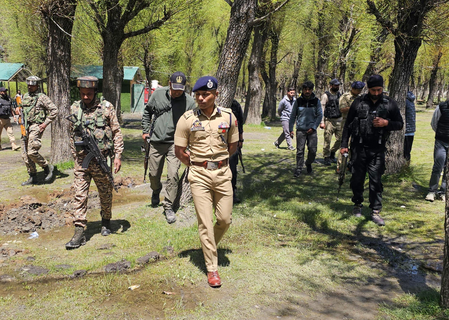
New Delhi, April 22 (IANS) Pakistan needed a decisive response following the dastardly Pahalgam terror attack and it got the one from India, timely and decisively. However, this was not just one location on terrorists’ radar. According to information picked by Intelligence agencies, the ISI had planned more such attacks in Jammu and Kashmir, with an intent to terrorise the tourists and bleed the tourism industry.
As tourism remains the lifeline of Jammu and Kashmir, Pakistan was looking to hurt the industry and had planned Pahalgam type attacks in various other locations by deploying terrorists of the Lashkar-e-Tayiba and Jaish-e-Mohammad. The brief was not to target the locals in J&K.
The ISI wanted to continue targeting tourists and wanted to make it appear as though these attacks were carried out by the locals. This would have led to the Kashmiris being targeted across the country. Ultimately it would have resulted in the people of Kashmir trying to move away from the mainstream and refusing to be a part of India. This was apparently the sinister plot behind more Pahalgam-styled attacks.
Following the Pahalgam attack, the situation could have turned any way. The efforts that the Indian government put in following the abrogation of Article 370, securing peace and bringing the people of Jammu and Kashmir to the mainstream would have all gone down the drain, had the ISI gone ahead with the attacks.
An Intelligence Bureau official said that post the Pahalgam attack which took place on April 22, 2025, the ISI decided to adopt a wait and watch game. It wanted to execute more such attacks in a phased manner. It had planned at least 3 such attacks with the clear intention of creating a communal divide. The response to the Pahalgam attack was strong.
The sentiments and anger among the people of India was high and all expected very strong action against Pakistan and its terror proxies, the official said.
The government too was clear that it was going to go beyond condemnation and action would need to be taken. Pakistan sensed that India’s actions would be strong. India was clear that it would hit terror infrastructure and hunt down terrorists. Sensing that there would be a no-nonsense approach by India, the ISI decided to keep the rest of its plans on hold.
Another official said that the sentiments were so strong that many, including Pakistan thought that India would go to war. However, India decided to execute a measured response and hit back hard with ‘Operation Sindoor’. During the operation, the Indian armed forces took down terror infrastructure – both in Pakistan occupied Kashmir (PoK) and deep within Pakistan. The hits that were executed inside Pakistan surprised the ISI and its army. This changed a lot within the ISI and terror groups.
The trust that terror groups such as the Jaish-e-Mohammad and Lashkar-e-Tayiba had in the ISI and Pakistan army began to erode. Questions were being asked about their protection and why the establishment failed to do so. The official said that given the situation and the trust deficit that built up, these terror groups would have refused to strike even if the army wanted them to, especially Operation Sindoor.
Another official said that had the response not been so severe, then the ISI would have gone ahead with its plans of carrying out three more Pahalgam styled strikes. While the abrogation of Article 370 that gave Jammu and Kashmir special status did irritate the Pakistanis, the restoration of peace in the Valley came as a surprise to Islamabad.
Moreover, the people of J&K have been gradually moving towards a new development paradigm and lifestyle. Livelihood is more important than separatism and terrorism for the younger generation.
This is the cycle that the ISI and Pakistan army sought to break and hence had hatched plans for more strikes to hurt the tourism sector.
–IANS
vn/mr