

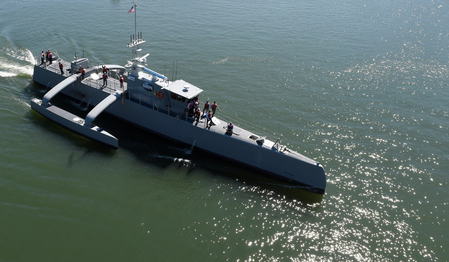
Washington, April 22 (IANS) US lawmakers have urged the Navy to speed up the deployment of unmanned surface vessels, warning that delays could leave the United States trailing adversaries adopting autonomous systems at a pace.
Opening a Senate Seapower subcommittee hearing on Tuesday, Senator Rick Scott said the Navy “must move decisively to integrate unmanned systems into the fight” and warned it “appears… late to the game already,” pointing to lessons from the war in Ukraine.
Scott said unmanned vessels can “extend our reach, reduce risks to American sailors and Marines… and give us the edge we need,” stressing that rivals are moving quickly in this domain.
Senator Tim Kaine highlighted growing threats at sea, noting that U.S. and partner vessels have faced repeated attacks in recent years. He said the Navy must respond to “threats that are growing more complicated every day,” especially in regions such as the Persian Gulf and the Strait of Hormuz.
Rear Admiral Derek Trinque, director of Surface Warfare, told the panel that unmanned surface vessels are a “critical component” of future naval operations but will work alongside traditional ships. “We are not moving toward an exclusively unmanned fleet,” he said, emphasising “manned and unmanned teaming.”
He said the Navy is trying to accelerate acquisition and field capabilities faster. Unmanned systems, he said, will “augment and complement the main battle force” and expand operational options for commanders.
Rebecca Gassler, the Navy’s portfolio acquisition executive for robotic and autonomous systems, said the service is shifting from experimentation to rapid deployment. “Unmanned systems are not a future concept… they are a response to a present operational reality,” she said.
She said adversaries are investing in “mass distribution and lower cost systems,” forcing the U.S. to adopt a “complementary approach” that increases reach and persistence.
Gassler said the Navy has introduced a competitive marketplace model, allowing companies to offer mature systems that compete for contracts. The approach aims to speed up procurement and scale production of proven technologies.
Officials said the Navy plans an initial procurement of about 30 medium unmanned surface vessels, with the fleet potentially expanding to around 70 over a five-year lifecycle, including sustainment.
Lawmakers raised concerns about clarity for the industry. Scott said companies need “a clear, sustained demand signal… not another pivot” to ensure continued investment.
The discussion also touched on how to measure naval strength. Kaine said traditional ship counts may no longer reflect “capacity and lethality,” calling for updated metrics that include unmanned systems.
Unmanned maritime systems have gained prominence globally, particularly after Ukraine used them effectively in the Black Sea against Russian forces.
The U.S. Navy, built around large warships and aircraft carriers, is now adapting to a changing battlespace as rivals invest in autonomous capabilities across air, surface and subsurface domains.
–IANS
lkj/sd/