

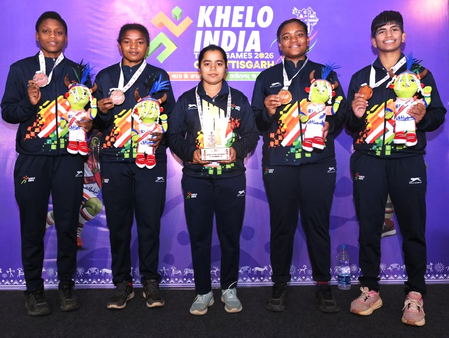
Ambikapur, April 4 (IANS) The saying ‘talent needs no introduction’ found a fitting example at the Khelo India Tribal Games 2026, where wrestlers from Karnataka’s Siddi community have made a powerful statement on the mat. Their success is no longer just about medals—it reflects the emergence of an entire community as a force in wrestling. Of African descent, there are about 50,000 Siddis in India of which one-third live in Karnataka.
Out of the nine wrestlers representing Karnataka at KITG 2026, four belonged to the Siddi community. Three of them clinched gold while one secured silver. The gold medallists include Manisha Juava Siddi (76 kg), Rohan M. Doddamani (Greco-Roman 60 kg) and Princita Pedru Fernandes Siddi (68 kg), while Shalina Sayer Siddi (57 kg) settled for silver.
Their achievements highlight not only personal grit and perseverance but also the growing dominance of the Siddi community in wrestling. All four wrestlers had topped the trials held at Delhi’s Indira Gandhi Stadium, underlining their consistency and potential.
Karnataka team coach Mamata expressed pride in their performance. “Just as Haryana dominates wrestling at the national level, the Haliyal region (in Uttara Kannada) has a similar influence in our state. The Department of Youth Development centres here largely cater to children from the Siddi community, and in recent years, there has been a surge in interest towards wrestling among them,” she told SAI Media.
Rohan M. Doddamani, a gold medallist from Dharwad district, comes from a humble background. His mother works as a cook in a government school and his father passed away six years ago.
“There are frequent local dangals (wrestling competitions) in our community, and winners are rewarded generously. Before this, I have competed in the senior national championships, National Games and All India University Games,” Rohan said.
Launched in 2018 by the Sports Authority of India (SAI) and the Ministry of Youth Affairs and Sports, the Khelo India initiative has played a crucial role in identifying and nurturing talent across the country. The rise of Siddi wrestlers is also a testament to these efforts.
Maha Singh Rao, a member of SAI’s Talent Development Committee, said, “We identify talented youngsters early and provide them with opportunities. With proper training and facilities, these athletes have the potential to excel at the international level and win medals for the country.”
Silver medallist Shalina Sayer Siddi from Uttara Kannada’s Karwar district said, “Interest in wrestling is growing within our community. I started on my uncle’s advice and have been training under him. I missed gold this time, but I will work harder going forward.”
Princita Pedru Fernandes Siddi, whose father works as a mason, added, “Initially, I wasn’t interested in wrestling and even resisted it. But seeing others from my community take it up I was motivated to play the sport. Now I train rigorously every day with the aim of winning medals at the international level,” said Princita.
The success of these wrestlers underlines a larger truth—when given the right platform, training and support, talent from even the most remote communities can rise to the highest level and shape India’s sporting future.
–IANS
hs/