

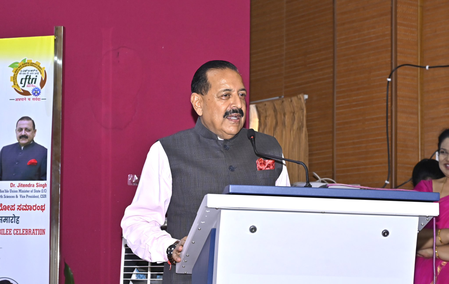
New Delhi, April 4 (IANS) Union Minister Dr Jitendra Singh has called for stronger outreach, including digital dissemination and targeted engagement with startups and MSMEs, particularly in emerging segments such as ready-to-eat and “carry-home” food products tailored to changing urban consumption patterns.
He emphasised that the next phase of growth lies in expanding the commercial and entrepreneurial ecosystem around such technologies.
India’s millet push received a dual institutional boost as the Centre moved to scale both technology and grassroots capacity, with Dr Jitendra Singh highlighting Millet recipes developed with Indian technology are being served by international food chains, including McDonalds.
During a visit to the country’s first dedicated ‘Centre of Excellence’ for Millets at the Central Food Technology & Research Institute (CFTRI) in Mysore, Dr Singh observed that the innovations from this Centre have already entered global food chains, and will now be complemented by a new residential training ecosystem to expand its reach nationwide.
Noting that institutions like CFTRI have already developed hundreds of technologies with high levels of commercial adoption, the Minister said the focus must now shift to ensuring wider market access and last-mile delivery.
The millet facility, supported by Rs 20 crore under RKVY, integrates advanced processing technologies capable of handling all nine varieties of millets within a single system.
With a cleaning capacity of 60–70 tonnes per day and milling capacity of 12–15 tonnes per day, it produces a range of value-added outputs including flour, semolina (sooji and rava) and bran, while ensuring higher nutrient retention, improved shelf life and industrial-scale efficiency in a hygienic, automated environment.
He stressed that scientific innovation must move beyond laboratories to directly support livelihoods, especially through partnerships with farmers, women’s groups and small enterprises.
With global attention turning towards climate-resilient crops and sustainable nutrition, millets are emerging as a strategic focus area for India’s food economy.
The CFTRI model, combining scientific research, industry linkage and grassroots capacity-building, is being positioned as a template for translating this opportunity into both economic growth and nutritional outcomes.
—IANS
na/