

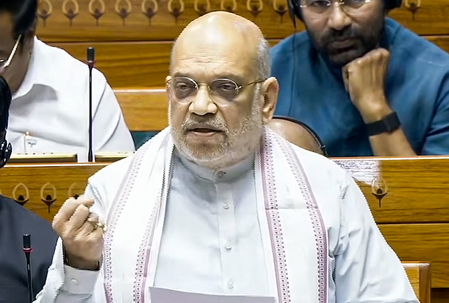
New Delhi, March 25 (IANS) Union Home Minister Amit Shah on Wednesday welcomed the passage of the Uniform Civil Code (UCC) Bill 2026 in the Gujarat Legislative Assembly, saying that the country should run on “principle of equal laws”.
After Uttarakhand, Gujarat became the second state to pass the Uniform Civil Code (UCC) Bill, 2026, on Tuesday, introducing a common legal framework for civil matters such as marriage, divorce, maintenance, and inheritance across communities and religions.
HM Shah, in a post on X, said, “Our belief is clear, the country should not run on the basis of appeasement, but on the principle of equal laws for all citizens. This is both our priority and our resolve.”
The Union Home Minister underlined that a uniform law is a “core commitment of the Bharatiya Janata Party (BJP)”.
“A uniform law for every citizen of the country has been a core commitment of the Bharatiya Janata Party since its inception. Under the leadership of Prime Minister Narendra Modi, BJP-ruled state governments are continuously moving forward in this direction.”
He praised Gujarat Chief Minister Bhupendra Patel and the MLAs who voted in favour of the Bill.
The Home Minister said, “I am pleased that after Uttarakhand, Gujarat has now passed the Uniform Civil Code (UCC) Bill, demonstrating its firm commitment to this principle. I extend my congratulations to Chief Minister Bhupendra Patel and all the legislators who supported this bill.”
Notably, the UCC legislation provides for compulsory registration of marriages and divorces and introduces uniform grounds and procedures for divorce across communities.
It prohibits extra-judicial forms of divorce, making court-based legal processes mandatory.
The Bill also mandates monogamy and includes provisions to declare marriages void where identity has been concealed.
It further introduces penal provisions for cases involving fraud, coercion or misrepresentation in marriage, with specified punishment for offences.
The law also provides maintenance rights for women without restrictions tied to personal laws and ensures equal inheritance rights for daughters and wives.
The Bill includes provisions requiring registration of live-in relationships with local authorities, which the government said is intended to provide legal safeguards and accountability.
–IANS
cg/dpb