

Islamabad, March 24 (IANS) The recent suicide bombing inside a mosque in Pakistan’s Islamabad, which killed at least 31 worshippers and injured over 160 others, was not an aberration but part of a grim continuum for Shia community in the country. The attack on Khadija Tul Kubra mosque in Islamabad signalled not only a local lapse but a systemic failure of deterrence. Shia mosques, processions, buses, hospitals, and shrines have faced attacks in Pakistan for the past 20 years.
“From Peshawar and Quetta to Parachinar and Karachi, attacks have followed a disturbingly consistent script — intelligence warnings, inadequate preventive measures, post-attack condemnations, and little visible accountability. The federal capital was long portrayed as an exception, a zone where the state’s coercive capacity would deter such violence,” Shinwari, a freelance journalist based in Pakistan, wrote in Afghan Diaspora Network.
“That assumption collapsed on February 6. The bombing demonstrated that sectarian militants could strike even where surveillance density is highest, raising serious doubts about threat assessment, intelligence coordination, and on-ground protection of vulnerable religious sites,” the article mentioned.
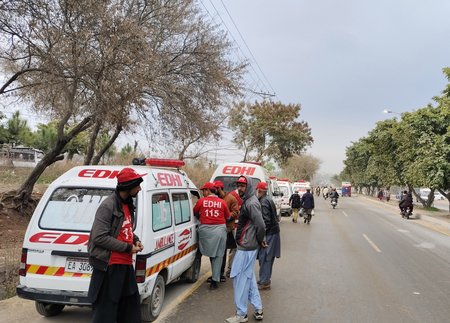
The Khadija Tul Kubra mosque is a popular Shia place of worship with people expected to come in large numbers during Friday prayers. The failure to have robust, visible security measures in such a situation is difficult to justify. According to officials, 169 injured people were rushed to hospitals, including the Pakistan Institute of Medical Sciences. The emergency response showcased not preparedness but improvisation, sparking concerns that contingency planning for attacks on religious sites remains insufficient.
“That such an attack occurred in Islamabad carries symbolic weight. The city represents the Pakistani state in its most concentrated form — ministries, embassies, military headquarters, and intelligence offices are clustered within its boundaries. When a suicide bomber can breach a mosque here, it signals not merely a local lapse but a systemic failure of deterrence,” the report in Afghan Diaspora Network stated.
“Top Shia leaders were explicit in their criticism. Raja Nasir Abbas Jafri described the bombing as a serious failure to protect human lives and questioned the performance of law enforcement agencies. His remarks echoed a broader sentiment within the community that official assurances of protection ring hollow when measured against repeated bloodshed,” it added.
Pakistan has a population of about 40 million Shia Muslims. Despite this demographic reality, sectarian violence has continued in Pakistan. Human rights groups and independent researchers estimate that thousands of people from Shia community have been killed in targeted attacks in Pakistan over the 20 years. These are not random casualties of instability but victims of sustained ideological hostility.
On November 21, 2024, a Shia religious procession commemorating the death of Prophet Muhammad’s daughter, Hazrat Fatima, was targetted by unidentified gunmen in Parachinar, killing 44 civilians. In July 2024, a land disagreement caused armed clashes between Sunni and Shia tribes, causing 43 deaths. Prominent and economically successful Shia individuals have been singled out and killed in Pakistan. As many as 61 worshippers were killed after a struck a Shia mosque in Sindh’s Shikarpur in 2015.
“The failure to safeguard Shia mosques, repeatedly and predictably, reflects more than operational shortcomings. It points to a deeper reluctance to confront sectarian extremism as a central national security threat rather than a peripheral issue. The Islamabad bombing did not occur in a vacuum. It emerged from years of tolerated hate speech, inconsistent enforcement, and a security paradigm that has prioritised some threats while downplaying others,” the article highlighted.
–IANS
akl/as