

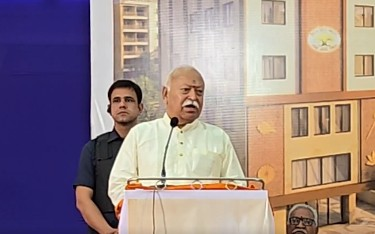
Nagpur, March 20 (IANS) Rashtriya Swayamsevak Sangh (RSS) chief Mohan Bhagwat on Friday underscored India’s pivotal role in addressing global instability, saying that “India can bring an end to the ongoing war”, during the groundbreaking ceremony for the Vishwa Hindu Parishad (VHP) Vidarbha Prant office in Nagpur.
Speaking on the escalating global conflicts, Bhagwat asserted that the world is increasingly looking towards India to restore balance through the foundation of Dharma.
Bhagwat noted that voices from various countries are increasingly looking towards India to mediate and end the ongoing war.
He mentioned it is now widely recognised that “only India” has the capability to bring peace to the Middle East due to its inherent nature. He stated that it is India’s responsibility to restore balance to a “stumbling world” by providing a foundation of dharma.
In a pointed critique of the current geopolitical climate, the RSS chief contrasted India’s historical values, especially “law of humanity” with the “law of the jungle” of the survival of the fittest, which is currently dominating global affairs.
He used a traditional parable of a wolf and a lamb to illustrate how power is often used to justify aggression. Bhagwat noted that without a strong moral force, truth and innocence are frequently suppressed by those with superior physical or military strength.
Addressing the ongoing wars in the Middle East and Europe, the RSS chief highlighted a growing international expectation for Indian intervention. He remarked that for 2,000 years, various ideologies have failed to bring lasting peace because they lacked a sense of interconnectedness and the foundation of unity.
Bhagwat identified selfish interests and the desire for regional or global dominance as the primary drivers of modern conflicts. He described it as an “inter-connected duty” to provide a stumbling world with a stable foundation.
He argued that true global happiness is impossible until everyone is at peace, a philosophy he identified as the core of Sanatan Dharma and the Indian Constitution’s preamble.
Beyond international relations, Bhagwat emphasised the need for internal strength and moral conduct within Indian society.
He noted that while different faiths in India—including Jainism, Buddhism, and Sikhism—may have different philosophies, they all converge on the same moral code of conduct: truth, non-stealing, and service to others.
The RSS chief called for the elimination of internal divisions, stating that a strong, united society is necessary because “the world does not respect the weak,” even if they possess the truth.
Bhagwat concluded by stating that when India prepares itself to fulfil its global duty of spreading harmony, its material and economic progress will naturally follow as a byproduct of its spiritual and moral awakening.
–IANS
sj/uk