

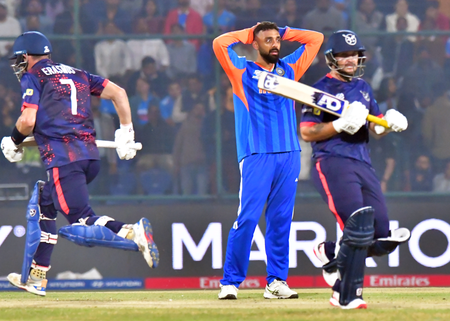
New Delhi, Feb 13 (IANS) Namibia captain Gerhard Erasmus said India wrist-spinner Varun Chakravarthy’s devastating spell was the game-breaker in his team’s 93-run defeat in their Group A clash at the Arun Jaitley Stadium on Thursday. Chakravarthy ended any lingering hopes of an upset result by picking three wickets within his ten balls after Namibia were 85/2 and effectively settle the contest in India’s favour.
“Honestly, I have to say that that was the game-breaker right there. I think he had three for five at one stage. For us, that’s another learning. It’s another one to take forward for the next World Cups, for the next games against big nations. How quickly the game evolves, how you can prepare for guys like that.
“You can do as much as you want in front of computers and in front of watching footage and talking about how you’re going to play. You’re going to play for every ball that comes in, but actually doing it is a different thing.
“Doing it on that level is something that we’ve learned, unfortunately, as our lesson. We couldn’t combat that skill. I don’t feel like the occasion or the lights or this or that was actually at the end of the day the main thing we had to combat. It was really just a new skill that we’ve never seen,” Erasmus told reporters in a mixed zone interaction at the conclusion of the game.
He also explained that mystery spin bowling which Chakaravarthy does is rarely encountered at the associate level. “I think just the spell of bowing – it’s a skill that we don’t naturally see in our level of cricket, is mystery bowling. Yes, there’s leg-spin googly every now and again that you face and people have become accustomed to that.
“It’s only in a few countries that they have guys bowling googlies and all sorts like the skills of Mujeeb and Varun and these types of guys. I don’t think there’s anyone in the associate cricket that bowls it. There’s probably Sher Malla (of Nepal), who’s probably the closest guy and the newest guy on our level.”
Erasmus further revealed that his team’s strategy was to avoid pace bowling and slow down the game in the middle overs, though he acknowledged the final over of powerplay, where Ishan Kishan hit JJ Smit for 28 runs – four sixes and a boundary – could have been handled better, as India ended six-over phase at 86/1.
“In our planning, it wasn’t really part of our plans to bowl too much spin in the powerplay. We thought that it’s going to be really good with it. Clearly to get out of the powerplay we’ll probably match up a little bit better with right-hand, left-hand combinations maybe in the middle period.”
“So in hindsight perhaps one of those overs could have gone to spin, seeing that the powerplay went for 80 odd. But I mean that’s always hindsight. I thought we were getting a wicket here and there, slowed down the powerplay a bit and then unfortunately that last over in the powerplay really went.”
“If we could have held it maybe to just past 60, then that’s probably a decent job done. So, that last over in the powerplay, they made it and credit to Kishan for pulling that off. But it was always going to be our plan to slow it up in the middle. The Indians are long not scared of any pace or anything like that and our weapon was always like how the USA used to just slow down the game.”
The Namibian captain said his team showed courage in patches but struggled to maintain composure under pressure against a high-quality opponent. “That’s actually quite a good assessment. Apart from that period when Varun bowled, I think the rest of the game on a flat wicket, middle strip, no wind or anything to use or no long side to use. Through periods of that bowling performance guys stuck up, especially towards the back end of the game of their batting innings.”
“That’s kind of something that you have to really get accustomed to is when you play in big stadiums in front of crowds and against big teams, is not to be overawed as a first step and then you can express your skills better. Felt that some guys did it in patches, but unfortunately some of those big overs that leaked and also that period of batting when we went three or four wickets straight.”
“It’s courageous in that we want to win the game and I think everyone needs to play that way. I think that’s the way certainly I want to get on the side. But courage is only one bit of the skill. If you want to be a high class cricketer, then you have to have courage.”
“But you also have to have calmness and the presence of mind to perform your skill under that pressure. For example, my shot was just a little bit way too far away from the ball. After getting closer to the ball and slog-sweeping for two or three successful shots there, things like that is what you learn from games like this.”
Erasmus signed off by highlighting the importance of more exposure to high-level cricket for associate nations. “It’s like under the exposure that you have there with 40,000 fans and high quality bowling, how can you access the same skills that you do when you play your peers in associate cricket, and in front of no crowds. More games like this give you more exposure, experience and know-how of how to go about it.
–IANS
nr/