



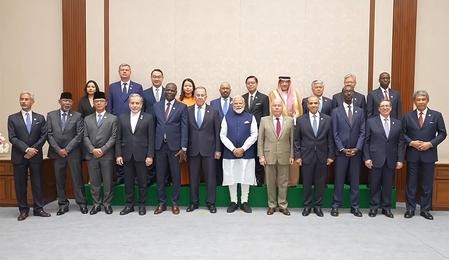
New Delhi, May 24 (IANS) As global geopolitical fault lines deepened, Indian diplomacy had to navigate complex challenges while chairing major multilateral forums, including the G20 in 2023 and the BRICS Foreign Ministers’ Meeting in 2026.
Held amid the escalating US-Israeli conflict with Iran and its spillover effects across the Gulf, the BRICS Foreign Ministers’ Meeting in New Delhi revealed conflicting views within the bloc, particularly between Iran and the UAE. The lack of consensus underscored the greater challenges BRICS could face if the hostilities in the West Asian region do not halt soon, Anil Trigunayat, a former Indian diplomat, wrote in ‘Saviours’.
He further highlighted that “dialogue, diplomacy, and de-escalation” remain India’s preferred approach for easing tensions.
“Prime Minister Narendra Modi and External Affairs Minister S. Jaishankar engaged extensively with their counterparts across the region and beyond to help reduce tensions while safeguarding the interests of India’s nearly 10-million-strong diaspora in West Asia,” the seasoned diplomat stated.
Trigunayat noted PM Modi expanded the BRICS acronym through the theme of India’s presidency — ‘Building for Resilience, Innovation, Cooperation and Sustainability’.
“This theme symbolises the direction in which BRICS, as a non-Western platform in an increasingly fractured global order, is likely to evolve. While the BRICS remains primarily focused on geo-economic cooperation, geopolitical divisions and great-power competition inevitably impinge upon its non-adversarial orientation. India has consistently emphasised that ‘non-Western’ should not be equated with ‘anti-Western’,” the former diplomat stated.
“However, as the United States and several major powers increasingly depart from established norms of international law and post-Second World War conventions, the search for alternative frameworks and models of global engagement has intensified,” he added.
According to the seasoned diplomat, India is set to chair the BRICS Summit in September; the US–Iran–Israel conflict has cast uncertainty over the prospects of securing a consensus-driven outcome document.
Trigunayat, however, stressed that the BRICS extends far beyond the immediate conflict, with the grouping focusing on a broad agenda covering “economic cooperation, counter-terrorism, climate action, trade, technology, connectivity, people-to-people exchanges, and sustainable development.”
Under India’s presidency, Trigunayat said that several practical, forward-looking initiatives are expected to emerge aimed at enhancing security, prosperity, and equitable development across the Global South.
“Equity, equality, and equanimity — driven by consensus, inclusiveness, and sustainable growth — increasingly define both the foundational principles of BRICS and India’s broader diplomatic priorities. These principles have acquired growing relevance and appeal among countries of the Global South or the ‘Global Majority’, despite the many internal and external challenges confronting the grouping,” he mentioned.
Reaffirming India’s commitment to BRICS in unequivocal terms: External Affairs Minister(EAM) Jaishankar had said, “India remains committed to strengthening BRICS in line with the principles of mutual understanding, solidarity, openness, inclusiveness, full consultation, and consensus.”
–IANS
scor/sd/