



New Delhi, June 9 (IANS) India has become a quintessential bridge-builder and balancer in contemporary affairs of the world. Having the capability to reshape the weakening global order, India can move it towards a fairer global governance, a report has stated.
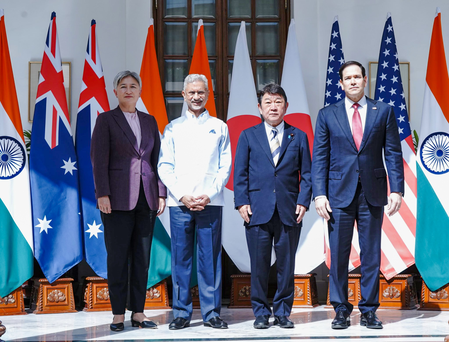
“One coalition of the willing with significant potential to help stabilise this order is the Quadrilateral Security Dialogue (Quad), comprising the United States, Japan, Australia, and India. However, India has resisted turning Quad into a formal military alliance, preserving flexibility,” Chairperson of The Centre for Alternative Political and Economic Thought, Phapano Phasha, wrote in an opinion piece for South Africa-based newspaper the ‘Sunday Independent’.
“Consequently, India has emerged as a quintessential bridge-builder and balancer in contemporary global affairs. It maintains strategic autonomy, a policy rooted in its Non-Aligned Movement (NAM) heritage, by engaging multiple platforms without formal alliances. This approach allows India to advance its national interests while positioning itself as a voice for the Global South and a reliable partner for the West,” he further stated.
The current weakening of the global institutions has created a unique opportunity for India due to its economic size, global presence and strategic ties. Through its ties with developing nations and supporting South-South cooperation, India plays a leadership role for the Global South. At the same time, India remains an important strategic partner for the West while maintaining ties with the European Union (EU), UK and the Nordic nations.
The unique position of India in the global economy allows it to function as a bridge between the North and the South. India has the capability to reshape the weakening global order and move it towards a fairer global governance. Since the Non-Aligned Movement (NAM), India has always encouraged global conversations towards global governance and the rule of law.
Through Quad, India plays an important role as a stabiliser in the multipolar world through partnerships, calls for the rule of law, and balancing between the US, Russia, China, the European powers, and the formidable force for the Global South.
“This bridging role is particularly significant for South Africa and the broader African continent, as it aligns with shared aspirations for a more equitable, multipolar order strengthened by platforms such as BRICS, where India assumed the chairmanship in 2026,” Phasha wrote in the ‘Sunday Independent’.
India holds the BRICS chair in 2026 guided by the theme of ‘Building for Resilience, Innovation, Cooperation and Sustainability’, reflecting a people-centric and humanity-first approach articulated by Prime Minister Narendra Modi at the 17th BRICS Summit held in Rio de Janeiro in 2025.
–IANS
akl/as