



New Delhi, June 9 (IANS) India has accelerated infrastructure creation over the past decade, vastly expanding its railway, highway and airport networks to improve mobility, logistics, and economic activity across the country.
A major shift during this period was the integration of infrastructure planning, as opposed to the earlier practice of fragmented project execution. Public capital expenditure increased from about Rs 2 lakh crore in FY2014–15 to Rs 12.2 lakh crore in FY2026–27. This reflects sustained focus on long- term infrastructure creation across sectors, according to an official factsheet issued on Tuesday.
Major programmes such as Sagarmala, Bharatmala, PM GatiShakti, PMAY, Jal Jeevan Mission, PM Ujjwala Yojana, and UDAN expanded infrastructure access. These initiatives linked infrastructure growth with household welfare, economic opportunity, and regional development.
Indian Railways infrastructure has undergone a large-scale transformation since 2014, enhancing capacity, efficiency, safety and service delivery across operations. Budgetary support increased from about Rs 32,000 crore in 2014–15 to Rs 2.78 lakh crore in FY2026–27, nearly a nine-fold rise.
Electrification progressed rapidly, rising from about 20 per cent of the network before 2014 to 99.6 per cent by March 2026. A total of 69,873 route kilometres have been electrified, improving energy efficiency and reducing dependence on fossil fuels. This transition also lowered operating costs and supported environmentally sustainable railway operations.
The indigenous Vande Bharat trains enhance modern rail travel by offering improved speed, comfort, and onboard technology. As of April 2026, 162 Vande Bharat train services are operational across the country, and higher-capacity 16-coach and 20-coach configurations are enhancing passenger capacity and accessibility.
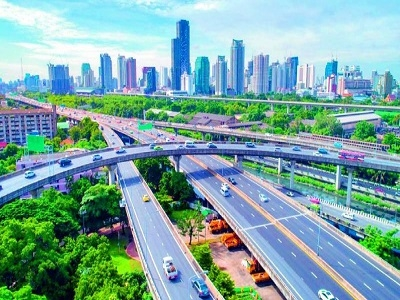
India’s road network has multiplied since 2014, improving connectivity across regions and economic corridors. At 63.73 lakh km, India has the second-largest road network in the world. Length of National highways increased by 61 per cent, from 91,287 km in FY14 to 1,46,566 km in March 2026. The length of four-lane and above national highways increased from 18,371 km in 2014 to 45,516 km. A total of 3,644 km of access-controlled high-speed corridors/expressways have been operationalised across the country. Initiatives focused on high-speed corridor development, economic node connectivity, and urban decongestion, supported by policies for highways, roads and bypasses.
Pradhan Mantri Gram Sadak Yojana (PMGSY) has transformed rural connectivity through all-weather road infrastructure, improving access to markets, education, healthcare, and economic opportunities. The Budgetary allocation for the program has increased from Rs 386 crore in 2014–15 to Rs 19,000 crore in 2026–27. So far, 99.6 per cent of eligible habitations have been connected under the programme. The length of completed roads increased from 3.86 lakh km during 2000–2014 to 4.11 lakh km during 2014–2026. The number of completed bridges rose from 484 to 10,293 during the same period.
Bharatmala Pariyojana was approved in 2017 to strengthen freight corridors and regional connectivity. Economic corridors, border roads, coastal roads, and expressways built under the plan accelerated cargo movement across the country. Under Bharatmala, 22,590 km of roads have been completed till March 31, 2026. Several landmark projects under the plan improved mobility across difficult terrains and strategic regions.
The UDAN (Ude Desh Ka Aam Nagrik) scheme, launched in 2016, improved affordability and access to air travel for wider sections. As of 2026, 665 routes connect 95 airports, heliports, and water aerodromes, benefiting over 1.64 crore passengers. The Modified UDAN scheme, launched in 2026 with an outlay of Rs 28,840 crore, aims to connect 120 new destinations.
Airport infrastructure expanded through greenfield projects and modernised terminal facilities across major and regional locations. Twenty-five greenfield airports have been approved after 2014, including Mopa, Kannur, Hollongi, Navi Mumbai, and Noida (Jewar).
–IANS
sps/vd